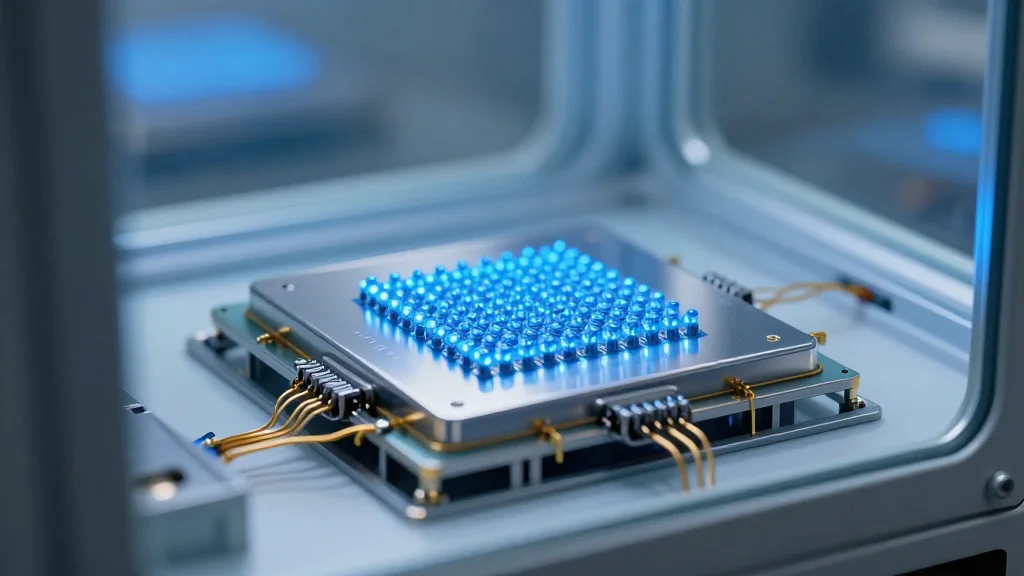
Architectural Blueprints for Fault-Tolerant Trapped-Ion and Neutral-Atom Systems
Companies Mentioned
Why It Matters
These architectures dramatically lower the space‑time overhead of quantum error correction, bringing practical, large‑scale quantum simulations closer to reality and signaling a shift toward hardware‑aware fault‑tolerant design.
Key Takeaways
- •IonQ's Walking Cat uses ion transport to run QLDPC codes
- •Dense [[102,22,9]] memory encodes 22 logical qubits in 102 physical
- •Neutral‑atom scheme parallelizes non‑Clifford gates, cutting runtime threefold
- •Both designs embed streaming decoders for real‑time error correction
Pulse Analysis
The emergence of hardware‑tailored fault‑tolerant architectures marks a pivotal moment for quantum computing. IonQ’s Walking Cat leverages the unique mobility of trapped ions within a Quantum Charge‑Coupled Device, allowing non‑local QLDPC code execution that would be infeasible on static platforms. By integrating "cat factories" that generate multi‑qubit entangled states, the design achieves a remarkably dense logical‑to‑physical qubit ratio, shrinking the qubit budget for complex simulations such as the 100‑site Heisenberg model. This approach underscores how ion‑trap flexibility can be harnessed to compress both spatial and temporal resources.
In parallel, the neutral‑atom blueprint addresses a different bottleneck: slow measurement cycles. Researchers from Duke, UT‑Austin, and Yale introduced a teleportation‑based parallelization that fills idle space in QLDPC modules with non‑Clifford gate injections. The result is a three‑fold speedup for Hamiltonian dynamics simulations without expanding the atom count, demonstrating that clever scheduling can offset hardware latency. By quantifying the impact of T‑state factory nondeterminism and magic‑state discard rates, the study provides a realistic wall‑time estimate that bridges the gap between theoretical resource counts and experimental constraints.
Both proposals converge on a common theme: real‑time error handling through streaming decoders and dedicated qubit‑recovery mechanisms. By detecting loss or leakage instantly and replacing faulty qubits, they prevent error propagation across the QLDPC lattice, a critical capability for sustained fault‑tolerant operation. These advances not only set a quantitative baseline for achieving quantum advantage in materials science and dynamic simulations but also signal a broader industry trend toward integrating error correction tightly with hardware capabilities, accelerating the path from laboratory prototypes to commercial quantum processors.
Architectural Blueprints for Fault-Tolerant Trapped-Ion and Neutral-Atom Systems
Comments
Want to join the conversation?
Loading comments...