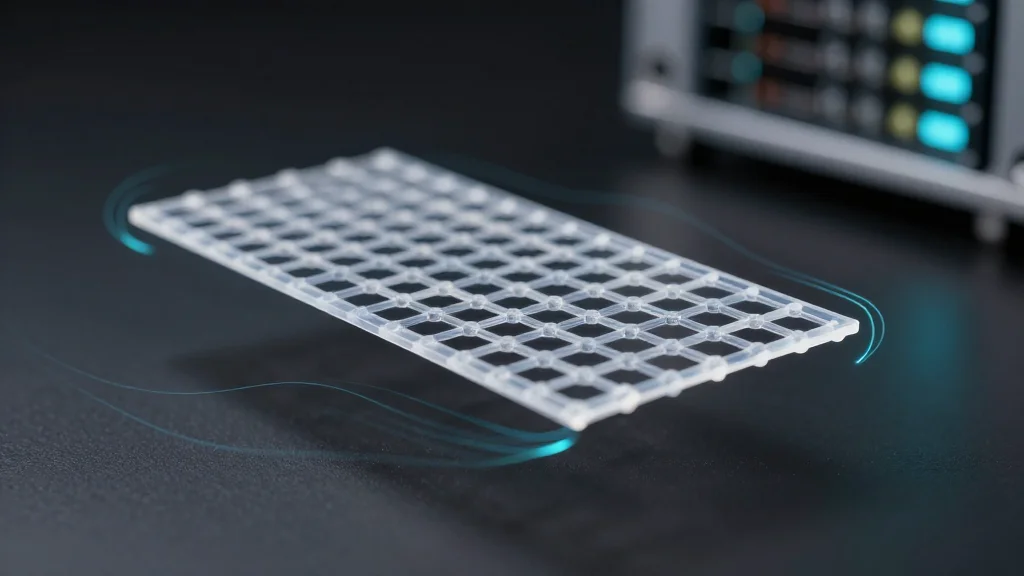
Atomic‑Scale Fluorographane Memory Hits 447 TB/Cm², Paving Way for Quantum‑Ready Storage

Why It Matters
The memory density demonstrated on fluorographane eclipses all existing storage technologies, directly confronting the bandwidth and capacity constraints that limit both AI training workloads and quantum error‑correction schemes. By offering near‑zero energy retention and unprecedented stability, the architecture could enable quantum processors to store large qubit‑state datasets locally, reducing decoherence risks associated with frequent memory transfers. Beyond quantum computing, the breakthrough could reshape data‑center design, allowing far greater storage per unit footprint and dramatically lowering power consumption. As AI models continue to scale into the multi‑trillion‑parameter regime, the ability to move terabytes of data at petabyte‑per‑second speeds without energy‑intensive cooling could become a decisive competitive advantage for cloud providers and hardware manufacturers.
Key Takeaways
- •447 TB of data stored per cm² on a single fluorographane sheet
- •Zero retention energy with thermal bit‑flip rate ~10⁻⁶⁵ s⁻¹
- •C‑F inversion barrier ~4.6 eV ensures long‑term stability
- •Projected data‑throughput of 25 PB/s at Tier 2 array scale
- •Potential to integrate ultra‑dense storage directly onto quantum chips
Pulse Analysis
Fluorographane memory arrives at a moment when the semiconductor industry is grappling with the physical limits of Moore's Law and the supply crunch of NAND flash. By moving away from charge‑based storage to a covalent‑bond‑based binary, the technology sidesteps the scaling roadblocks that have plagued conventional memory for years. Its radiation hardness also positions it as a rare candidate for space‑qualified quantum hardware, where cosmic rays can corrupt traditional memory cells.
Historically, memory breakthroughs have often lagged behind processor advances, creating the classic memory wall. The 447 TB/cm² density not only shatters that wall but also redefines the economics of on‑chip storage. If manufacturers can transition from the scanning‑probe proof‑of‑concept to wafer‑scale production, the cost per gigabyte could drop dramatically, making ultra‑dense memory a commodity rather than a niche research tool. This could accelerate the adoption of quantum error‑correction codes that require massive ancillary qubit storage, thereby shortening the timeline to fault‑tolerant quantum computers.
Looking ahead, the biggest challenge will be engineering the Tier 2 near‑field array and the associated control electronics. Success will likely depend on collaborations between materials scientists, photonics engineers, and quantum hardware designers. Should those partnerships materialise, fluorographane could become the foundational storage layer for next‑generation AI accelerators and quantum processors alike, reshaping the competitive landscape of high‑performance computing.
Atomic‑Scale Fluorographane Memory Hits 447 TB/cm², Paving Way for Quantum‑Ready Storage
Comments
Want to join the conversation?
Loading comments...