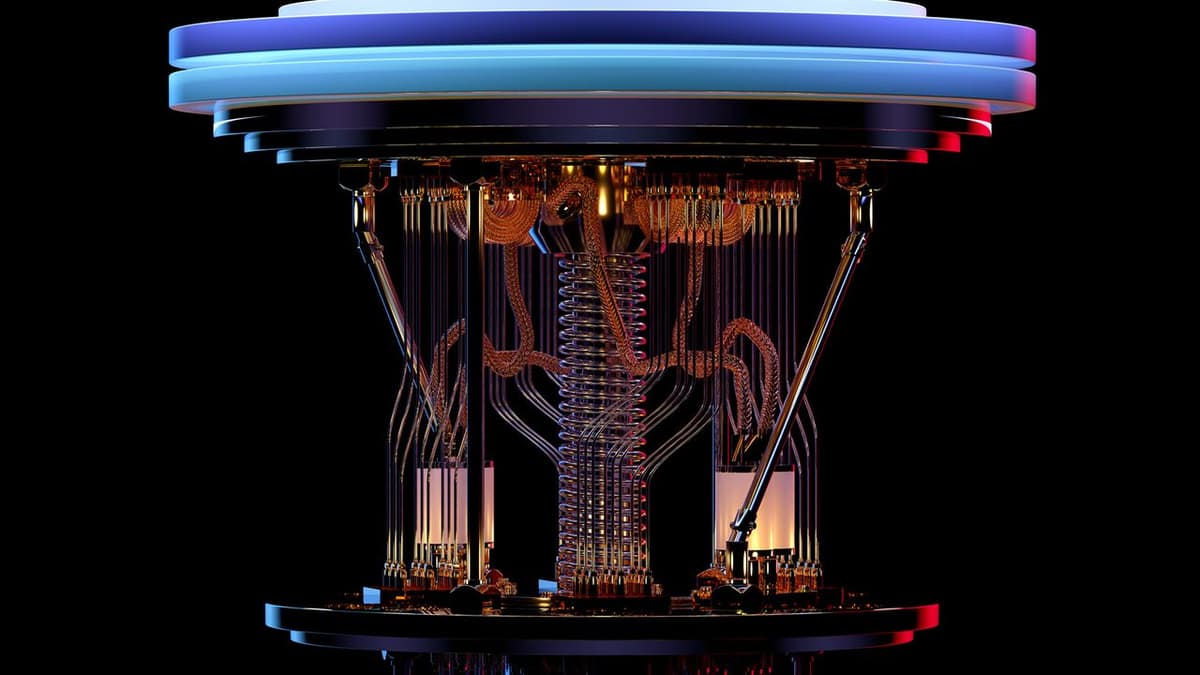
Bell Labs’ Michael Eggleston on Nokia’s Research Into Topological Quantum Computing
Companies Mentioned
Why It Matters
Stable topological qubits could accelerate quantum advantage for enterprise‑grade optimization and simulation, while informing Nokia’s security strategy against future quantum threats. The research positions Nokia as a contender in the emerging quantum hardware market.
Key Takeaways
- •Bell Labs focuses on topological qubits for enhanced stability
- •Current prototype stores a single qubit with week‑long coherence
- •Nokia’s approach uses electromagnetic fields in a supercooled electron liquid
- •Topological qubits could outperform conventional superconducting architectures
- •Post‑quantum cryptography research ties directly to Bell Labs’ roadmap
Pulse Analysis
Bell Labs, the storied research division acquired by Nokia in 2016, has turned its historic innovation engine toward topological quantum computing. By exploiting anyons—quasiparticles that exist in two‑dimensional systems—the lab creates qubits whose quantum states are protected by topology, allowing them to remain coherent for weeks rather than milliseconds. This stability stems from manipulating charges with precise electromagnetic fields inside a super‑cooled electron liquid, a method that contrasts with the superconducting circuits used elsewhere.
The topological approach offers a compelling alternative to the architectures pursued by Microsoft, IBM and Google. While Microsoft’s Majorana chip relies on engineered hybrid materials, Bell Labs leverages naturally occurring gallium arsenide‑based processes, promising simpler fabrication pathways. The current prototype demonstrates a single‑qubit gate operation, a proof‑of‑concept that validates the long‑coherence claim but also highlights the scaling challenge of moving to multi‑qubit systems. Compared with conventional superconducting qubits, topological qubits promise reduced error rates and lower cooling overhead, potentially shortening the timeline to practical quantum advantage.
For businesses, the payoff could be transformative. Stable qubits enable more reliable quantum simulations for drug discovery, financial modeling, and complex logistics optimization. Simultaneously, the looming ability of quantum computers to break current encryption drives Nokia’s parallel investment in post‑quantum cryptography and quantum‑key‑distribution solutions. By integrating quantum hardware research with security roadmaps, Nokia aims to both harness quantum benefits and mitigate the associated risks, positioning itself at the forefront of the next computing paradigm.
Bell Labs’ Michael Eggleston on Nokia’s research into topological quantum computing
Comments
Want to join the conversation?
Loading comments...