Beyond a Single Quantum Chip: Why the Future of Quantum Computing Is Modular
Companies Mentioned
Why It Matters
Modular designs address the physical and manufacturing limits of monolithic chips, unlocking the qubit counts needed for real‑world applications. Companies that master interconnects will shape the emerging quantum data‑center market.
Key Takeaways
- •Xanadu's Aurora linked 35 photonic chips via 13 km fiber, forming 12‑qubit system
- •IBM's Heron and Flamingo chips use chip‑to‑chip couplers for modular scaling
- •DARPA's HARQ program funds heterogeneous quantum architectures combining multiple qubit types
- •Photonic interconnects enable room‑temperature networking, reducing cryogenic complexity
- •Modular quantum data centres could solve battery chemistry by pairing qubit modules
Pulse Analysis
The shift toward modular quantum computing mirrors the evolution of classical high‑performance systems, where single monolithic machines gave way to networks of specialized nodes. By distributing qubits across multiple chips, engineers sidestep the exponential yield loss and wiring congestion that plague ever‑larger monolithic processors. This approach also opens a path to quantum data centres, where racks of modest‑size modules can be added incrementally, offering a more manageable manufacturing roadmap and the flexibility to upgrade individual components without redesigning an entire chip.
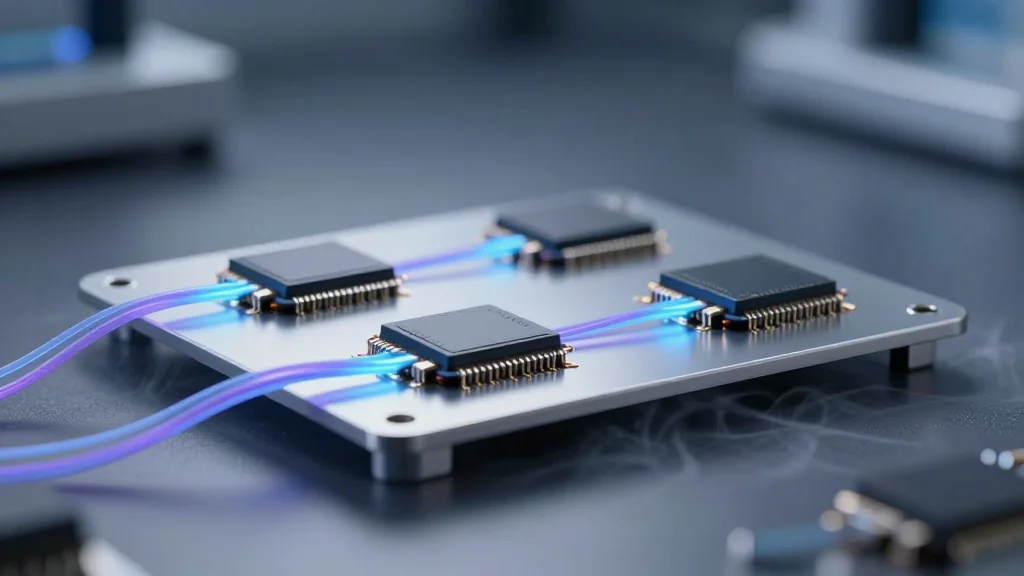
Homogeneous modularity has already moved from theory to practice. Xanadu’s Aurora system demonstrated that 35 photonic chips, linked by 13 km of optical fiber, can operate as a coherent 12‑qubit machine—an architecture that could, in principle, expand to millions of qubits across thousands of racks. IBM’s Heron and upcoming Flamingo processors further illustrate the industry’s commitment to chip‑to‑chip couplers, while China’s CAS Cold Atom Technology unveiled a dual‑core neutral‑atom device, underscoring a global consensus that interconnects, not just qubit density, will drive performance gains.
The next frontier is heterogeneous modularity, where distinct qubit modalities collaborate within a single workflow. DARPA’s Heterogeneous Architectures for Quantum (HARQ) program funds both software layers that allocate tasks across superconducting, trapped‑ion, neutral‑atom, and photonic platforms, and the physical interconnects that bind them. A concrete illustration is the proposed battery‑chemistry pipeline: neutral‑atom arrays simulate electrolyte interactions, trapped ions calculate reaction pathways, superconducting chips run optimization algorithms, and photonic links shuttle data at room temperature. By leveraging each technology’s strengths, such systems could accelerate material discovery far beyond what any single qubit type can achieve, positioning modular quantum computing as the backbone of future industrial innovation.
Beyond a Single Quantum Chip: Why the Future of Quantum Computing is Modular
Comments
Want to join the conversation?
Loading comments...