Breakthrough in Experimental Light-Powered Quantum Computers Could Mean Scaling Them up Is Now Far More Viable
Why It Matters
The ability to suppress errors before they arise makes photonic quantum computers far more scalable and cost‑effective, accelerating their path to commercial quantum advantage. It also positions room‑temperature photonics as a viable alternative to cryogenic superconducting systems.
Key Takeaways
- •Photon distillation filters errors before qubit creation.
- •Demonstrated below‑threshold error mitigation for photonic systems.
- •Enables scalable, room‑temperature quantum computing.
- •Reduces qubit overhead, lowering hardware costs.
- •First error‑prevention breakthrough in light‑powered quantum computers.
Pulse Analysis
Photonic quantum computing has long promised a route to high‑speed, low‑power processing by encoding qubits in individual photons rather than superconducting circuits. The approach naturally operates at ambient temperatures, eliminating the bulky cryogenic infrastructure that dominates today’s quantum hardware landscape. However, photons are inherently noisy; variations in timing, polarization, or loss can produce ‘rogue’ photons that derail calculations. Traditional quantum error correction addresses mistakes after they occur, but in a moving‑photon architecture the errors often manifest before qubits are even formed, creating a formidable barrier to scaling.
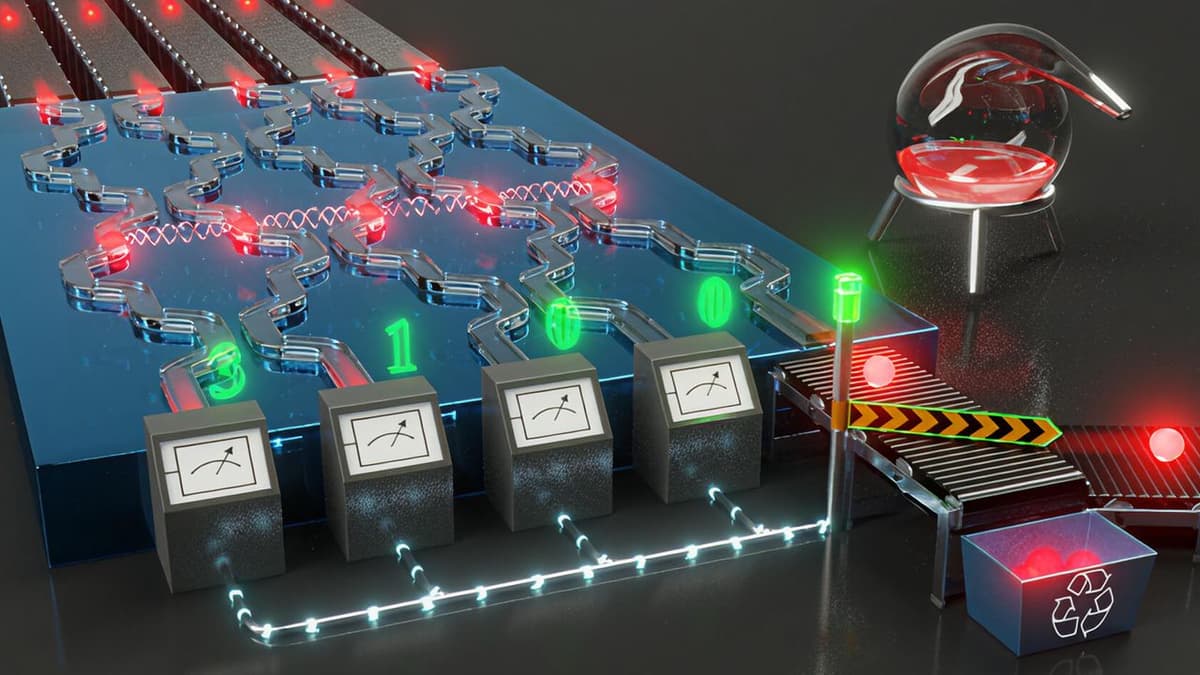
The new photon‑distillation protocol introduced by QuiX Quantum tackles this problem at its source. By routing imperfect photons through a specially designed interferometric circuit, the method exploits quantum interference to probabilistically discard mismatched photons while preserving high‑fidelity ones. The result is a net‑positive, below‑threshold error rate—meaning the error probability decreases as the system grows rather than accumulating. This pre‑emptive mitigation dramatically reduces the number of ancillary photons required to produce a single reliable qubit, slashing hardware overhead and paving the way for fault‑tolerant photonic processors.
From a market perspective, the breakthrough could shift investment toward room‑temperature photonic platforms, which promise lower capital expenditures and easier integration with existing fiber‑optic networks. Companies such as QuiX Quantum, Xanadu, and PsiQuantum may accelerate product roadmaps, while cloud providers could soon offer photonic‑based quantum‑as‑a‑service. Moreover, the technique narrows the performance gap with superconducting systems, potentially diversifying the quantum ecosystem and fostering competition that drives standards and interoperability. As error rates fall below the fault‑tolerance threshold, scalable photonic quantum computers move from laboratory curiosity to viable commercial technology.
Breakthrough in experimental light-powered quantum computers could mean scaling them up is now far more viable
Comments
Want to join the conversation?
Loading comments...