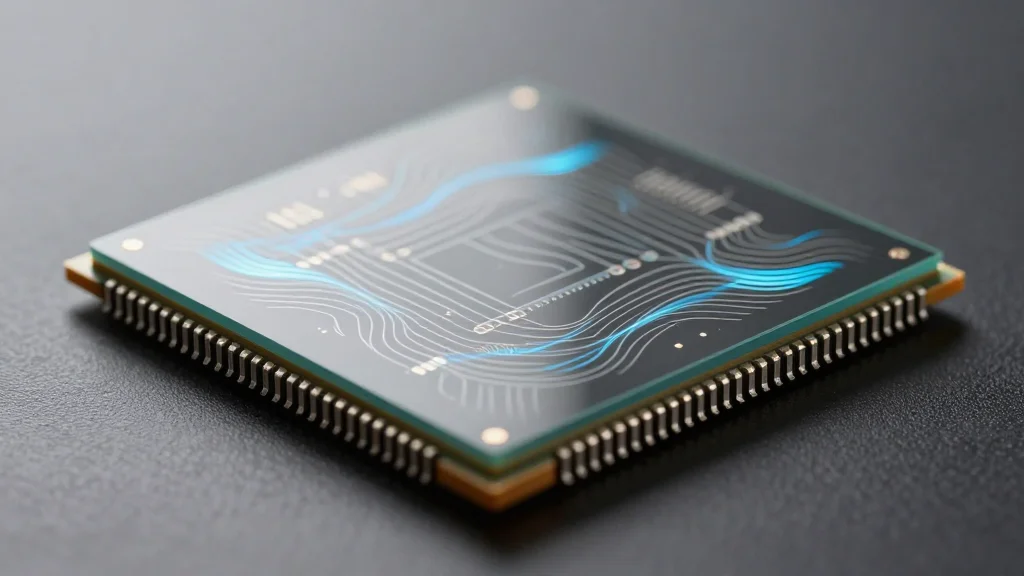
Chalmers AI ‘Super‑Brain’ Cuts Photonic Simulations 10‑Fold, Boosting Quantum Tech

Why It Matters
The ability to accelerate photonic material design directly addresses a critical bottleneck in scaling quantum hardware. Quantum processors require ultra‑low‑loss, precisely engineered optical pathways to move qubits and entangle distant nodes; traditional simulation pipelines can take weeks, delaying hardware iterations. By slashing simulation time to days, QNM‑Net enables more rapid prototyping, reducing R&D costs and shortening time‑to‑market for quantum communication components. Beyond quantum computing, the physics‑informed AI paradigm could reshape any field where wave phenomena dominate, from telecommunications to medical imaging. Embedding domain knowledge into machine‑learning models offers a path to high‑accuracy predictions with modest data, a compelling proposition for industries facing data‑scarcity or expensive experiments.
Key Takeaways
- •Chalmers' QNM‑Net reduces photonic simulation time by 90%, from ~30 days to 3 days.
- •Physics constraints (electromagnetism) are built into the neural network, cutting required training data.
- •The method leverages quasinormal‑mode theory to link scattering behavior to resonant properties.
- •Potential to speed up design of photonic crystals for quantum interconnects and consumer optics.
- •Results published in *Laser & Photonics Reviews*; next step is hardware validation.
Pulse Analysis
Embedding first‑principles physics into AI models marks a strategic shift from data‑hungry black‑box learning to knowledge‑guided inference. In the quantum‑technology arena, where every nanometer of material can alter coherence times, the ability to iterate designs in days rather than weeks could be a decisive advantage. Historically, breakthroughs in quantum hardware have been paced by incremental improvements in materials and fabrication; QNM‑Net flips that script by front‑loading the design phase with high‑fidelity simulations.
From a market perspective, the development arrives as venture capital and corporate R&D budgets pour into quantum photonics. Companies that can field photonic interconnects with lower loss and higher bandwidth will command premium positions in the emerging quantum‑network ecosystem. QNM‑Net’s efficiency could lower the barrier to entry for smaller firms, democratizing access to advanced design tools that were previously the domain of national labs.
Looking forward, the broader AI‑physics integration trend may spawn a new class of hybrid simulators that combine analytical models with deep learning, offering both interpretability and speed. If Chalmers can demonstrate that QNM‑Net’s predictions hold up in fabricated devices, it could trigger a wave of similar approaches across acoustics, plasmonics, and even quantum‑matter simulations, accelerating the overall pace of quantum technology commercialization.
Chalmers AI ‘Super‑Brain’ Cuts Photonic Simulations 10‑Fold, Boosting Quantum Tech
Comments
Want to join the conversation?
Loading comments...