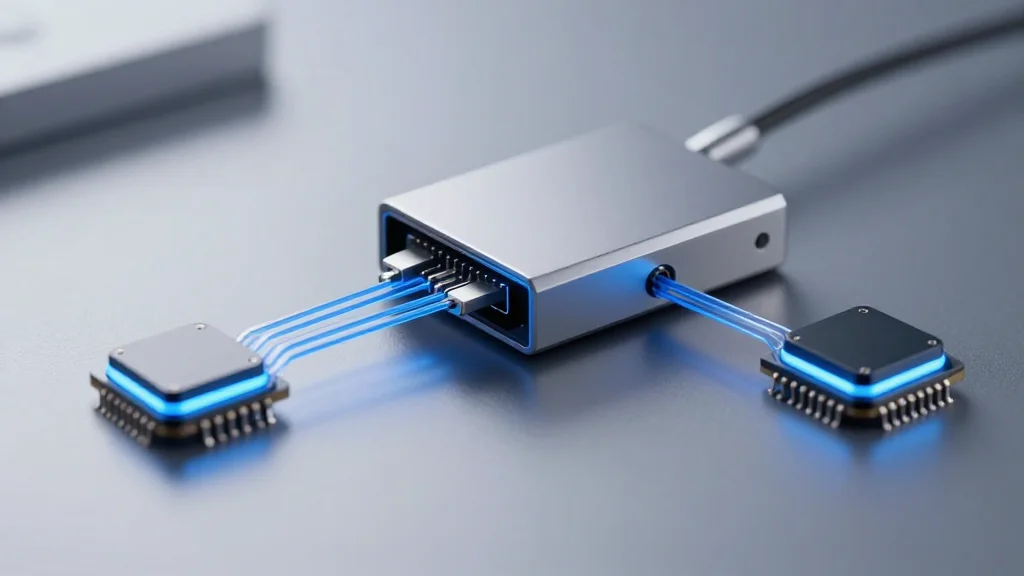
Cisco Launches Universal Quantum Switch to Enable Scalable Quantum Networks

Why It Matters
The Universal Quantum Switch addresses a fundamental bottleneck in quantum computing: the inability to interconnect disparate quantum systems without destroying their information. By enabling modality‑agnostic routing over standard fiber, Cisco could accelerate the formation of a quantum internet, unlocking new use cases in secure communications, distributed sensing, and cloud‑based quantum computing. The announcement also signals that legacy networking giants are now serious contenders in the quantum hardware arena, potentially reshaping investment flows and partnership strategies across the sector. If Cisco’s approach proves viable at scale, it could lower the cost and complexity of building quantum networks, making the technology accessible to a broader set of players. This democratization may spur faster innovation cycles, drive standards development, and ultimately bring practical quantum applications to market sooner than anticipated.
Key Takeaways
- •Cisco introduced the Universal Quantum Switch, a prototype that routes quantum data across encoding modalities without loss.
- •The switch operates at room temperature on existing telecom fiber, using a Cisco‑patented conversion engine.
- •Validated with polarization encoding; time‑bin and frequency‑bin support are next in the roadmap.
- •Vijoy Pandey, SVP/GM of Outshift, highlighted the milestone as a pivotal step for quantum networking.
- •Cisco aims to move from lab validation to field trials with quantum hardware partners.
Pulse Analysis
Cisco’s foray into quantum networking is more than a product launch; it’s a strategic play to extend its dominance from classical to quantum infrastructure. Historically, Cisco’s control of Ethernet and IP routing standards gave it leverage over the evolution of the internet. By applying the same playbook—standardized hardware, extensive supply‑chain, and broad ecosystem support—to quantum interconnects, Cisco could set de‑facto standards that lock in its technology for the next generation of networks.
The competitive landscape, however, remains fragmented. Startups like QuTech and Pasqal focus on cryogenic photonic switches that promise lower loss but require expensive cooling, limiting near‑term commercial viability. Cisco’s room‑temperature solution sidesteps that barrier, positioning it as a more pragmatic entry point for enterprises and cloud providers. Yet, the quantum community still grapples with error rates, repeaters, and the need for quantum‑aware network protocols. Cisco’s success will hinge on its ability to integrate with emerging quantum error‑correction schemes and to influence standards bodies such as the Quantum Internet Alliance.
Looking ahead, the most critical test will be real‑world interoperability. If Cisco can demonstrate seamless handoff between superconducting qubits, trapped‑ion systems, and photonic processors, it will validate the universal claim and likely attract early contracts from government research labs and hyperscale cloud operators. Conversely, failure to achieve low‑loss conversion at scale could relegate the switch to a research curiosity. The next 12‑18 months, therefore, will be decisive in determining whether Cisco’s Universal Quantum Switch becomes the backbone of the quantum internet or a footnote in the broader race to quantum supremacy.
Cisco Launches Universal Quantum Switch to Enable Scalable Quantum Networks
Comments
Want to join the conversation?
Loading comments...