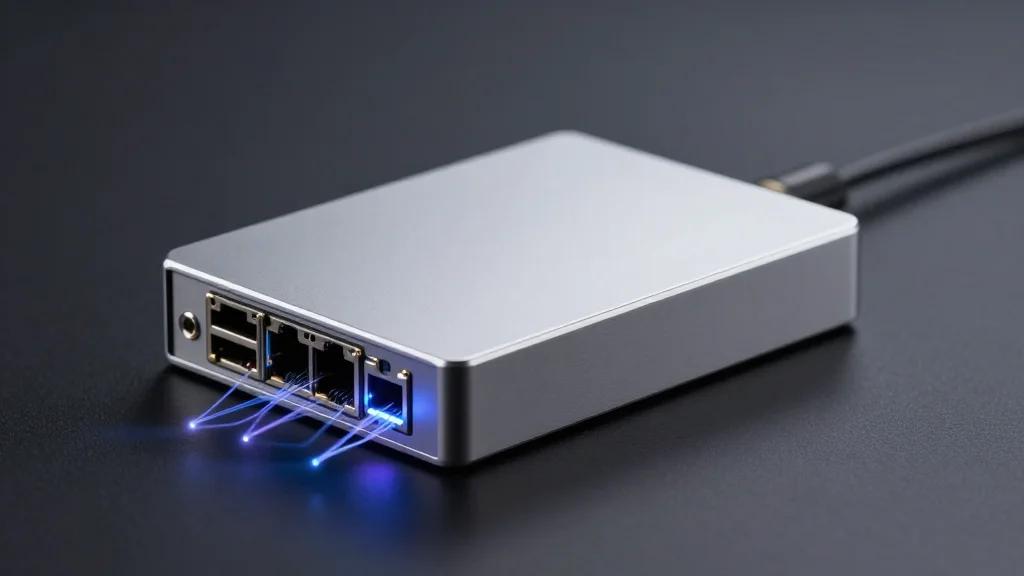
Cisco Launches Universal Quantum Switch to Scale Quantum Networks

Companies Mentioned
Why It Matters
Cisco’s entry into quantum networking underscores the sector’s evolution from isolated processor research to a full‑stack ecosystem that includes routing, switching, and network management. By providing a vendor‑agnostic switch, Cisco could standardize interconnects, reduce integration costs, and accelerate the deployment of quantum‑enhanced services such as secure communications and distributed quantum computing. The move also pressures pure‑play quantum firms to broaden their offerings or partner with established networking players, potentially reshaping the competitive landscape. If Cisco’s switch proves technically viable, it could catalyze the creation of quantum‑ready data centers, enabling cloud providers to offer quantum‑accelerated workloads alongside classical services. This would broaden the market beyond research institutions, opening new revenue streams for hardware vendors, software developers, and service providers, and hastening the realization of a functional quantum internet.
Key Takeaways
- •Cisco unveiled a universal quantum switch on Jan. 25, 2026.
- •The switch is designed to be vendor‑agnostic, supporting multiple qubit technologies.
- •Cisco claims a plug‑and‑play interface that abstracts underlying quantum hardware.
- •Pilot deployments are planned for early 2027 with commercial rollout in 2028.
- •Cisco’s entry signals ecosystem maturation and could drive standards adoption.
Pulse Analysis
Cisco’s foray into quantum networking is less about immediate revenue than about positioning the company at the foundation of a future quantum internet. Historically, Cisco has built market dominance by defining networking standards—think Ethernet and IP routing. By introducing a universal quantum switch, Cisco is attempting to replicate that playbook in a domain where standards are still fluid. The company’s massive engineering resources and existing relationships with data‑center operators give it a unique advantage in integrating quantum links with classical networks, a hurdle that many startups struggle to overcome.
However, the technical challenges are non‑trivial. Quantum coherence is extremely sensitive to temperature, vibration, and electromagnetic noise—conditions that clash with the high‑density, high‑throughput design philosophy of traditional switches. Cisco will need to demonstrate that its hardware can maintain low error rates while scaling to the port densities required for enterprise use. Early pilot results will be critical; a successful demo could lock in Cisco as a de‑facto standards leader, while a failure could reinforce the notion that quantum networking remains a specialist niche.
From a market perspective, Cisco’s announcement may act as a catalyst for increased corporate investment in quantum networking infrastructure. Venture capitalists have already poured over $1 billion into the space, and a heavyweight like Cisco validates the commercial potential, likely prompting more traditional IT vendors to explore quantum offerings. In the longer term, the universal switch could become a linchpin for hybrid quantum‑classical workloads, enabling seamless orchestration across quantum processors and classical CPUs. If Cisco can deliver on its promises, the company could shape the architecture of the quantum internet for the next decade.
Cisco Launches Universal Quantum Switch to Scale Quantum Networks
Comments
Want to join the conversation?
Loading comments...