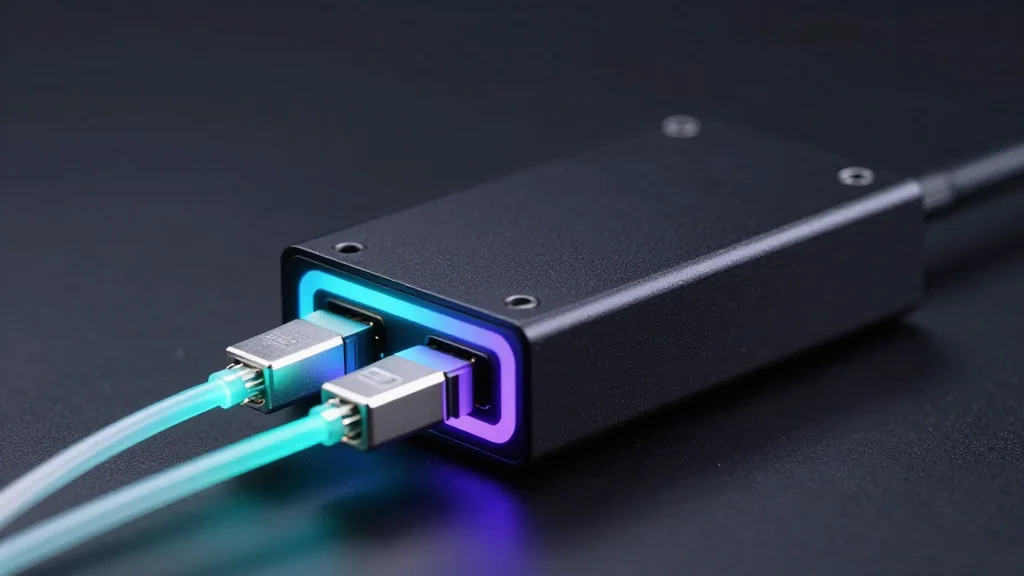
Cisco Unveils Room‑Temperature Universal Quantum Switch, Enabling Cross‑Vendor Quantum Networks

Companies Mentioned
Why It Matters
Interoperability has been the Achilles’ heel of quantum computing, with each vendor locking customers into proprietary encoding schemes. Cisco’s Universal Quantum Switch offers a hardware‑level translation layer that could unlock a market for quantum‑network services, allowing cloud providers and enterprises to stitch together best‑of‑breed quantum processors. If the technology matures, it could catalyze a shift from isolated quantum labs to distributed quantum applications in finance, drug discovery, and climate modeling. The switch also signals a convergence of the telecom and quantum sectors. By reusing existing fiber infrastructure, the barrier to entry for telecom operators drops dramatically, potentially creating a new revenue stream for a traditionally saturated market. This could spur investment in quantum‑ready upgrades to backbone networks, accelerating the timeline for a functional quantum internet.
Key Takeaways
- •Cisco unveiled a Universal Quantum Switch prototype that operates at room temperature.
- •The switch translates among polarization, time‑bin, frequency‑bin and path encoding with <4 % fidelity loss.
- •Sub‑nanosecond electro‑optic switching and power draw under 1 mW make it compatible with existing telecom fiber.
- •Cisco is partnering with IBM, Qunnect and Atom Computing to validate cross‑vendor interoperability.
- •The prototype is research‑stage; commercial rollout is targeted for the early 2030s.
Pulse Analysis
Cisco’s entry into quantum networking mirrors its historic strategy of defining the connective layer rather than the compute layer. By providing a universal translation engine, Cisco is attempting to lock in the standards that will govern quantum data traffic, much as it did with Ethernet and IP in the 1990s. This could give the company a first‑mover advantage in a market that is still fragmented across superconducting, photonic and trapped‑ion platforms.
The technical claims—sub‑4 % fidelity loss and sub‑nanosecond switching—are impressive but must be weighed against the stringent error‑correction thresholds required for scalable quantum communication. Current quantum error‑correction protocols typically demand error rates an order of magnitude lower. Therefore, while Cisco’s prototype proves the concept, substantial engineering work remains before the switch can support fault‑tolerant, long‑distance links.
From a market perspective, the switch could lower the total cost of ownership for quantum networks by eliminating the need for dedicated cryogenic fiber runs. Telecom operators, already grappling with declining traditional revenue, may view this as a pathway to new services. If Cisco can translate its prototype into a commercial product, it could reshape the value chain, positioning network operators as the gatekeepers of quantum connectivity and opening a lucrative niche for Cisco’s networking hardware and software stack.
Cisco Unveils Room‑Temperature Universal Quantum Switch, Enabling Cross‑Vendor Quantum Networks
Comments
Want to join the conversation?
Loading comments...