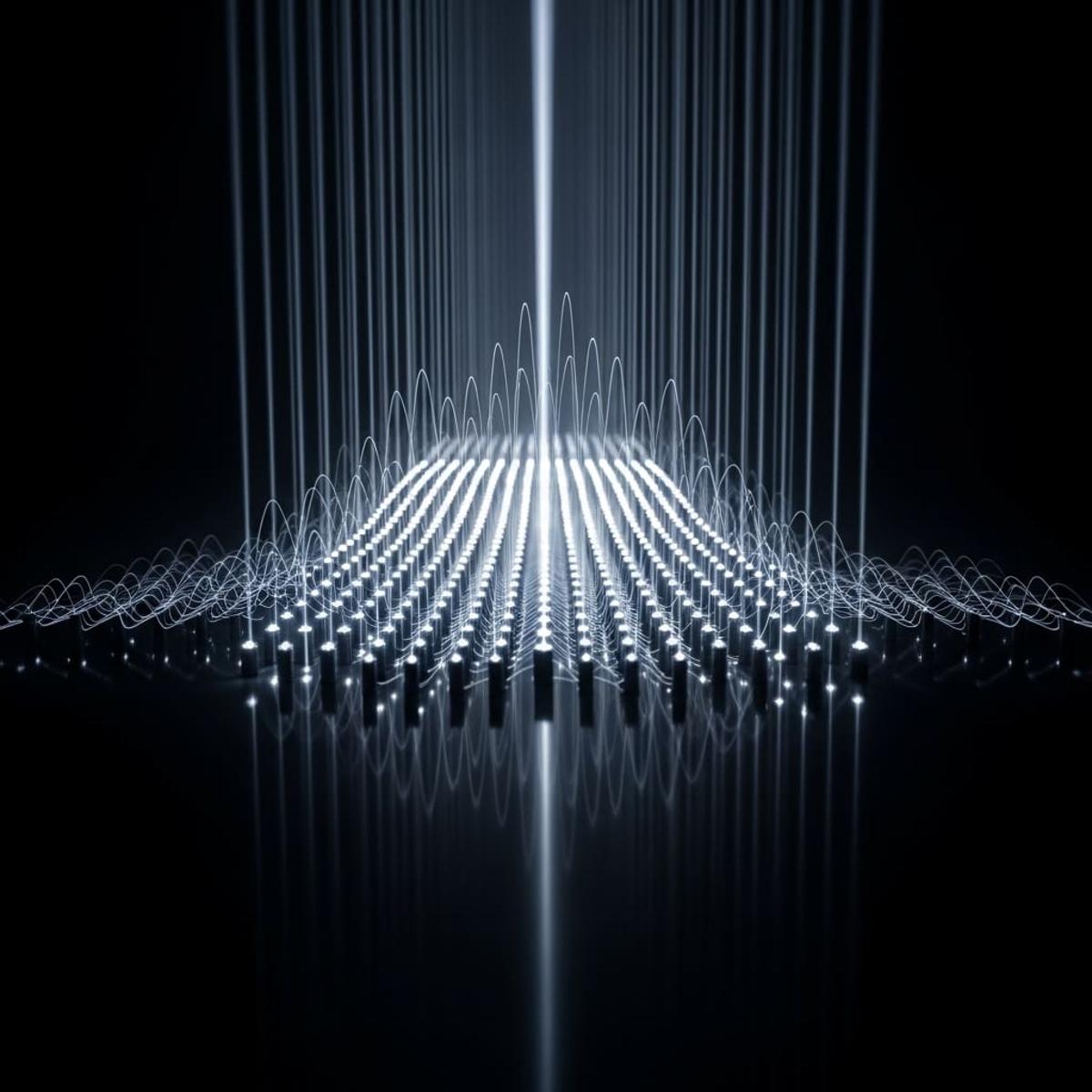
Coherent Emitters Unlock Brighter, Correlated Light Sources

Key Takeaways
- •Spin‑½ emitters generate squeezing transferred to cavity photons
- •Squeezed superradiant laser yields brighter, correlated quantum light
- •Lipkin‑Meshkov‑Glick model enables all‑to‑all spin interactions
- •Simulations show thermal, lasing, bistable phase transitions
- •Platform compatible with trapped ions and ultra‑cold atoms
Pulse Analysis
The quest for ever‑more precise light sources has driven laser research from simple incoherent emitters to collective superradiant devices. Yet both approaches leave a gap: they lack intrinsic interactions among the emitters that could imprint quantum correlations onto the emitted photons. By embedding a network of spin‑½ particles within an optical cavity and engineering all‑to‑all couplings via the Lipkin‑Meshkov‑Glick model, the CUHK team creates a quantum many‑body laser where the emitters themselves become a source of squeezing. This squeezing, a reduction of quantum noise in the spin ensemble, is locked to the cavity field, allowing the photons to inherit the same reduced uncertainty.
The theoretical framework combines a rotating‑frame Hamiltonian with a master‑equation treatment of dissipation, capturing cavity loss and spontaneous emission. Numerical solutions reveal three characteristic regimes: an exponential photon‑number distribution indicative of thermal emission, a Poissonian distribution marking true lasing, and a mixed distribution signaling bistability. These phases align closely with mean‑field predictions, confirming that the collective spin dynamics reliably dictate the optical output. Crucially, the transfer of spin squeezing to the light persists across these regimes, delivering bright photons whose quantum correlations survive beyond the short‑lived coherence of conventional lasers.
Beyond the immediate proof‑of‑concept, this approach reshapes how quantum optics can be integrated into practical technologies. The reliance on coherent many‑body interactions, rather than weak nonlinear media, suggests a more flexible architecture that can be implemented with trapped ions, ultra‑cold atoms, or superconducting qubits. If scalability challenges—maintaining coherence across larger emitter ensembles—are overcome, squeezed superradiant lasers could become cornerstone components for quantum‑enhanced sensors, secure communication links, and photonic quantum processors, delivering performance unattainable with existing laser platforms.
Coherent Emitters Unlock Brighter, Correlated Light Sources
Comments
Want to join the conversation?