D-Wave Outlines Superconducting Gate-Model Roadmap Targeting 100 Logical Qubits
Companies Mentioned
Why It Matters
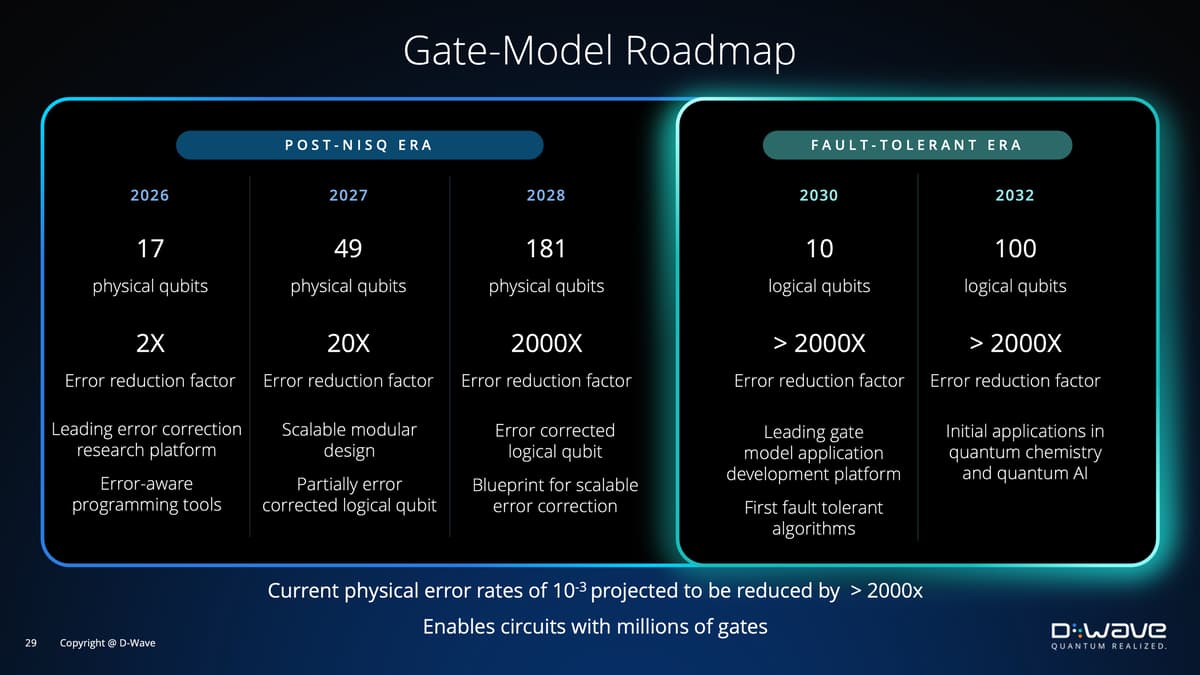
Achieving 100 logical qubits with high‑speed error correction could position D‑Wave as a rare dual‑platform provider, accelerating enterprise adoption of fault‑tolerant quantum computing. The roadmap signals a tangible path toward commercial quantum advantage in AI and chemistry workloads.
Key Takeaways
- •D‑Wave targets 100 logical qubits by 2032.
- •Dual‑rail qubits detect ~90% of physical errors.
- •Planned Lambda value of 10 outperforms industry norm of 2.
- •10‑logical‑qubit system slated for 2030 for early fault‑tolerant algorithms.
- •Gate‑model chips will integrate with Leap quantum cloud service.
Pulse Analysis
The quantum‑computing landscape has been dominated by two distinct approaches: quantum annealing and gate‑model processors. D‑Wave, historically known for its annealing systems, is now charting a clear course toward gate‑model hardware, a move that could bridge the gap between specialized optimization and universal quantum computing. By announcing a concrete timeline that culminates in a 100‑logical‑qubit, fault‑tolerant machine, the company is signaling confidence that its superconducting technology can compete with the likes of IBM, Google, and Rigetti, especially as investors seek measurable progress beyond the noisy intermediate‑scale quantum (NISQ) era.
At the heart of D‑Wave’s strategy is a dual‑rail qubit architecture that embeds error‑detection circuitry directly into each qubit. Early tests show 99.9% two‑qubit gate fidelity and the ability to flag about 90% of errors in real time, dramatically reducing the physical qubit overhead required for quantum error correction. The firm’s Lambda metric—targeting a value of 10 versus the industry average of 2—captures this aggressive error‑suppression ambition. A staged rollout, beginning with a 17‑physical‑qubit demonstrator in 2026 and scaling to 181 physical qubits by 2028, provides a transparent path to the 100‑logical‑qubit goal, while also offering intermediate capabilities for early adopters.
For enterprises, the integration of gate‑model chips into D‑Wave’s Leap cloud platform promises a seamless hybrid workflow that can tap both annealing and universal quantum resources. This dual‑platform model could accelerate use‑case development in quantum‑enhanced AI, drug discovery, and complex materials simulation, areas where classical resources hit performance ceilings. If D‑Wave meets its roadmap milestones, it may set a new benchmark for commercial fault‑tolerant quantum computing, compelling cloud providers and large corporates to reconsider their quantum roadmaps and investment strategies.
D-Wave Outlines Superconducting Gate-Model Roadmap Targeting 100 Logical Qubits
Comments
Want to join the conversation?
Loading comments...