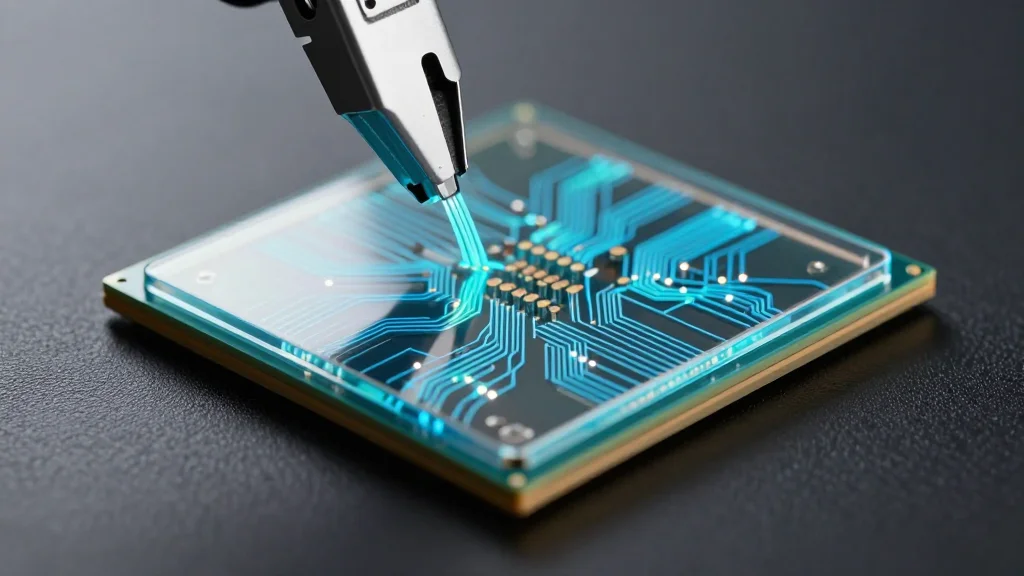
Delft, QuTech and Intel Unveil Flexible Quantum Processor with Tunable Qubits

Companies Mentioned
Why It Matters
The demonstrated processor bridges a gap between two dominant quantum paradigms, offering a path to scalable, low‑cost hardware that can adapt to evolving software demands. By enabling post‑fabrication reconfiguration, the technology reduces the risk of costly redesign cycles and could accelerate the deployment of quantum services in cloud environments. If the approach proves viable at larger scales, it may shift investment toward semiconductor‑centric quantum roadmaps, influencing funding decisions across governments and venture capital firms. The ability to leverage existing silicon fabs also means that supply‑chain constraints, a recurring issue for superconducting qubit manufacturers, could be mitigated, potentially reshaping the competitive dynamics of the global quantum race.
Key Takeaways
- •Delft University of Technology, QuTech and Intel co‑presented a flexible quantum processor using movable spin qubits.
- •Qubits are encoded in electron spin within semiconductor quantum dots and can be shuttled electrically across the chip.
- •Post‑fabrication re‑routing allows the connectivity graph to be altered for different error‑correction schemes or algorithms.
- •The architecture leverages standard silicon manufacturing, promising lower per‑qubit costs and higher yields.
- •A multi‑qubit benchmark demonstrating on‑the‑fly algorithm changes is planned for Q4 2026.
Pulse Analysis
The hybrid processor marks a strategic pivot from monolithic quantum chip designs toward a modular, software‑defined model. Historically, quantum hardware has been locked into a single topology, forcing algorithm developers to work around hardware constraints. By decoupling physical layout from logical operation, the Delft‑QuTech‑Intel team introduces a level of abstraction akin to classical reconfigurable logic, which could democratize quantum software development and reduce time‑to‑market for new applications.
From a market perspective, the ability to produce qubits in existing CMOS fabs could erode the cost advantage held by superconducting and trapped‑ion vendors that rely on specialized packaging. This shift may attract a broader set of investors, especially those familiar with the semiconductor supply chain, and could accelerate the consolidation of quantum startups around foundry‑friendly designs. However, the approach also introduces new engineering challenges, such as maintaining coherence while shuttling electrons and integrating high‑speed control electronics on the same die.
Looking forward, the success of the upcoming scalability tests will be a litmus test for the commercial viability of movable‑qubit architectures. If the team can demonstrate fault‑tolerant operations with dozens of re‑routable qubits, it would validate a roadmap that aligns quantum hardware development with the well‑established economics of silicon manufacturing, potentially reshaping the competitive landscape for the next decade.
Delft, QuTech and Intel Unveil Flexible Quantum Processor with Tunable Qubits
Comments
Want to join the conversation?
Loading comments...