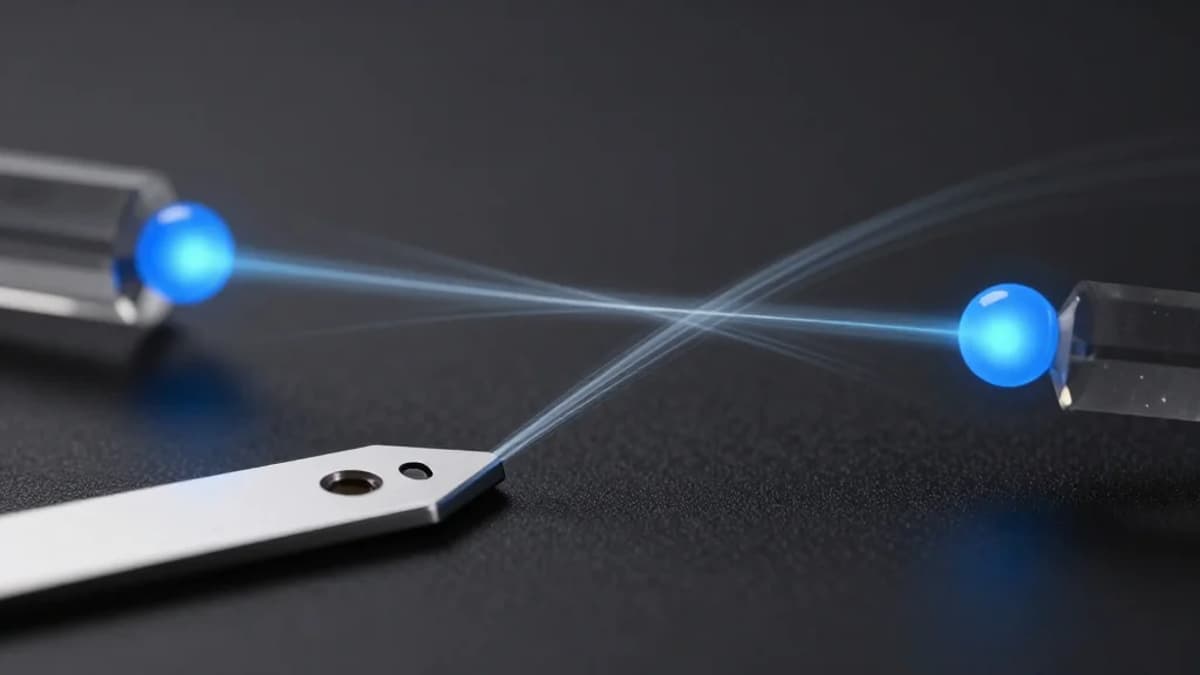
Entangled Atomic Clouds Enable More Precise Quantum Measurements
•January 22, 2026
0
Why It Matters
The breakthrough proves that distributed quantum entanglement can enhance real‑world metrology, opening pathways for more accurate timekeeping and geophysical sensing. It signals a shift toward scalable quantum sensor networks that outperform classical measurement strategies.
Key Takeaways
- •Entangled three spatially separated atomic clouds
- •Simultaneous multiparameter measurement precision surpasses classical limit
- •Technique reduces common-mode noise in optical lattice clocks
- •Enhances gravimeter spatial gravity gradient detection
- •Scalable approach for quantum sensor networks
Pulse Analysis
Quantum metrology has long relied on squeezing the collective spin of atoms to beat the standard quantum limit, yet most demonstrations confined the atoms to a single location. The Basel‑Paris collaboration extends this paradigm by distributing entangled spins across multiple, physically separated clouds. This spatial entanglement preserves the quantum correlations while allowing each cloud to probe a different region of an external field, effectively turning a single sensor into a coordinated array that can extract several parameters at once. The result is a measurable reduction in projection noise and a cancellation of disturbances that act uniformly on all clouds, delivering a clear advantage over classical multiplexed measurements.
The experimental protocol begins with a cold‑atom ensemble whose spins are squeezed via light‑matter interactions. The ensemble is then adiabatically split into three distinct clouds while maintaining the entangled state. By interrogating each cloud with tailored probe beams, the team reconstructed the spatial profile of an electromagnetic field with precision that exceeds the unentangled benchmark by a factor dictated by the degree of squeezing. Crucially, the method requires only a handful of measurement cycles, highlighting its efficiency for time‑critical applications. The approach also sidesteps the need for complex error‑correction schemes, as the shared entanglement inherently suppresses common‑mode fluctuations.
Beyond the laboratory, the technique promises immediate impact on technologies that depend on ultra‑precise measurements. In optical lattice clocks, spatially varying light shifts can now be calibrated out, pushing clock stability toward the 10⁻¹⁸ regime. Atom interferometer gravimeters, used for mineral exploration and monitoring tectonic activity, stand to gain finer resolution of gravity gradients, enhancing their utility in Earth‑science surveys. As quantum sensor networks mature, the ability to entangle distant nodes could enable distributed sensing platforms for navigation, fundamental physics tests, and secure communications, positioning this research at the forefront of the emerging quantum‑enabled measurement industry.
Entangled atomic clouds enable more precise quantum measurements
0
Comments
Want to join the conversation?
Loading comments...