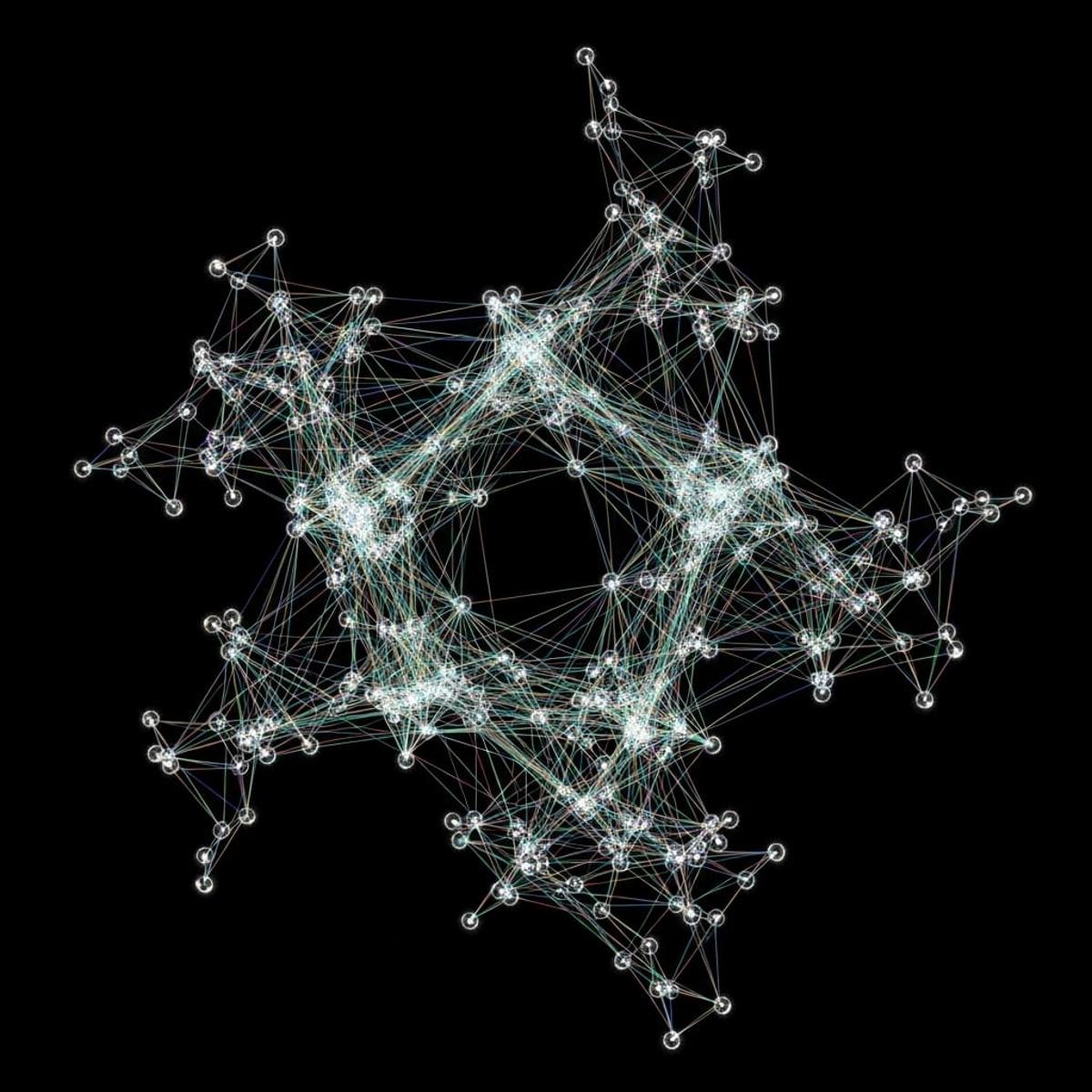
Entanglement Hyperlinks Achieve Exact Representation of Multipartite Entanglement Entropy for Pure States

Key Takeaways
- •EHLs give exact multipartite entanglement entropy representation.
- •Inclusion‑exclusion principle prevents double‑counting in quantum systems.
- •EHL sign distinguishes redundancy versus synergy in entanglement.
- •Connects to holographic duality and monogamy constraints.
- •Computational cost rises sharply with increasing party number.
Pulse Analysis
The quantification of multipartite entanglement has long been a bottleneck for both quantum information theory and condensed‑matter physics. Traditional entanglement‑link (EL) frameworks approximate the entropy of a region by summing contributions that cross its boundary, but they fall short of capturing higher‑order correlations. Santalla, Roy, Sierra and collaborators introduce entanglement hyperlinks (EHLs), an exact extension built on the inclusion‑exclusion principle. By systematically adding and subtracting subsystem entropies, EHLs reconstruct the full multipartite entanglement entropy of pure states without the double‑counting errors that plague earlier methods.
The mathematical structure of EHLs reveals a rich taxonomy of quantum correlations. The sign of an EHL encodes whether a set of parties exhibits redundancy—where any subset suffices for full information—or synergy—where only the complete set reveals the correlation. This mirrors concepts from partial information decomposition and aligns with the monogamy of entanglement, limiting how strongly a subsystem can share entanglement with many others. Moreover, the authors link third‑order EHLs to holographic duality and the Ryu‑Takayanagi formula, suggesting that geometric constraints in AdS/CFT may enforce specific sign patterns.
From a practical standpoint, EHLs provide a rigorous tool for diagnosing entanglement structures in quantum simulators, error‑correcting codes, and emerging quantum processors. While the exact calculation scales combinatorially with the number of parties, the framework opens avenues for approximations that retain sign information, potentially guiding resource allocation in quantum networks. Future work is expected to explore conditional EHLs, their role in multipartite redundancy‑synergy trade‑offs, and algorithmic strategies to tame the computational overhead. The exactness of EHLs positions them as a cornerstone for next‑generation quantum technologies.
Entanglement Hyperlinks Achieve Exact Representation of Multipartite Entanglement Entropy for Pure States
Comments
Want to join the conversation?