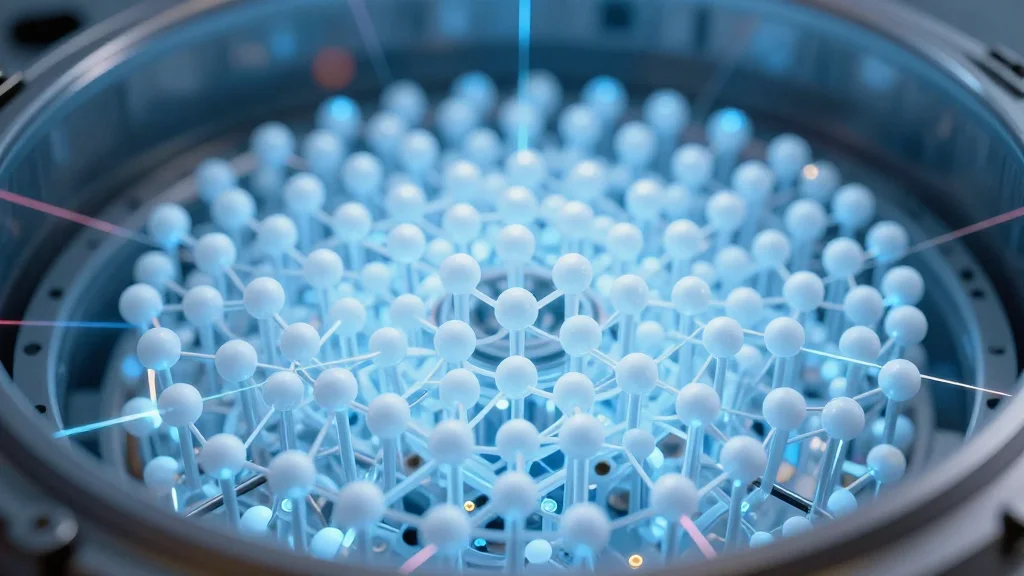
ETH Zurich Scales Neutral‑Atom Qubits to 17,000 with 99.91% Gate Fidelity

Companies Mentioned
Why It Matters
The ETH Zurich demonstration proves that neutral‑atom quantum computers can scale to tens of thousands of qubits without sacrificing gate fidelity, a milestone that narrows the gap between theoretical quantum advantage and practical hardware. By showing a robust, noise‑insensitive gate mechanism, the work addresses a long‑standing criticism of neutral‑atom platforms—error rates that rise with system size. This breakthrough could redirect funding, talent, and corporate strategy toward neutral‑atom architectures, diversifying the quantum hardware landscape and accelerating the timeline for real‑world applications. In addition, the geometric‑phase approach offers a new design paradigm for quantum gates across all platforms. If other qubit technologies can adopt similar noise‑immune techniques, the overall error budget for quantum processors may improve, hastening the deployment of fault‑tolerant quantum computers.
Key Takeaways
- •ETH Zurich demonstrated a 17,000‑qubit neutral‑atom array using potassium atoms in an optical lattice.
- •The swap gate achieved 99.91% fidelity, corresponding to a 0.09% error rate.
- •Geometric‑phase gates are largely independent of laser intensity fluctuations, improving robustness.
- •Neutral‑atom platforms now rival superconducting and trapped‑ion systems in both scale and error performance.
- •European Quantum Flagship has allocated €1 billion (≈ $1.08 billion) to neutral‑atom research, likely to increase after this result.
Pulse Analysis
ETH Zurich’s 17,000‑qubit demonstration is a watershed for neutral‑atom quantum computing, but its impact will be judged by how quickly the approach can be turned into a programmable, fault‑tolerant processor. The geometric‑phase swap gate sidesteps the laser‑noise problem that has plagued earlier neutral‑atom experiments, yet the gate speed remains slower than microwave‑driven superconducting gates. Industry players will need to balance raw qubit count against clock rate and integration complexity.
From a market perspective, the result is likely to catalyze a wave of venture capital into neutral‑atom startups. Investors have already funded companies like Pasqal and QuEra, but the ETH breakthrough provides a concrete technical validation that could justify larger Series B and C rounds. Government programs, especially in Europe, may prioritize funding for geometric‑phase research, potentially reshaping the allocation of the Quantum Flagship budget.
Strategically, the breakthrough forces the broader quantum ecosystem to reconsider roadmaps. IBM’s 1,121‑qubit roadmap and Google’s 1,000‑plus‑qubit plans are impressive, but they still operate under error rates an order of magnitude higher than ETH’s 0.09% two‑qubit error. If neutral‑atom systems can maintain low error while scaling to hundreds of thousands of qubits, they could become the preferred substrate for algorithms that require massive parallelism, such as quantum Monte Carlo simulations. The next critical milestone will be demonstrating error‑corrected logical qubits on this platform—a step that will determine whether the ETH result is a laboratory curiosity or the foundation of the next generation of quantum computers.
ETH Zurich Scales Neutral‑Atom Qubits to 17,000 with 99.91% Gate Fidelity
Comments
Want to join the conversation?
Loading comments...