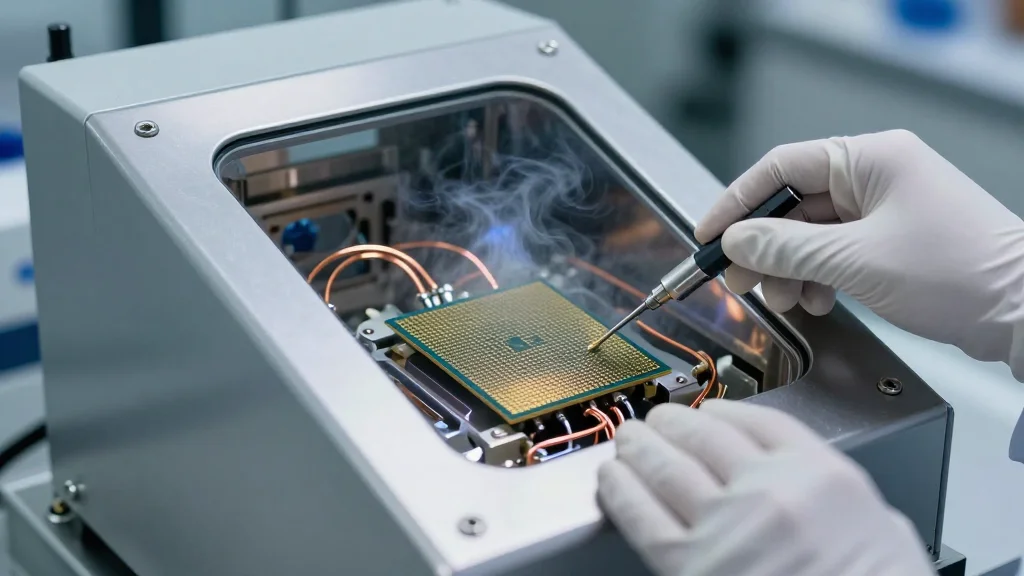
FormFactor Deploys 4‑K Cryogenic Probe Station to Accelerate Quantum Chip Yield

Why It Matters
Early‑stage testing of quantum dies addresses a critical yield bottleneck that has slowed the transition from prototype to volume production. By providing a 4‑kelvin platform that can evaluate many devices in a single cool‑down, FormFactor reduces the time and cost associated with iterative design cycles, accelerating the overall development timeline for quantum processors. The move also signals a broader shift in the quantum supply chain toward specialized infrastructure providers. As governments and venture capital pour money into quantum computing, companies that supply the underlying tools—such as cryogenic test stations—stand to capture a sizable share of the emerging market, potentially reshaping investment patterns away from pure‑play qubit startups toward the hardware ecosystem that enables them.
Key Takeaways
- •FormFactor launched the HPD IQ3000, a 4‑kelvin cryogenic probe station for wafer‑level quantum die testing.
- •The platform enables rapid characterization of superconducting qubits and single‑photon detectors in a single chill‑down cycle.
- •FormFactor's stock has risen over 300% in the past year as investors target quantum infrastructure plays.
- •NIST cites realistic low‑temperature measurement capability as a central bottleneck in quantum research.
- •Upcoming user workshops will let leading quantum teams evaluate the IQ3000 and influence future product roadmaps.
Pulse Analysis
FormFactor’s entry into quantum chip testing reflects a maturation of the quantum supply chain that mirrors the semiconductor industry’s earlier evolution. In the 1990s, equipment vendors that could reliably test and package CMOS dies at scale became indispensable, and their market valuations exploded. FormFactor is positioning itself at a similar inflection point for quantum, where the ability to validate dies before costly packaging could become a prerequisite for any commercial‑grade quantum processor.
The company’s advantage lies in its existing relationships across the semiconductor ecosystem and its deep expertise in handling fragile, high‑precision devices. This gives FormFactor a data advantage: by observing a broad spectrum of qubit architectures, it can anticipate emerging standards and tailor its equipment accordingly. Competitors that lack this breadth may find themselves chasing a moving target, especially as the industry has yet to coalesce around a single qubit technology.
However, the upside is not guaranteed. Quantum hardware remains in a research‑heavy phase, and the timeline for volume production is still uncertain. If the industry fragments into multiple competing architectures, demand for a single test platform could be diluted. Moreover, the capital intensity of building and operating cryogenic test labs may limit adoption to well‑funded labs and large consortia. FormFactor’s success will therefore hinge on its ability to demonstrate clear cost‑per‑die reductions and to embed its tools within the design‑for‑manufacturability workflows of leading quantum chipmakers.
FormFactor Deploys 4‑K Cryogenic Probe Station to Accelerate Quantum Chip Yield
Comments
Want to join the conversation?
Loading comments...