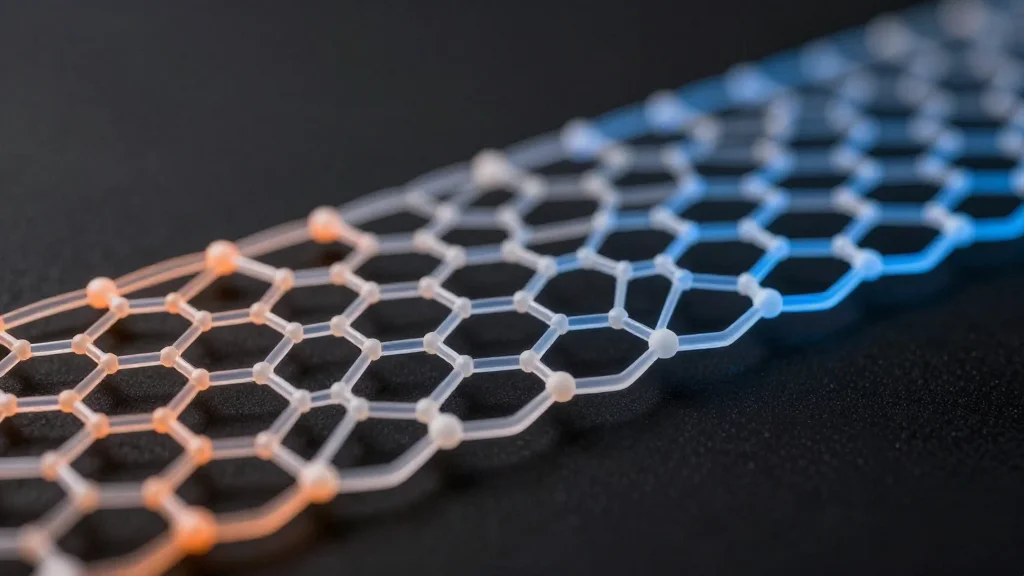
Graphene Breaks Wiedemann‑Franz Law, Paving Way for Quantum Hardware

Why It Matters
The discovery that graphene can violate the Wiedemann‑Franz law by more than two orders of magnitude reshapes our understanding of heat‑charge coupling at the quantum scale. For the quantum computing industry, where thermal management is a primary bottleneck, a material that naturally separates electrical and thermal currents could dramatically lower cooling requirements, enabling denser qubit arrays and longer coherence times. Beyond computing, the Dirac fluid offers a new platform for probing exotic states of matter, linking condensed‑matter experiments to high‑energy physics concepts such as perfect fluids and quark‑gluon plasma analogues. In the longer term, the ability to engineer Dirac‑fluid behavior in scalable devices could spur a wave of innovations in quantum sensing, low‑loss interconnects, and even thermoelectric energy conversion. The result is a potential shift in how hardware architects approach the trade‑offs between performance, power, and stability in quantum technologies.
Key Takeaways
- •IISc and NIMS researchers observed a 200‑fold breach of the Wiedemann‑Franz law in graphene.
- •The violation occurs at the Dirac point, where electrons form a low‑viscosity Dirac fluid.
- •Electrical conductivity rises while thermal conductivity falls, decoupling heat and charge flow.
- •The Dirac fluid mimics the quark‑gluon plasma, offering a tabletop platform for extreme physics.
- •Potential applications include low‑loss quantum interconnects and ultra‑sensitive quantum sensors.
Pulse Analysis
The graphene breakthrough arrives at a moment when the quantum hardware ecosystem is grappling with thermal bottlenecks. Current superconducting qubit platforms rely on massive dilution refrigerators that consume significant power and limit scalability. By providing a material that can conduct electrons efficiently while suppressing heat flow, the Dirac fluid could act as a passive thermal barrier, reducing the load on cryogenic systems. This aligns with industry trends toward heterogeneous integration, where 2D materials are layered onto silicon or superconducting substrates to tailor specific properties.
Historically, the Wiedemann‑Franz law has been a cornerstone of solid‑state physics, linking electrical and thermal conductivities through the Lorenz number. Its breakdown in graphene underscores the growing relevance of many‑body quantum effects in practical devices. As researchers push toward ever‑smaller feature sizes, collective electron behavior—once considered a curiosity—may become a design lever. The fact that the Dirac fluid exhibits near‑perfect fluidity suggests that future quantum processors could leverage hydrodynamic electron flow to minimize resistive losses, a concept that has only recently entered the engineering lexicon.
Looking forward, the key challenge will be translating the laboratory conditions—ultra‑clean samples, precise carrier density control, and cryogenic temperatures—into manufacturable processes. If the community can overcome these hurdles, we may see a new class of quantum chips that integrate Dirac‑fluid channels alongside conventional superconducting circuits, delivering higher qubit densities without proportionally increasing cooling demands. The ripple effects could extend to quantum communication, metrology, and even low‑temperature thermoelectrics, positioning graphene not just as a wonder material but as a foundational component of the quantum technology stack.
Graphene Breaks Wiedemann‑Franz Law, Paving Way for Quantum Hardware
Comments
Want to join the conversation?
Loading comments...