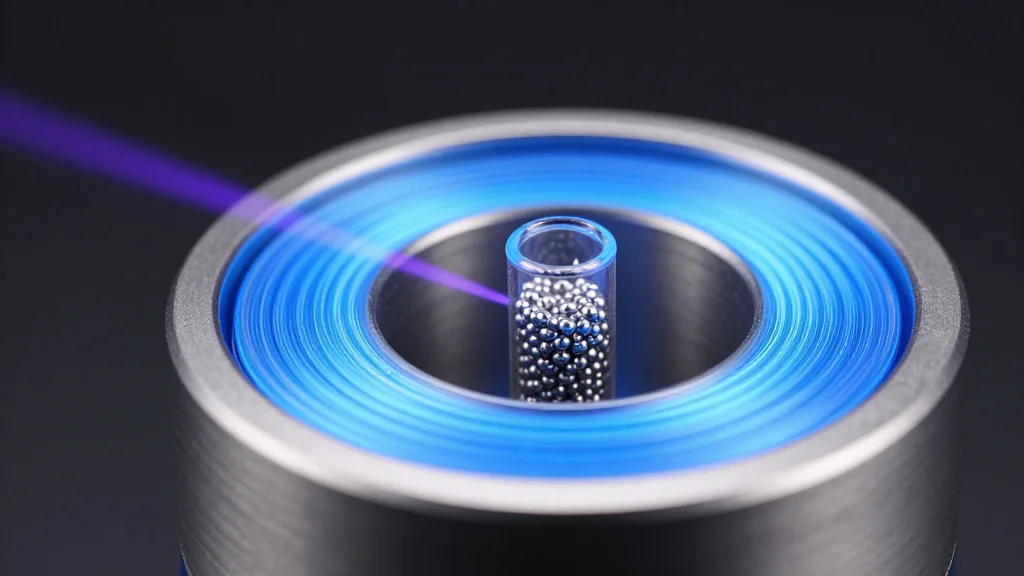
High-Resolution EPR Achieves 210 Ppb Resonance Width with 396GHz Excitation

Key Takeaways
- •14 T, 396 GHz EPR yields 210 ppb linewidth.
- •In‑situ NMR calibration improves g‑factor accuracy to 16 ppb.
- •Resolves lithium metal particle morphology in LiF.
- •Enables terahertz EPR precision comparable to liquid‑state NMR.
- •Current limitation: liquid‑sample only, solid‑state adaptation needed.
Pulse Analysis
High‑resolution electron paramagnetic resonance has long lagged behind its NMR counterpart due to constraints in terahertz instrumentation and magnetic field homogeneity. The Warwick team’s new spectrometer tackles these hurdles by pairing a 14‑tesla magnet with a 396‑gigahertz source, delivering a full‑width half‑maximum of just 210 ppb. This level of spectral sharpness, previously seen only in liquid‑state NMR, allows researchers to pinpoint resonance positions with sub‑part‑per‑trillion accuracy, fundamentally redefining the precision envelope of EPR measurements.
The instrument’s core innovation lies in its in‑situ NMR referencing, which continuously calibrates the magnetic field during EPR acquisition. This synergy reduces systematic errors, pushing g‑factor uncertainties down to 16 ppb—a tenfold improvement over conventional high‑field EPR setups. Such precision opens doors to quantifying minute electronic interactions, validating theoretical models, and measuring fundamental constants with unprecedented reliability. Moreover, the ability to resolve fine spectral features, as demonstrated with lithium‑metal particles in LiF, showcases the spectrometer’s potential for detailed materials characterization, including morphology‑dependent electronic behavior.
While the current configuration is limited to liquid samples, the methodological framework sets a clear path for extending high‑resolution capabilities to solids and complex biological matrices. Future adaptations could integrate cryogenic probes or solid‑state NMR references, broadening the technique’s applicability across pharmaceuticals, energy storage materials, and quantum computing components. By bridging the resolution gap between EPR and NMR, this breakthrough promises to accelerate interdisciplinary research and drive innovation in sectors that rely on precise spin‑based diagnostics.
High-Resolution EPR Achieves 210 Ppb Resonance Width with 396GHz Excitation
Comments
Want to join the conversation?