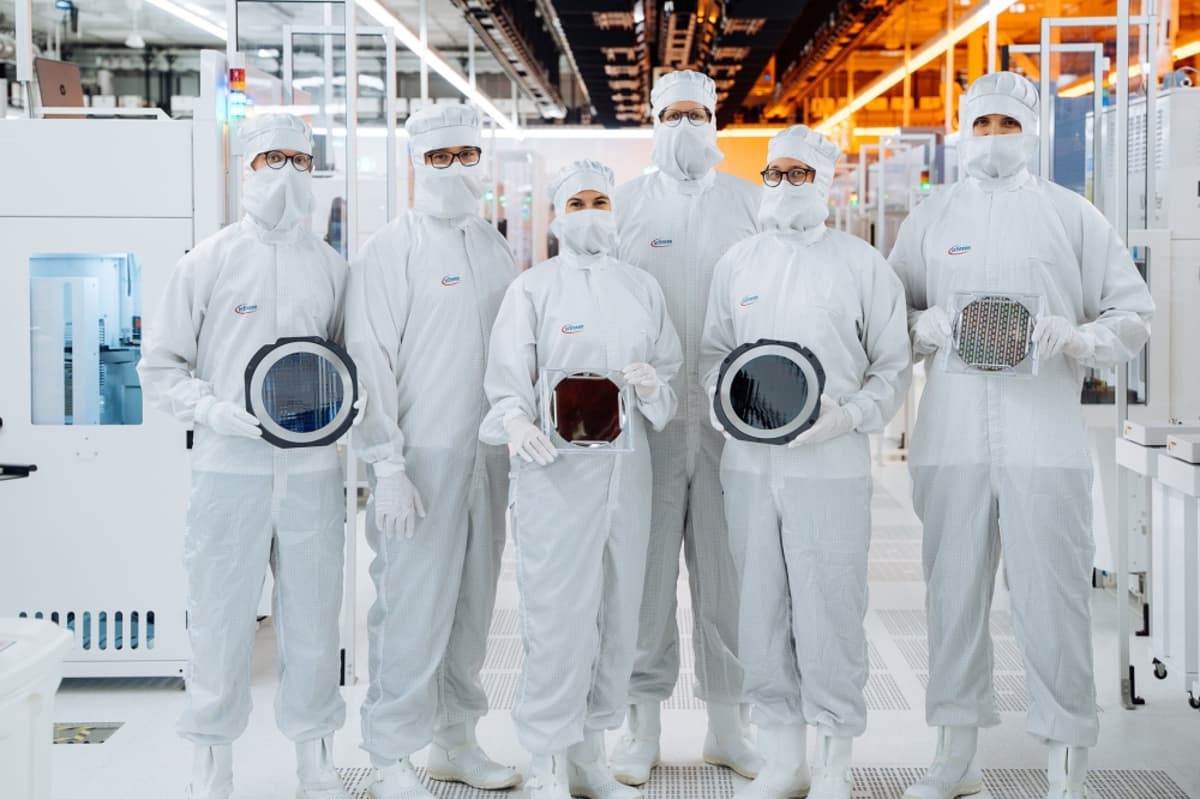
Infineon Contributes Industrialisation Know-How to European Quantum Pilot Lines
Companies Mentioned
Why It Matters
Scaling quantum components through industrial‑grade pilot lines accelerates market readiness and strengthens Europe’s strategic autonomy in a $97 billion future market.
Key Takeaways
- •Infineon joins three EU quantum pilot lines: ion‑trap, superconducting, CMOS
- •CHAMP‑ION aims to mass‑produce ion‑trap chips with integrated photonics
- •SUPREME targets a 200‑qubit 3‑D module to boost yield
- •SPINS uses standard CMOS to enable multi‑project wafer runs for quantum chips
Pulse Analysis
Europe’s quantum ecosystem is entering a critical transition phase as the continent seeks to convert breakthrough research into manufacturable products. The newly funded pilot lines—CHAMP‑ION, SUPREME and SPINS—provide open‑access, industrial‑grade facilities that let startups and SMEs bypass the costly step of building their own fabs. By pooling expertise from academia, national labs and industry leaders like Infineon, the consortia aim to standardise design kits, streamline wafer runs, and establish repeatable processes that meet the stringent reliability demands of quantum processors. This collaborative model mirrors the semiconductor industry’s evolution, where shared platforms accelerated volume production and cost reductions.
Infineon’s involvement brings a unique advantage: deep experience in high‑volume semiconductor manufacturing coupled with a dedicated quantum‑technology team. Its role spans ion‑trap micro‑fabrication, superconducting qubit integration and CMOS‑based spin qubits, ensuring that each pilot line benefits from proven process control and yield optimisation. The SUPREME consortium’s target of a 200‑qubit, three‑dimensional module exemplifies how Infineon’s process know‑how can translate into tangible performance gains, reducing error rates and improving thermal stability—key hurdles for scaling quantum computers. Meanwhile, CHAMP‑ION’s focus on integrating photonic structures directly on ion‑trap chips could unlock compact, low‑latency interconnects essential for large‑scale quantum architectures.
The broader impact extends beyond technology; it reinforces the European Chips Act’s ambition for digital sovereignty and reduces reliance on non‑European supply chains. With the EU projecting a $97 billion quantum market by 2035, the pilot lines serve as a catalyst for domestic job creation, intellectual property generation, and export potential. By delivering repeatable, high‑volume production capabilities, Europe positions itself to capture a significant share of the emerging quantum economy, while providing a template for other regions aiming to bridge the lab‑to‑fab gap.
Infineon contributes industrialisation know-how to European quantum pilot lines
Comments
Want to join the conversation?
Loading comments...