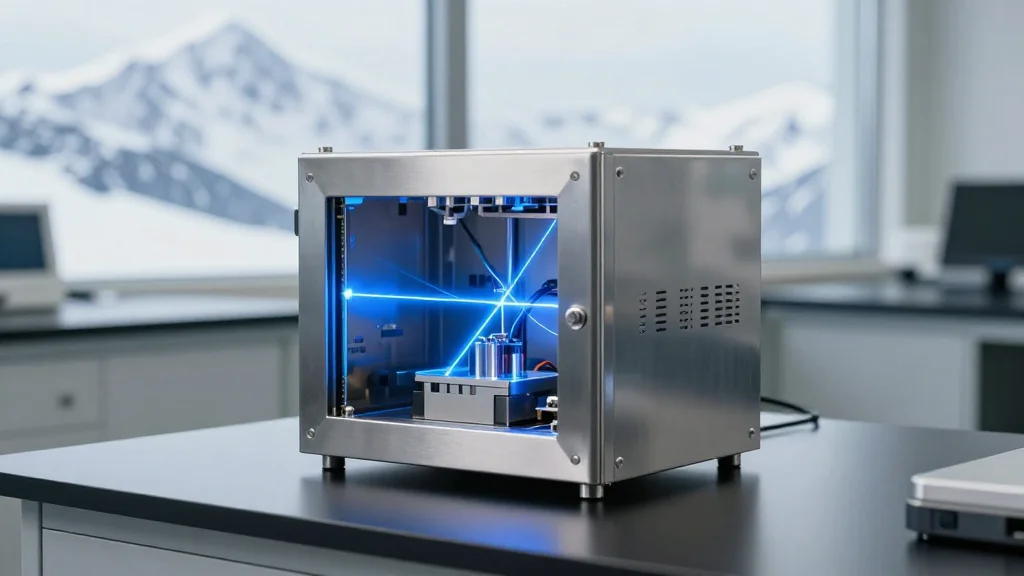
IonQ Launches 22,000‑sq‑ft Quantum R&D and Chip‑testing Hub in Boulder

Companies Mentioned
Why It Matters
IonQ’s Boulder expansion deepens the United States’ quantum hardware capabilities at a time when global competition for quantum supremacy is intensifying. By anchoring a trapped‑ion R&D and testing operation in a state‑backed innovation hub, the company leverages local talent and policy incentives to accelerate a manufacturing pathway that could lower costs and improve scalability. The move also validates Colorado’s strategy of positioning itself as a quantum corridor, potentially attracting further private investment and fostering a supply chain ecosystem that supports both hardware and application developers. The facility’s focus on semiconductor‑compatible ion traps could reshape industry expectations around quantum chip production. If IonQ demonstrates reliable, high‑fidelity qubits using standard semiconductor processes, it may prompt a shift away from bespoke, high‑cost manufacturing methods, opening the market to a broader set of players and accelerating the timeline for quantum‑enabled services in sectors such as pharmaceuticals, logistics, and energy.
Key Takeaways
- •IonQ opened a 22,000‑sq‑ft quantum R&D and chip‑testing lab in Boulder, Colorado.
- •First trapped‑ion quantum computer expected to be fully installed by Q3 2026.
- •Dozens of high‑pay deep‑tech jobs to be created, including quantum scientists and system engineers.
- •Colorado approved an eight‑year performance‑based Job Growth Incentive Tax Credit and refundable credits via the Boulder CHIPS Zone.
- •IonQ’s electronics‑based trapped‑ion approach aims for mass manufacturability using standard semiconductor supply chains.
Pulse Analysis
IonQ’s Boulder launch is more than a real‑estate announcement; it is a strategic bet on the manufacturability of trapped‑ion qubits. Historically, trapped‑ion systems have excelled in coherence times but lagged in scaling due to complex laser infrastructure. By substituting lasers with electronic control, IonQ hopes to align quantum chip fabrication with the existing semiconductor ecosystem, a move that could dramatically reduce per‑qubit costs and accelerate volume production. If the Boulder facility validates this approach, it may force competitors to reconsider their own scaling strategies, potentially sparking a wave of hybrid hardware development.
The timing aligns with a broader policy push, exemplified by the CHIPS and Science Act, which incentivizes domestic semiconductor and advanced technology manufacturing. Colorado’s targeted tax credits and the CHIPS Zone create a financial cushion that de‑risks early‑stage capital expenditures, allowing IonQ to focus on engineering breakthroughs rather than purely on fundraising. This public‑private synergy could become a template for other states seeking to attract quantum firms, especially as the federal government ramps up funding for quantum research.
From a market perspective, the Boulder hub could serve as a catalyst for enterprise adoption. Companies that have been hesitant to commit to quantum pilots often cite hardware availability and reliability as barriers. A locally tested, semiconductor‑compatible trapped‑ion platform may offer the performance consistency needed for production‑grade workloads, nudging sectors like drug discovery and materials science toward concrete quantum deployments. In the next 12‑18 months, the industry will watch closely for benchmark results from IonQ’s Boulder‑based systems; success could translate into a surge of partnership announcements and a re‑pricing of quantum hardware equities across the sector.
IonQ launches 22,000‑sq‑ft quantum R&D and chip‑testing hub in Boulder
Comments
Want to join the conversation?
Loading comments...