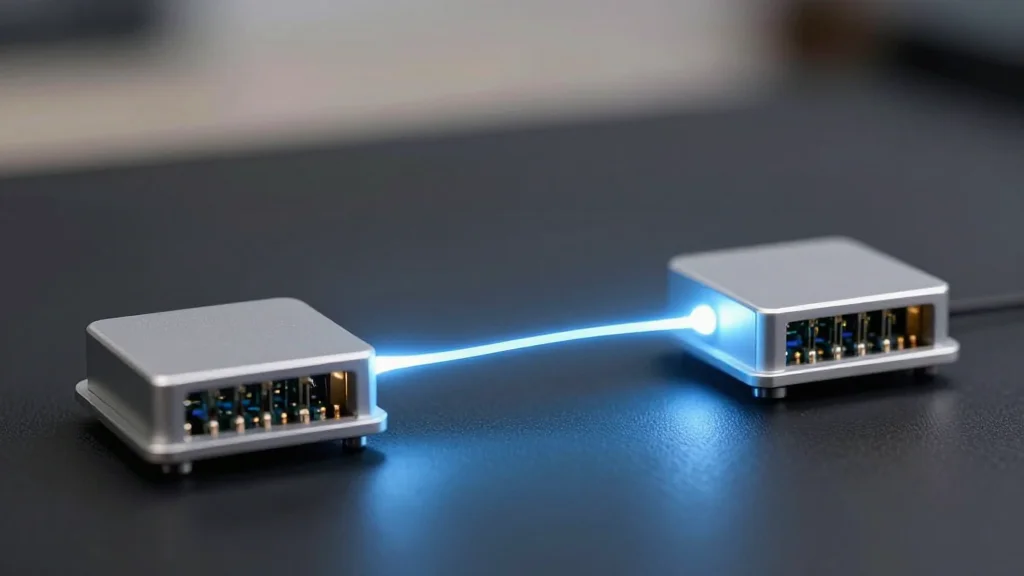
IonQ Links Two Commercial Quantum Computers with Photonic Interconnect

Companies Mentioned
Why It Matters
The ability to entangle separate quantum processors via photons moves the field from isolated laboratory experiments to practical, modular architectures. Distributed quantum computing could dramatically expand usable qubit counts without requiring a single monolithic chip, lowering engineering complexity and cost. For the defense sector, a quantum network offers secure communication channels and rapid, distributed computation for mission‑critical tasks. In the broader market, the milestone validates a business model where quantum resources are offered as a network service, potentially unlocking new revenue streams for cloud providers. Furthermore, the collaboration with the Air Force Research Laboratory and progress in DARPA’s benchmarking program illustrate how federal funding is accelerating commercialization. As more players demonstrate interoperable quantum links, standards for quantum networking are likely to emerge, shaping the future regulatory and technical landscape.
Key Takeaways
- •IonQ linked two commercial trapped‑ion quantum computers using a photonic interconnect.
- •The demonstration achieved entanglement and maintained coherence across the remote link.
- •Funding came partially from the U.S. Air Force Research Laboratory, tying the work to defense initiatives.
- •IonQ advanced to Stage B of DARPA’s quantum benchmarking program and appointed former Space Force chief John Raymond to its board.
- •The company recently set a 99.99% two‑qubit gate fidelity record, underscoring hardware reliability.
Pulse Analysis
IonQ’s photonic networking breakthrough marks a strategic inflection point for the quantum computing industry. Historically, scaling quantum hardware has been constrained by the physical limits of a single chip—thermal management, control wiring, and error rates all worsen as qubit counts rise. By proving that two commercial processors can be entangled over distance, IonQ demonstrates a viable path to bypass those constraints through modular, networked designs.
From a market perspective, the move could reshape the competitive dynamics between cloud‑based quantum providers. IBM and Microsoft have focused on software layers and error‑correction codes, while Google’s roadmap emphasizes superconducting qubits on a single wafer. IonQ’s approach leverages the inherent long‑coherence times of trapped‑ion qubits and the low‑loss nature of photonic channels, offering a differentiated value proposition for customers needing high‑fidelity, low‑latency quantum links. If IonQ can scale the network to three or more nodes while integrating error‑corrected operations, it could capture a niche in high‑performance quantum workloads that demand more qubits than any single device can provide.
The defense angle adds another layer of urgency. Quantum networks promise tamper‑evident communication and distributed sensing capabilities that are attractive to national‑security agencies. By aligning its research with the Air Force and DARPA, IonQ not only secures funding but also positions itself as a preferred supplier for government contracts. This alignment may accelerate standard‑setting efforts and create early‑adopter markets that could fund further R&D.
Looking forward, the key challenges will be engineering robustness at scale and establishing interoperable protocols across different quantum hardware platforms. Success will likely hinge on collaborative standards bodies and continued public‑private investment. IonQ’s current momentum suggests it is well‑placed to influence those standards, but the race is far from over.
IonQ Links Two Commercial Quantum Computers with Photonic Interconnect
Comments
Want to join the conversation?
Loading comments...