Majorana Modes Withstand Disorder in Atomic Chains, Boosting Fault-Tolerant Quantum Computing
Why It Matters
The experiment validates a key advantage of topologically protected qubits—intrinsic error resistance—bringing fault‑tolerant quantum processors closer to practical deployment.
Key Takeaways
- •Majorana modes observed at ends of 11‑atom Fe chains despite substrate disorder
- •STM/STS at 4 K confirmed zero‑energy states, matching realistic theoretical simulations
- •Topological protection persists across realistic disorder levels, supporting fault‑tolerant qubits
- •Hybrid platform of Nb, Ag, and BiAg₂ alloy enables robust Majorana hosting
- •Future studies will probe disorder impact on Majorana braiding for quantum logic
Pulse Analysis
Topological quantum computing hinges on qubits that can survive the noisy reality of hardware environments. Majorana quasiparticles, predicted to encode information non‑locally, offer a built‑in shield against local perturbations, a property that could dramatically lower error correction overhead compared with conventional superconducting transmons. While theory has long suggested this resilience, experimental confirmation has been scarce, leaving the field uncertain about the practicality of scaling such devices.
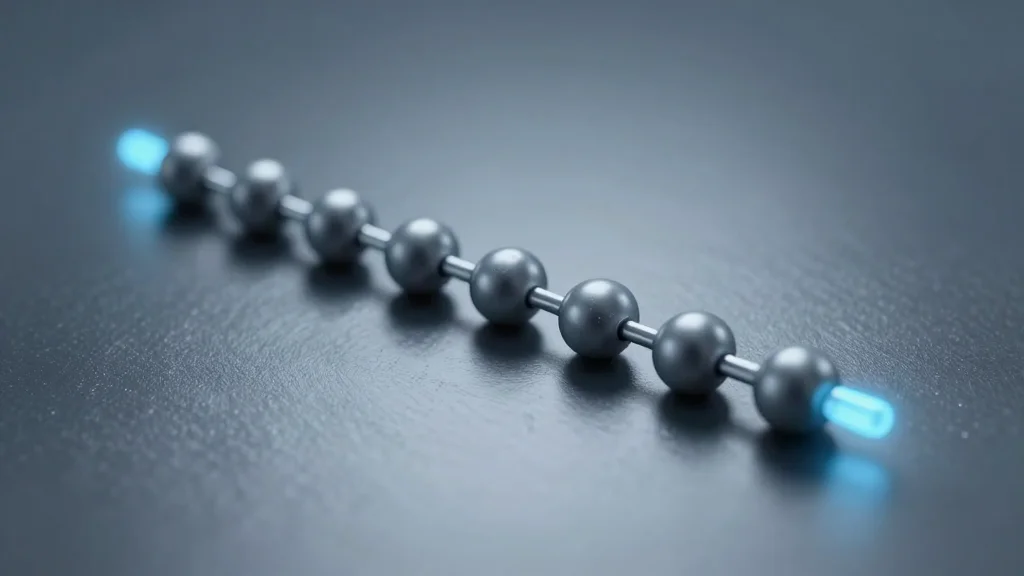
The Hamburg team’s breakthrough lies in demonstrating that Majorana zero modes survive in atomic iron chains even when the underlying BiAg₂ substrate exhibits nanoscale electronic disorder. By assembling 11‑atom chains atom‑by‑atom with an STM tip and probing them at cryogenic temperatures, the researchers captured clear zero‑energy signatures at the chain ends—hallmarks of Majorana states. Complementary simulations, calibrated with realistic disorder parameters, reproduced the observations, establishing a direct link between topological protection and material imperfections. This dual experimental‑theoretical validation narrows a critical gap between abstract models and manufacturable quantum hardware.
Looking ahead, the ability to maintain Majorana coherence amid disorder opens a pathway to more tolerant qubit architectures. Industry players can now consider hybrid platforms that combine conventional superconductors with engineered Rashba alloys, potentially simplifying fabrication while preserving topological advantages. Moreover, the planned studies on disorder‑influenced braiding operations will address the next logical hurdle: implementing logical gates with Majorana qubits. If successful, these advances could shift investment toward topological quantum processors, offering a competitive alternative to the dominant gate‑based approaches and accelerating the timeline for fault‑tolerant quantum advantage.
Majorana modes withstand disorder in atomic chains, boosting fault-tolerant quantum computing
Comments
Want to join the conversation?
Loading comments...