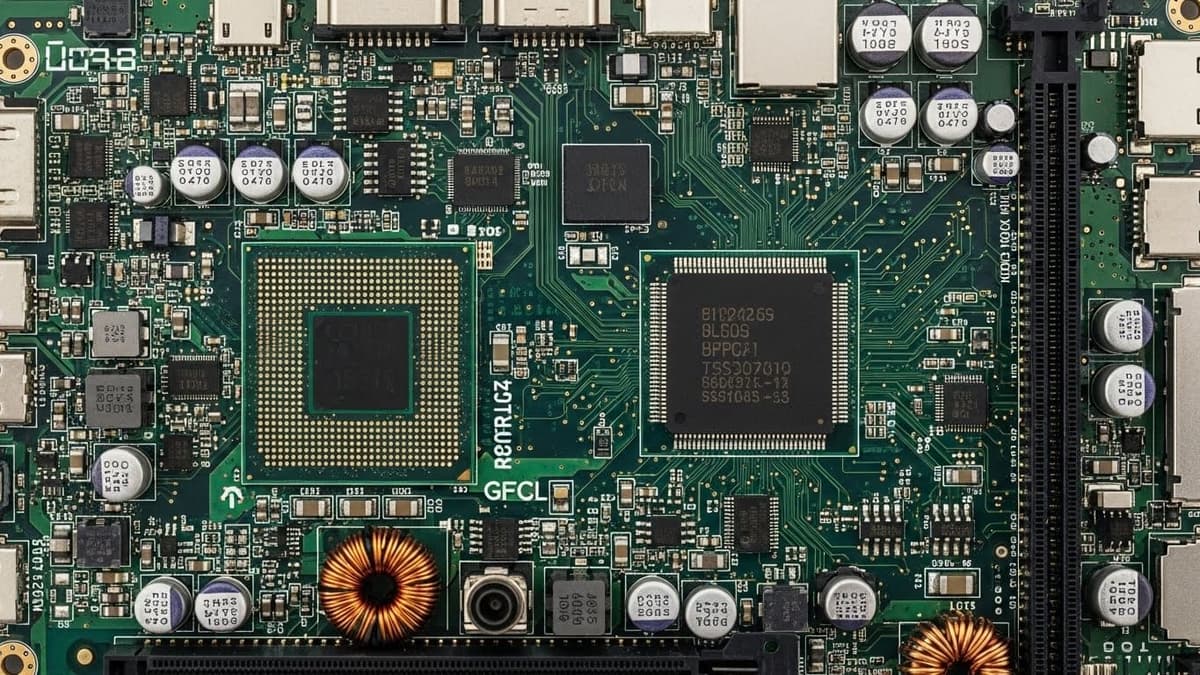
MicroCloud Hologram’s FPGA Achieves Efficient Quantum Simulation on Classical Hardware

Key Takeaways
- •FPGA pipeline yields 1.7× CPU speedup.
- •Energy efficiency improves over twofold versus CPUs.
- •Hierarchical design handles higher entanglement ranks.
- •Automatic Verilog generation speeds hardware development.
- •Roadmap includes VQE and QLSA acceleration.
Pulse Analysis
Quantum many‑body research relies on tensor‑network methods such as MPS and PEPS to tame exponential state spaces. Traditional CPUs and GPUs struggle when entanglement rank grows, leading to prohibitive compute times and power consumption. Field‑programmable gate arrays, with their fine‑grained parallelism and reconfigurable logic, present a compelling alternative, especially when the computational kernels—tensor contraction and matrix multiplication—are hard‑wired into the fabric. By eliminating frequent memory transfers and control overhead, FPGAs can sustain higher throughput for the floating‑point intensive workloads that dominate quantum simulations.
MicroCloud Hologram’s Hierarchical Tensor Contraction Pipeline translates these kernels into a three‑layer architecture: input scheduling breaks tensors into cache‑friendly blocks, a core layer of MAC arrays executes pipelined contractions, and an output reduction stage merges results while caching intermediates. Implemented via Verilog and high‑level synthesis, the design automatically adapts to target FPGA families, achieving a 1.7× speed advantage and over 2× better energy efficiency compared with CPU baselines. The static scheduling and data‑reuse strategies maximize logic utilization, enabling simulations at higher χ values without the exponential cost surge typical of software‑only solutions.
The broader implication is a practical bridge between classical and quantum hardware. As quantum processors mature, they will still depend on classical accelerators for error mitigation, state preparation, and hybrid algorithms like VQE and QLSA. An FPGA‑centric accelerator can offload these tasks, delivering low‑latency, power‑aware computation that scales with algorithmic complexity. For enterprises eyeing quantum‑ready infrastructure, MicroCloud Hologram’s approach offers a near‑term pathway to embed quantum‑grade performance within existing data‑center ecosystems, potentially accelerating the commercialization of quantum technologies.
MicroCloud Hologram’s FPGA Achieves Efficient Quantum Simulation on Classical Hardware
Comments
Want to join the conversation?