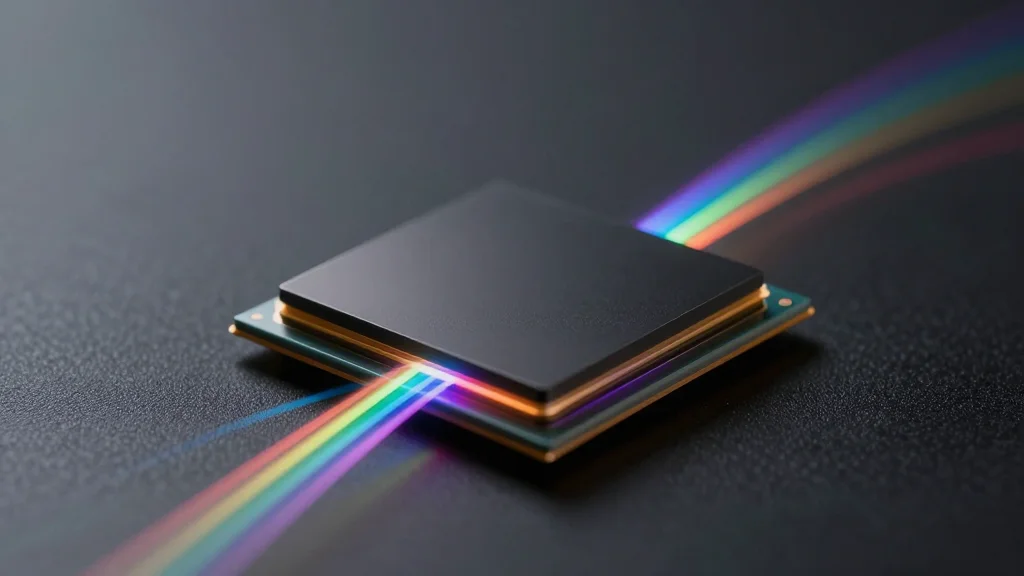
NIST Demonstrates Any‑Wavelength Laser Chip, Boosting Quantum Computing Hardware

Why It Matters
The ability to generate any wavelength on a silicon platform removes a critical engineering hurdle for quantum computers, which currently rely on a patchwork of external lasers that are expensive, bulky, and difficult to scale. By embedding versatile light sources directly onto chips, NIST’s approach could lower the barrier to entry for startups and large firms alike, fostering faster innovation cycles and broader adoption of quantum technologies. Beyond quantum computing, the technology could reshape any field that depends on precise light control, from optical communications to biomedical imaging. A universal, chip‑scale laser source would enable more compact, energy‑efficient devices, potentially unlocking new applications that were previously limited by the size and cost of traditional laser hardware.
Key Takeaways
- •NIST scientists created a silicon photonic chip that emits laser light across the visible and infrared spectrum.
- •The device uses a three‑layer stack of silicon dioxide, lithium niobate, and tantala to convert and route light.
- •Quotes: Scott Papp highlighted the chip’s multifunctional circuitry; Grant Brodnik emphasized tantala’s seamless integration.
- •Potential to replace external laser modules in quantum computers, reducing system size and power use by up to 40 %.
- •Next steps include demonstrating quantum‑gate operations within a year and pursuing volume manufacturing with foundries.
Pulse Analysis
NIST’s any‑wavelength laser chip arrives at a moment when the quantum hardware ecosystem is grappling with scaling challenges. Historically, the industry has outsourced laser generation to specialized vendors, creating supply‑chain bottlenecks and inflating the bill of materials. By moving the laser function onto a CMOS‑compatible substrate, NIST not only cuts costs but also aligns photonic quantum processors with the same manufacturing infrastructure that drives the semiconductor boom. This convergence could accelerate economies of scale, making quantum devices more price‑competitive with classical accelerators.
The breakthrough also shifts the competitive dynamics among photonics players. Companies that have built expertise in heterogeneous integration—such as Intel’s silicon photonics division and emerging startups focused on lithium‑niobate modulators—may find themselves on the front lines of a new market segment. Meanwhile, traditional laser manufacturers could be forced to pivot toward higher‑power or specialty wavelengths that remain difficult to integrate on chip. The timing is crucial: as governments pour billions into quantum research, a hardware solution that simplifies system design will likely attract both public funding and private venture capital.
Looking ahead, the key risk lies in the transition from laboratory prototype to reliable, high‑volume production. Yield rates for multilayer nonlinear materials have historically lagged behind pure silicon processes, and any variability could impact the uniformity of the emitted wavelengths. If NIST and its industrial partners can resolve these manufacturing hurdles, the any‑wavelength chip could become a foundational building block for the next generation of quantum processors, optical clocks, and beyond, effectively turning the promise of quantum advantage into a commercially viable reality.
NIST Demonstrates Any‑Wavelength Laser Chip, Boosting Quantum Computing Hardware
Comments
Want to join the conversation?
Loading comments...