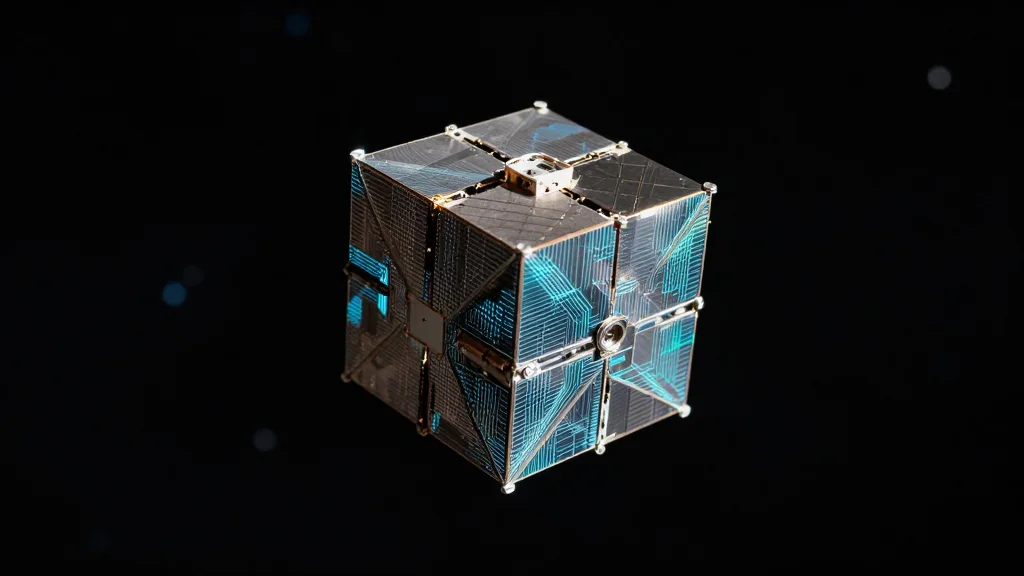
OCaml Runtime Goes to Orbit, Demonstrates First In‑Space Post‑Quantum Key Rotation

Companies Mentioned
Why It Matters
The Borealis demonstration bridges two critical frontiers: safe‑language runtimes and post‑quantum cryptography in space. By proving that a pure‑OCaml stack can operate reliably on a hosted‑payload satellite, the project challenges the long‑standing dominance of low‑level languages in aerospace and offers a path to more robust, mathematically verified software. Simultaneously, the successful over‑the‑air rotation of ML‑DSA‑65 keys shows that PQC can be deployed operationally without costly hardware upgrades, addressing NASA’s mandate and setting a precedent for commercial constellations that must secure decades‑long missions against future quantum adversaries. For the broader quantum‑security ecosystem, this in‑orbit proof point validates the practicality of PQC beyond laboratory settings. It demonstrates that post‑quantum algorithms can be integrated into existing communication protocols (CCSDS, BPv7) and managed remotely, reducing the risk of key compromise over a satellite’s lifespan. As the quantum computing horizon approaches, such real‑world deployments will become essential benchmarks for regulators, insurers, and satellite operators assessing the readiness of their security architectures.
Key Takeaways
- •Borealis, a pure‑OCaml CCSDS stack, booted on DPhi Space’s ClusterGate‑2 payload on 23 April.
- •The system performs end‑to‑end encrypted command and control and rotates ML‑DSA‑65 post‑quantum keys via OTAR.
- •Orbit period is approximately 90 minutes; key rotation can occur without reflashing the satellite.
- •NASA‑STD‑1006A requires post‑quantum command authentication for missions lasting 10‑15 years.
- •The demo highlights OCaml’s safety and performance as an alternative to C/Rust for space‑grade software.
Pulse Analysis
The Borealis deployment is more than a technical curiosity; it signals a shift in how the space industry will address long‑term security. Historically, satellite software has been written in languages that prioritize low‑level control at the expense of safety, leading to costly patch cycles and vulnerability exposure. OCaml’s memory‑safe guarantees, combined with its recent multi‑threading capabilities introduced in OCaml 5, make it uniquely suited for the constrained, high‑reliability environment of orbit. By proving that an OCaml runtime can survive the harsh conditions of space and still deliver cryptographic performance, Parsimoni and DPhi have opened the door for a new class of high‑assurance flight software.
Equally important is the operationalization of post‑quantum key rotation. While many PQC algorithms have been standardized, few have been tested in the field, especially in the latency‑tolerant, disconnected context of satellite communications. Borealis’s use of OTAR to rotate ML‑DSA‑65 keys without a full firmware update demonstrates a practical pathway for operators to meet NASA’s quantum‑security mandates without incurring prohibitive costs. This capability will likely become a differentiator for satellite service providers as customers demand quantum‑resilient links for critical data.
Looking ahead, the real test will be scaling this approach across large constellations where hundreds or thousands of satellites must each manage their own PQC lifecycle. Automation, remote attestation, and standardized interfaces will be essential. If the community embraces open‑sourcing of the OCaml stack, we could see a rapid convergence of safe‑language tooling, formal verification, and quantum‑ready cryptography, ultimately raising the security baseline for the entire space sector.
OCaml Runtime Goes to Orbit, Demonstrates First In‑Space Post‑Quantum Key Rotation
Comments
Want to join the conversation?
Loading comments...