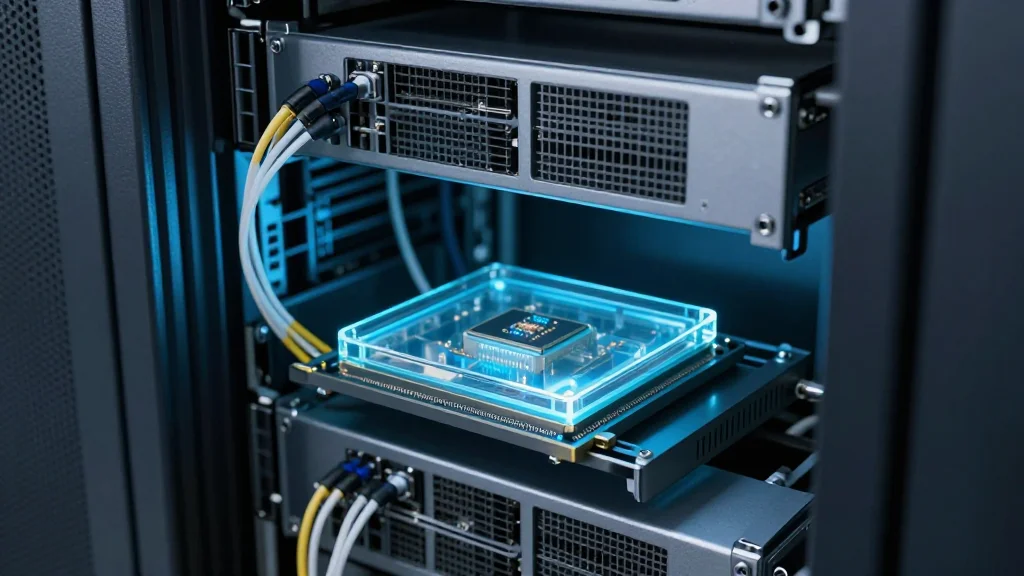
ORCA Computing Integrates Photonic Systems Into London Digital Realty Innovation Lab
Companies Mentioned
Why It Matters
The integration proves quantum accelerators can operate within existing data‑center infrastructure, accelerating enterprise adoption and cutting deployment barriers. It gives businesses a practical path to blend AI and quantum workloads, potentially reshaping high‑performance computing strategies.
Key Takeaways
- •ORCA’s PT Series runs at room temperature in standard server racks.
- •Digital Realty Innovation Lab offers live benchmarking for hybrid quantum‑classical workloads.
- •Integration eliminates need for cryogenic cooling, lowering deployment costs.
- •Partnerships with NVIDIA and others enable AI‑quantum co‑processing.
- •Enterprise clients can test migration roadmaps without vendor lock‑in.
Pulse Analysis
Photonic quantum computing is emerging as a pragmatic alternative to traditional superconducting qubits, which demand costly cryogenic systems. ORCA Computing’s PT Series leverages time‑bin interferometer technology to manipulate photons at ambient conditions, allowing the hardware to sit directly in conventional server racks. This architectural shift reduces capital expenditure and simplifies integration, making quantum acceleration more accessible to organizations that already operate dense HPC clusters.
The Digital Realty Innovation Lab (DRIL) in London provides a unique, carrier‑neutral environment where these photonic processors can be evaluated alongside classical CPUs, GPUs, and AI accelerators. By offering live, co‑located testing, DRIL enables firms to benchmark end‑to‑end quantum‑classical pipelines for generative AI, tensor‑network simulations, and combinatorial optimization. Strategic alliances with NVIDIA, Toyota Tsusho, SiC Systems and JIJ Inc. further enrich the ecosystem, delivering optimized software stacks and cross‑vendor interoperability that accelerate proof‑of‑concept cycles.
For enterprises, the ability to validate hybrid workloads in a production‑like setting mitigates risk and clarifies migration roadmaps. Financial services, logistics, and energy sectors can now experiment with offloading specific algorithmic kernels to photonic QPUs without committing to full‑scale cloud contracts or facing vendor lock‑in. As more data‑center operators adopt similar labs, photonic quantum computing could become a standard tier of the HPC stack, driving a new wave of performance gains and opening revenue streams for both quantum vendors and traditional cloud providers.
ORCA Computing Integrates Photonic Systems into London Digital Realty Innovation Lab
Comments
Want to join the conversation?
Loading comments...