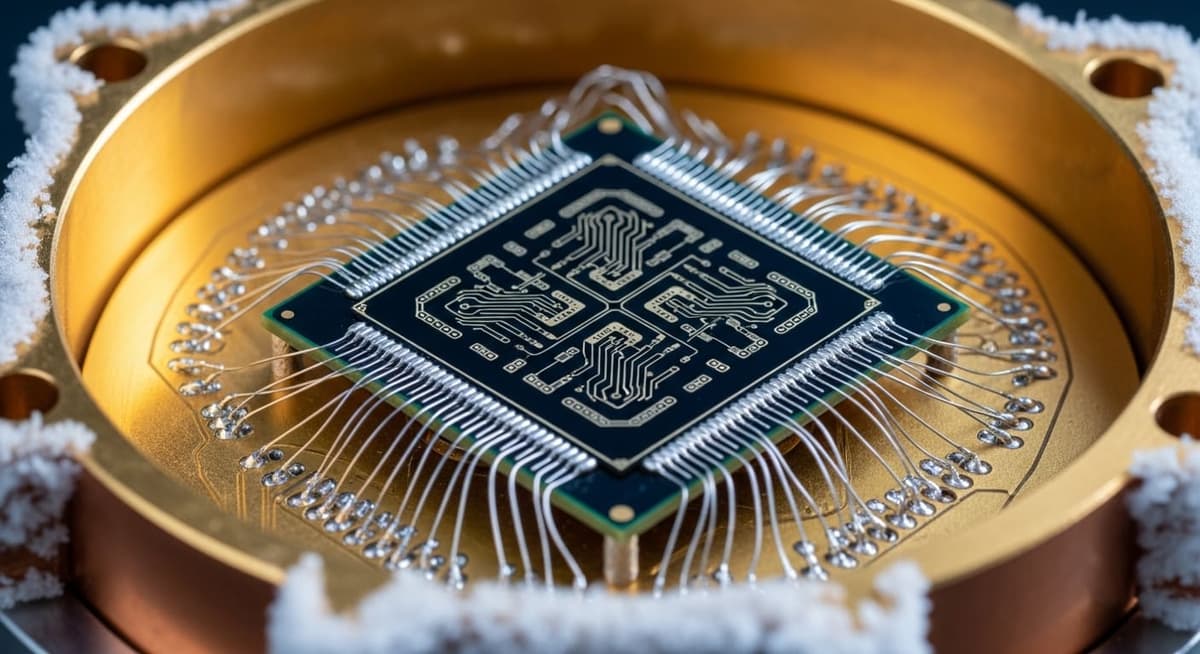
Origin Quantum Computing Achieves High-Accuracy Flux Crosstalk Compensation in Superconducting Qubits

Key Takeaways
- •Spin‑echo technique isolates quantum and flux crosstalk
- •Crosstalk coefficient accuracy reaches ~10⁻⁵ after compensation
- •Frequency‑shift noise baseline reduced to ~20 kHz
- •Learning algorithm speeds high‑parallelism measurements
- •Enables higher‑fidelity control of large‑scale processors
Pulse Analysis
Magnetic flux crosstalk has long hampered superconducting qubit arrays, introducing unpredictable frequency shifts that degrade gate fidelity. Traditional compensation methods struggle because quantum‑level interactions intertwine with flux disturbances, limiting scalability. By applying a spin‑echo sequence, Origin Quantum can disentangle these two effects, providing a clear measurement window that isolates pure flux‑induced errors. This methodological clarity is essential as the industry pushes toward processors with hundreds or thousands of qubits, where even minute interference can cascade into substantial computational errors.
The core of the new approach lies in integrating a learning‑based algorithm with a high‑parallelism measurement framework. The algorithm iteratively refines crosstalk models, dramatically cutting the number of experimental cycles required for accurate characterization. Results published in *Physics Applied* show a noise baseline of roughly 20 kHz and crosstalk‑coefficient precision on the order of 10⁻⁵ after compensation—metrics that surpass existing tunable‑coupling architectures. Such performance gains translate into more stable qubit frequencies and tighter control margins, directly supporting higher‑fidelity quantum gates.
For the broader quantum ecosystem, this development signals a tangible step toward commercially viable quantum computers. Reliable crosstalk mitigation reduces the overhead of error‑correction protocols, lowering both hardware complexity and operational costs. Companies aiming to build large‑scale quantum processors can adopt this spin‑echo framework to accelerate their roadmaps, while academic labs gain a powerful tool for probing qubit dynamics. As the field moves from prototype chips to production‑grade systems, techniques that enhance measurement efficiency and accuracy will be decisive in shaping market leadership.
Origin Quantum Computing Achieves High-Accuracy Flux Crosstalk Compensation in Superconducting Qubits
Comments
Want to join the conversation?