Oxford Researchers Teleport Quantum Gate Between Two Supercomputers with 96.9% Fidelity

Companies Mentioned
Why It Matters
Distributed quantum computing promises to overcome the physical limits of scaling single‑chip quantum processors. By proving that a high‑fidelity quantum gate can be teleported between separate ion‑trap modules, Oxford’s work validates a core building block for quantum networks that can be expanded incrementally. This approach could accelerate the deployment of quantum services in cloud environments, lower the cost of hardware upgrades, and reduce the risk of decoherence that plagues large monolithic devices. Moreover, the experiment showcases photonic interconnects as a practical engineering solution, bridging the gap between laboratory demonstrations and commercial quantum architectures. As governments and corporations invest billions in quantum research, a modular, network‑centric model may become the preferred route for building scalable, fault‑tolerant machines, influencing funding priorities and industry roadmaps worldwide.
Key Takeaways
- •Oxford team teleported a CZ gate between two ion‑trap modules with 96.89% fidelity.
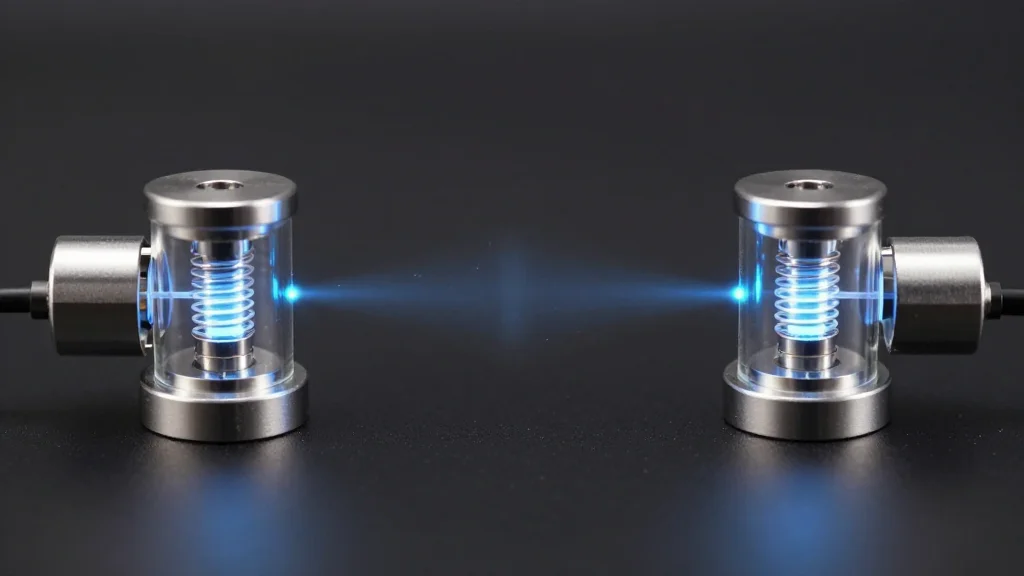
- •Modules were separated by roughly two meters and linked via photonic entanglement.
- •Each module contained a strontium network qubit and a calcium circuit qubit.
- •The experiment demonstrates a viable path to distributed, modular quantum computers.
- •Future work aims to increase node distance, add more qubits, and perform multi‑gate teleportation.
Pulse Analysis
The Oxford experiment is a watershed for quantum hardware strategy. For years, the field has been split between two camps: one betting on ever‑larger monolithic chips, the other on networking smaller, high‑quality modules. The high‑fidelity gate teleportation achieved here tilts the balance toward the latter, because it proves that the overhead of photonic links does not erode computational accuracy beyond error‑correction thresholds. This could reshape vendor roadmaps, prompting companies like IonQ, Honeywell, and Rigetti to prioritize modular photonic interconnects over raw qubit count.
From a market perspective, the result may catalyze a new class of quantum‑cloud services. Cloud providers could offer "quantum clusters" where users dynamically allocate linked nodes, akin to classical container orchestration. Such flexibility would lower entry barriers for enterprises seeking quantum acceleration, expanding the addressable market beyond niche research labs. However, the path to commercialization will require standardization of photonic interfaces, robust error‑correction protocols across nodes, and scalable manufacturing of ion‑trap modules.
In the longer term, the ability to teleport gates across distance opens the door to quantum internet applications, where distributed quantum processors collaborate over metropolitan or even inter‑city fiber networks. If the fidelity can be maintained over longer spans, we could see a hybrid architecture that blends local quantum processing with remote entanglement resources, dramatically expanding the computational envelope available to scientists and industry alike.
Oxford Researchers Teleport Quantum Gate Between Two Supercomputers with 96.9% Fidelity
Comments
Want to join the conversation?
Loading comments...