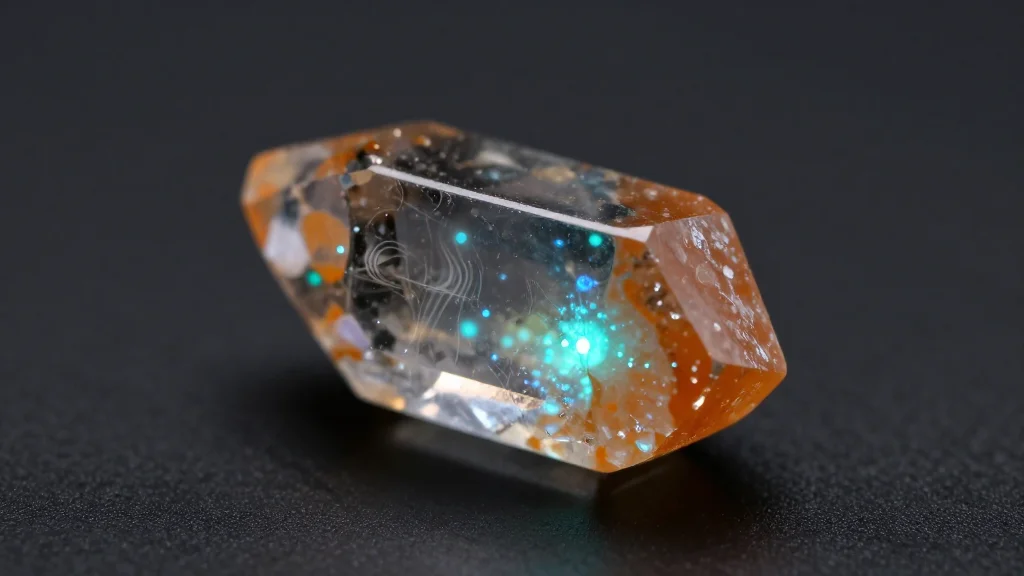
Perovskite Crystals Can Host Qubits, Challenging Long-Held Assumptions
Why It Matters
If perovskite qubits can be produced at modest temperatures and low cost, they could accelerate the commercialization of quantum computers and broaden access to quantum technologies.
Key Takeaways
- •Perovskite crystals act as viable spin qubit hosts
- •Synthesis occurs at 480 °C, far above cryogenic temps
- •Chromium doping enables optical signal readout
- •Production is cheap, scalable, and chemically tunable
- •Could rival superconducting and diamond qubits
Pulse Analysis
Quantum computing today hinges on fragile qubit platforms such as superconducting circuits that demand millikelvin cooling, or diamond‑based spin defects that require complex fabrication. These constraints inflate capital expenditures and limit scalability, prompting researchers to explore alternative materials that can deliver coherent quantum states without extreme cryogenics. Perovskite semiconductors, long celebrated for their tunable optoelectronic properties in solar cells, have emerged as a promising candidate because their crystal lattice can be engineered at the atomic level, offering a new degree of freedom for quantum device design.
The Linköping University team leveraged the solution‑based synthesis of halide double perovskites, heating precursor chemicals to 480 °C before cooling to form a crystalline matrix. Introducing chromium ions creates localized spin centers that function as qubits, while the host lattice’s optical transparency enables direct conversion of spin states into photon signals. This dual capability—high‑temperature operation and optical readout—addresses two major bottlenecks: the need for bulky dilution refrigerators and the difficulty of integrating qubits with photonic communication channels. Moreover, the chemical versatility of perovskites allows researchers to fine‑tune coherence times and transition frequencies through compositional adjustments, a flexibility rarely achievable with traditional superconducting materials.
Industry analysts see perovskite qubits as a potential disruptor for the quantum hardware market. Lower fabrication costs and relaxed thermal requirements could democratize access for startups and research labs lacking deep‑cryogenic infrastructure. However, challenges remain, including long‑term material stability, error‑correction integration, and scaling from single‑qubit demonstrations to multi‑qubit architectures. Ongoing collaborations between materials scientists, quantum engineers, and photonics experts will be crucial to translate laboratory success into commercial quantum processors. If these hurdles are overcome, perovskite‑based quantum chips could complement or even replace existing platforms, reshaping the roadmap for quantum advantage across finance, drug discovery, and climate modeling.
Perovskite crystals can host qubits, challenging long-held assumptions
Comments
Want to join the conversation?
Loading comments...