QAOA Achieves 0.9443 Approximation Ratio with Efficient Parameter Transfer Optimisation

Key Takeaways
- •Parameter transfer cuts QAOA optimisation time eightfold.
- •Targeted single-layer optimisation reaches 0.9443 approximation ratio.
- •L2 regularisation reduces suboptimal cases to 3.81%.
- •Method works on unweighted and some weighted graph families.
- •Enables near‑optimal QAOA on near‑term quantum hardware.
Pulse Analysis
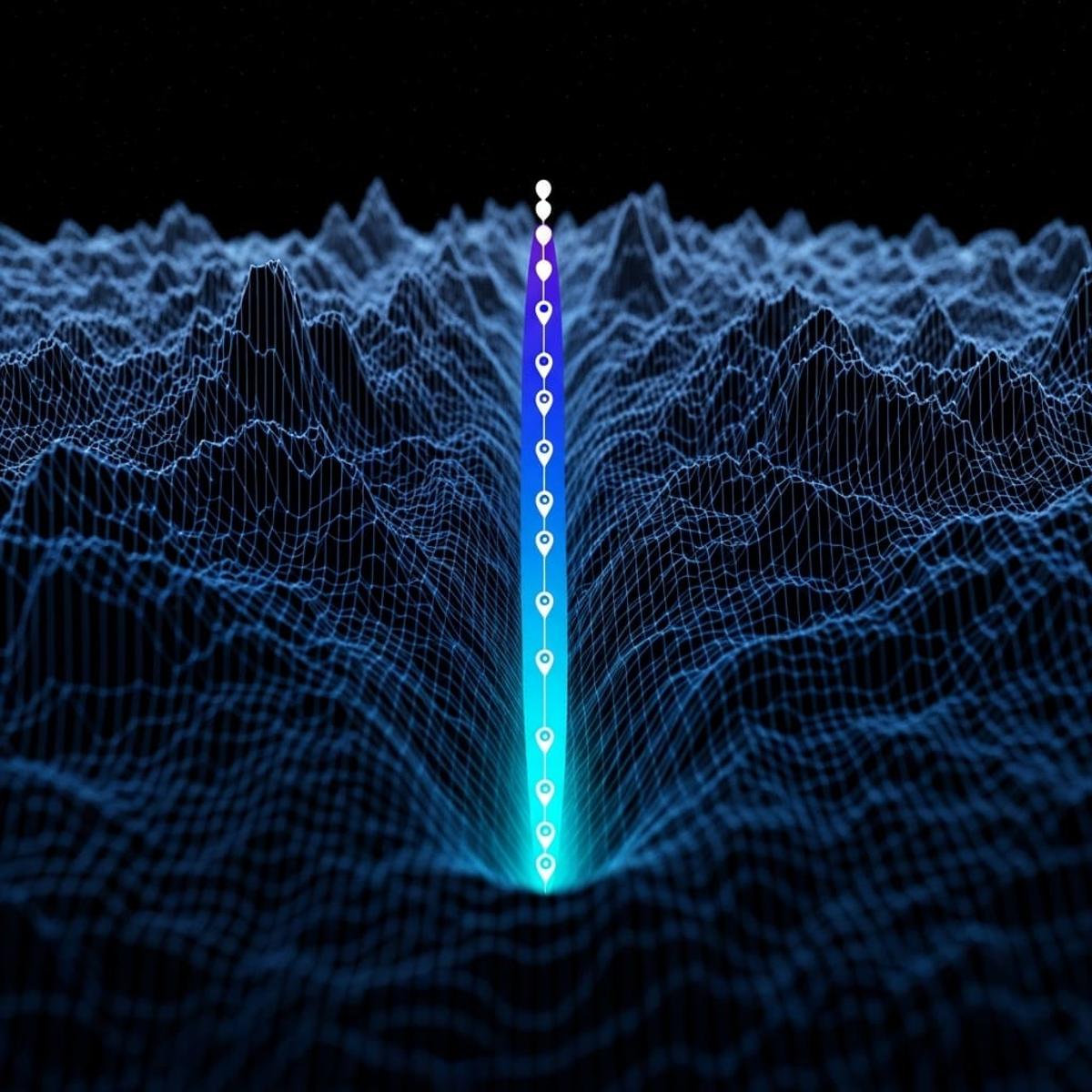
Quantum Approximate Optimisation Algorithm (QAOA) has long promised quantum speed‑ups for combinatorial problems, yet its practical deployment stalls at the costly parameter‑optimisation stage. Traditional full‑circuit optimisation scales poorly as problem size grows, often trapping the optimiser in local minima. By borrowing transfer‑learning ideas from deep learning, the Delhi team pre‑optimises small donor graphs and reuses those parameters for larger acceptor instances, dramatically shrinking the search space before a focused refinement step.
The study’s empirical results underscore the power of this hybrid strategy. On MaxCut benchmarks across three graph families, a single‑layer targeted optimisation achieved a mean approximation ratio of 0.9443—just 1.1 % shy of the 0.9551 obtained via exhaustive optimisation—while delivering an 8.06‑fold reduction in computational time for unweighted graphs. Introducing ridge (L2) regularisation smoothed the loss landscape, cutting the proportion of cases where full optimisation outperformed the targeted method from 8.92 % to 3.81 %. These gains translate directly into lower circuit depth and shorter runtimes, crucial for noisy intermediate‑scale quantum (NISQ) devices with limited qubit coherence.
Beyond the immediate performance boost, the methodology signals a broader shift toward scalable quantum algorithm design. Efficient parameter transfer and selective layer optimisation can be adapted to other variational quantum algorithms, extending their reach into logistics routing, portfolio optimisation, and materials discovery. As quantum hardware matures, such software‑level efficiencies will be pivotal in achieving genuine quantum advantage, positioning QAOA as a viable tool for industry‑grade optimisation challenges.
QAOA Achieves 0.9443 Approximation Ratio with Efficient Parameter Transfer Optimisation
Comments
Want to join the conversation?