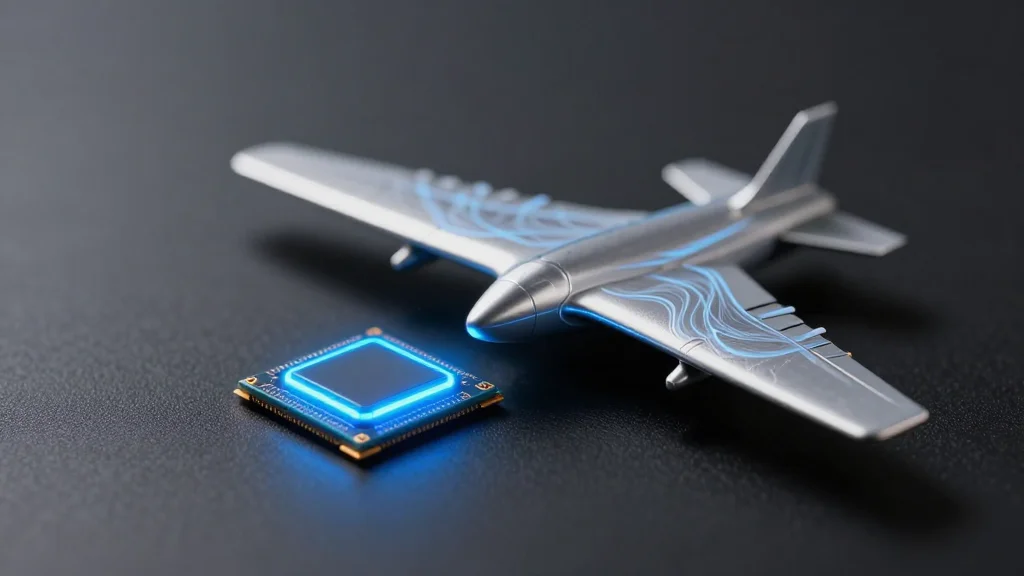
Quandela and Safran Partner to Develop Quantum Algorithms for Fluid Dynamics
Why It Matters
Quantum‑accelerated fluid simulations could dramatically shorten aircraft design cycles and lower fuel use, giving European aerospace firms a competitive sustainability edge.
Key Takeaways
- •Photonic qubits operate at room temperature, integrate with data centers
- •Project targets PDEs for propulsion and combustion modeling
- •Aims to replace costly wind‑tunnel tests with quantum simulations
- •Enables evaluating more engine configurations than classical HPC
- •Supports Safran’s digital platform for sustainable aviation
Pulse Analysis
Europe’s aerospace sector is increasingly turning to quantum computing to break through the performance limits of classical simulation tools. Quandela’s photonic platform, which leverages light‑based qubits that run at ambient temperature, sidesteps the cryogenic overhead of superconducting systems and fits neatly into existing data‑centre environments. By securing regional funding through the PAQ Quantique programme, the AQeFLU project illustrates how public‑private collaboration can fast‑track quantum research from academic labs to real‑world engineering challenges.
Fluid dynamics lies at the heart of aircraft propulsion, yet solving the governing partial differential equations demands massive computational resources. Traditional high‑performance computing clusters can evaluate only a limited set of design variants before time and cost become prohibitive. Quantum algorithms promise exponential speed‑ups for certain linear‑algebraic tasks, enabling more precise airflow modelling around wings and engine components. If successful, the technology could replace many wind‑tunnel experiments, delivering higher fidelity data while slashing material and operational expenses.
For Safran, integrating quantum‑accelerated workflows aligns with its broader digital‑platform strategy to shorten development cycles and meet stricter emissions targets. By simulating a broader array of engine configurations early in the design phase, the company can identify fuel‑efficient architectures before physical prototypes are built. This not only strengthens Safran’s competitive position against rivals adopting similar quantum initiatives but also supports the industry’s push toward sustainable aviation. As photonic quantum hardware matures, the AQeFLU partnership could become a benchmark for how aerospace manufacturers embed cutting‑edge computation into next‑generation aircraft design.
Quandela and Safran Partner to Develop Quantum Algorithms for Fluid Dynamics
Comments
Want to join the conversation?
Loading comments...