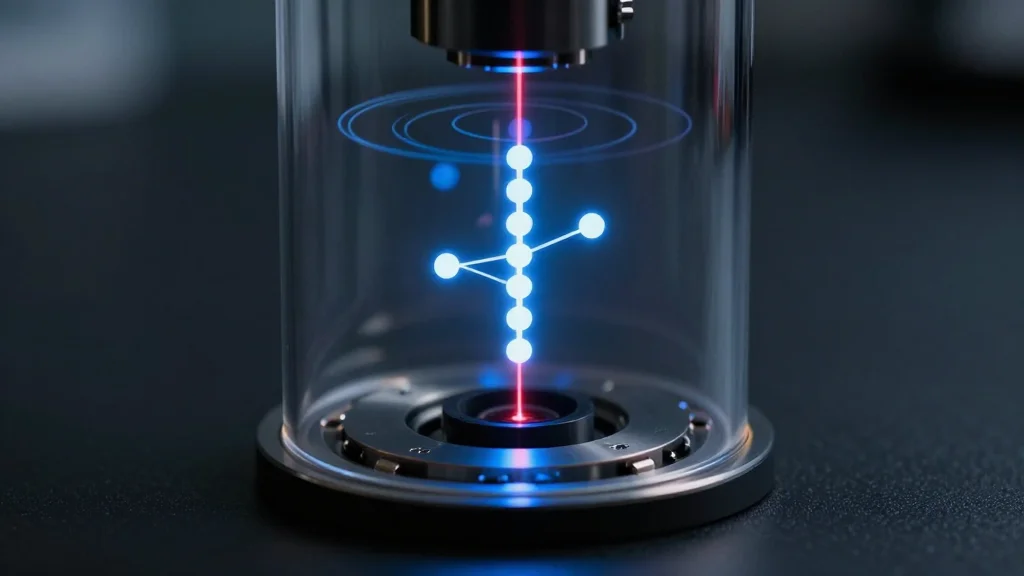
Quantum Art Unveils Algorithm to Model 10¹⁸‑Point Electromagnetic Waves on 60 Qubits

Companies Mentioned
Why It Matters
The announcement marks a concrete step toward applying quantum computing to real‑world engineering problems that have long been out of reach for classical hardware. By demonstrating a viable pathway to model electromagnetic phenomena at unprecedented scales, Quantum Art challenges the prevailing view that quantum advantage is confined to abstract chemistry or optimization tasks. The capability could accelerate the design of next‑generation communication infrastructure, reduce the time and cost of defense planning, and stimulate investment in trapped‑ion platforms that promise lower error rates than superconducting rivals. Beyond immediate applications, the result underscores the growing importance of government‑industry collaborations in quantum R&D. The involvement of a national R&D agency signals that strategic stakeholders see quantum simulation as a national security priority, potentially unlocking funding streams and regulatory support that could hasten commercialization.
Key Takeaways
- •Quantum Art's algorithm simulates wave propagation over tens of km at cm resolution using ~60 qubits.
- •Benchmarking shows >100× speedup versus leading superconducting quantum platform and >10× vs another trapped‑ion system.
- •Problem size of ~10¹⁸ sampling points, previously infeasible for classical supercomputers, is now tractable.
- •Potential impact on telecom coverage planning, defense communications, and other PDE‑heavy industries.
- •Collaboration with an Israeli governmental R&D agency; further field trials and partner pilots planned.
Pulse Analysis
Quantum Art’s press release arrives at a moment when the quantum hardware race is shifting from raw qubit counts to algorithmic efficiency. Trapped‑ion systems have traditionally lagged behind superconducting chips in sheer qubit numbers, but their superior gate fidelity and the ability to execute multi‑qubit operations in a single step give them a distinct edge for depth‑sensitive algorithms like PDE solvers. By leveraging these hardware traits, Quantum Art demonstrates that a modest qubit budget can still unlock exponential scaling for specific problem classes.
The claimed 100× advantage over a superconducting platform is striking, yet it must be contextualized. Benchmarks were likely performed on synthetic workloads rather than end‑to‑end engineering pipelines, and real‑world deployment will encounter noise, calibration drift, and integration overheads. Nonetheless, the result validates a growing body of research suggesting that quantum‑accelerated simulation can outpace classical HPC for certain high‑dimensional, linear‑algebra‑heavy tasks. If Quantum Art can translate laboratory performance into field‑ready software, it could force telecom and defense firms to rethink their simulation stacks, potentially reallocating budget from massive supercomputing farms to quantum cloud services.
Strategically, the partnership with a governmental R&D agency hints at a broader policy push to embed quantum capabilities into national infrastructure. Similar moves in the U.S. and Europe have earmarked billions for quantum‑enhanced sensing and communications. Quantum Art’s progress may attract further public‑private funding, catalyzing a virtuous cycle where algorithmic breakthroughs drive hardware investment, which in turn enables more ambitious applications. The next six months—when field trials compare simulated and measured wave patterns—will be the true litmus test for whether this press release signals a market‑ready technology or a promising prototype awaiting further maturation.
Quantum Art Unveils Algorithm to Model 10¹⁸‑Point Electromagnetic Waves on 60 Qubits
Comments
Want to join the conversation?
Loading comments...