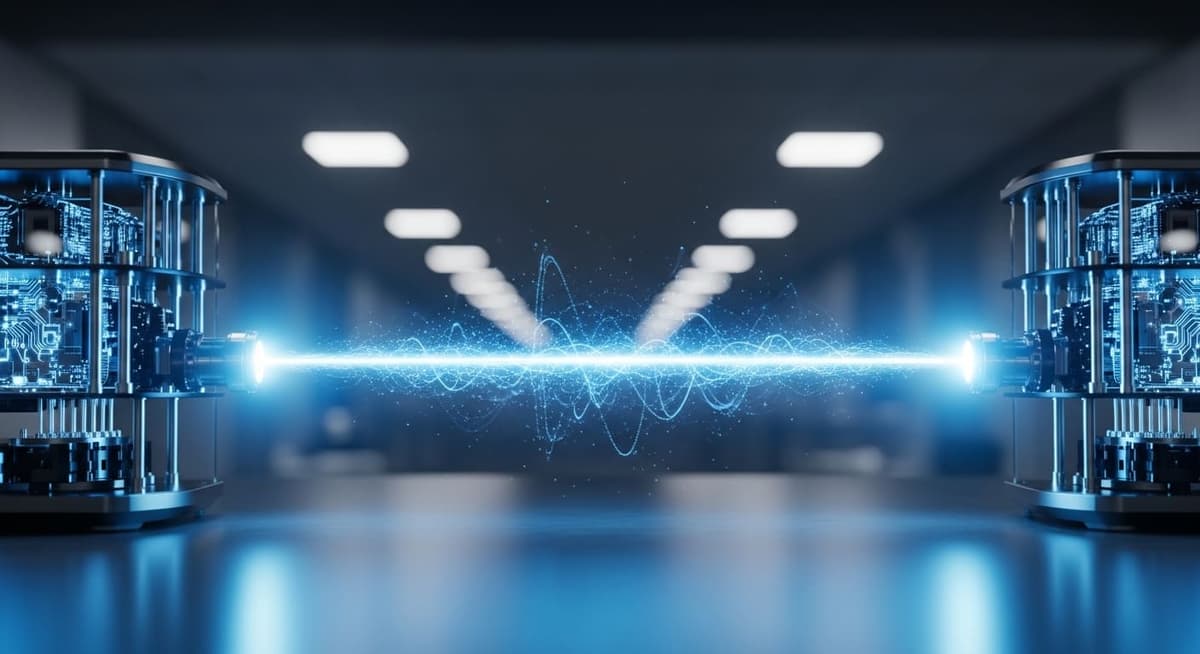
Quantum Computers Move Closer with Light-Based Link Breakthrough

Key Takeaways
- •First demonstration of non‑classical microwave‑to‑optical photon conversion
- •Internal conversion efficiency reaches 1.6 × 10⁻³, external 2.2 × 10⁻⁴
- •Signal‑to‑noise ratio of up‑converted photons peaks at 5.1
- •Added noise below 0.012 quanta, near quantum‑limited performance
- •Enables optical‑fiber links for distributed superconducting quantum processors
Pulse Analysis
Scaling superconducting quantum processors has long been hampered by the need for millikelvin environments, which prevent direct long‑range communication. Traditional microwave interconnects suffer from high loss and thermal loading, making optical fibers an attractive alternative. Recent advances in electro‑optic materials and resonator engineering have set the stage for bridging this gap, but converting a genuine quantum state—rather than a classical signal—remained elusive until now.
The breakthrough hinges on a lithium‑niobate whisper‑gallery‑mode resonator that exploits the Pockels effect to couple microwave and optical fields. By embedding a transmon qubit in a three‑dimensional aluminium cavity, the team generated on‑demand single microwave photons at 8.9 GHz, which were routed to the transducer and up‑converted to 193.4 THz telecom photons. Measured internal conversion efficiency of 1.6 × 10⁻³ and an external efficiency of 2.2 × 10⁻⁴, combined with a signal‑to‑noise ratio of 5.1 ± 1.1 and added noise below 0.012 quanta, demonstrate near‑quantum‑limited performance and validate the approach for real‑world quantum networking.
Beyond the laboratory, this capability paves the way for modular quantum computers where separate cryogenic nodes communicate over existing fiber infrastructure. Heralded entanglement distribution and gate teleportation become feasible, reducing the need for monolithic chip designs and easing thermal management challenges. Industry players eyeing quantum‑secure communications and cloud‑based quantum services can now consider heterogeneous architectures that blend superconducting processors with photonic links, accelerating the roadmap toward scalable, fault‑tolerant quantum computing.
Quantum Computers Move Closer with Light-Based Link Breakthrough
Comments
Want to join the conversation?