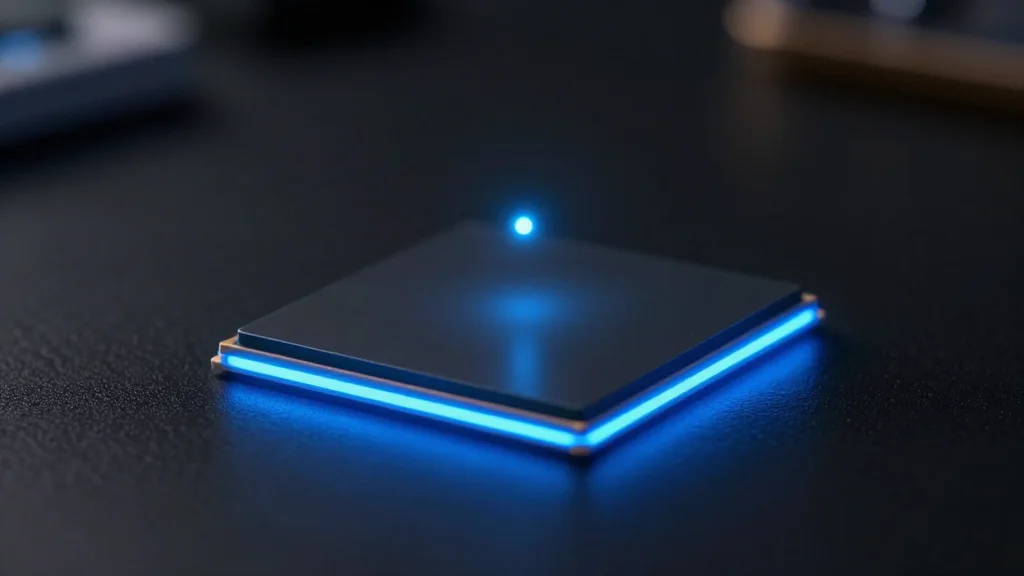
Quantum Computing's Next Dark Horse Emerges From a Frozen Surface, Where Almost Nothing Behaves as Expected
Why It Matters
Ultra‑low noise and long coherence directly improve quantum gate fidelity, making the neon‑based qubit a viable competitor for large‑scale quantum computers and potentially lowering entry barriers for the industry.
Key Takeaways
- •Electron-on-neon qubit shows 10‑10,000× lower noise than semiconductor qubits
- •Coherence time reaches 0.1 ms, rivaling top superconducting qubits
- •Fabrication uses solid neon and light‑bulb electrons, cutting material costs
- •Noise “sweet spot” identified; off‑peak testing reveals stray‑electron disturbances
- •Ongoing work targets surface uniformity to further suppress residual noise
Pulse Analysis
Quantum computing’s promise hinges on qubits that can retain fragile quantum states long enough to perform useful calculations. Today’s dominant platforms—semiconductor spin qubits and superconducting circuits—suffer from material defects, charge noise, and fabrication variability that truncate coherence times to microseconds. Researchers therefore chase alternative hosts that naturally suppress environmental disturbances. Solid neon, an inert noble‑gas solid, offers a pristine lattice free of impurities, providing a uniquely quiet backdrop for electron‑based qubits.
The Argonne‑Notre Dame team leverages this advantage by trapping a single electron just above a frozen neon film and controlling it with microwave resonators. Their latest measurements reveal noise levels up to 10,000 times lower than conventional semiconductor qubits and a coherence time of 0.1 ms—comparable to the best superconducting qubits that require complex cryogenic fabrication. Moreover, the electron source can be as simple as a light‑bulb filament, dramatically reducing material costs and simplifying the manufacturing pipeline. The study also maps a “sweet spot” frequency where the qubit is intrinsically immune to electric fluctuations, while exposing residual noise sources such as stray electrons and surface roughness that future work aims to eliminate.
If these refinements continue, neon‑based qubits could reshape the quantum hardware landscape. Lower noise translates to higher gate fidelity, reducing the overhead for quantum error correction and shortening the path to fault‑tolerant machines. The inexpensive, scalable fabrication method may also democratize access for startups and academic labs, accelerating innovation across drug discovery, materials design, and complex optimization problems. As the industry seeks practical routes to quantum advantage, the solid‑neon platform positions itself as a compelling, cost‑effective alternative to the entrenched semiconductor and superconducting approaches.
Quantum computing's next dark horse emerges from a frozen surface, where almost nothing behaves as expected
Comments
Want to join the conversation?
Loading comments...