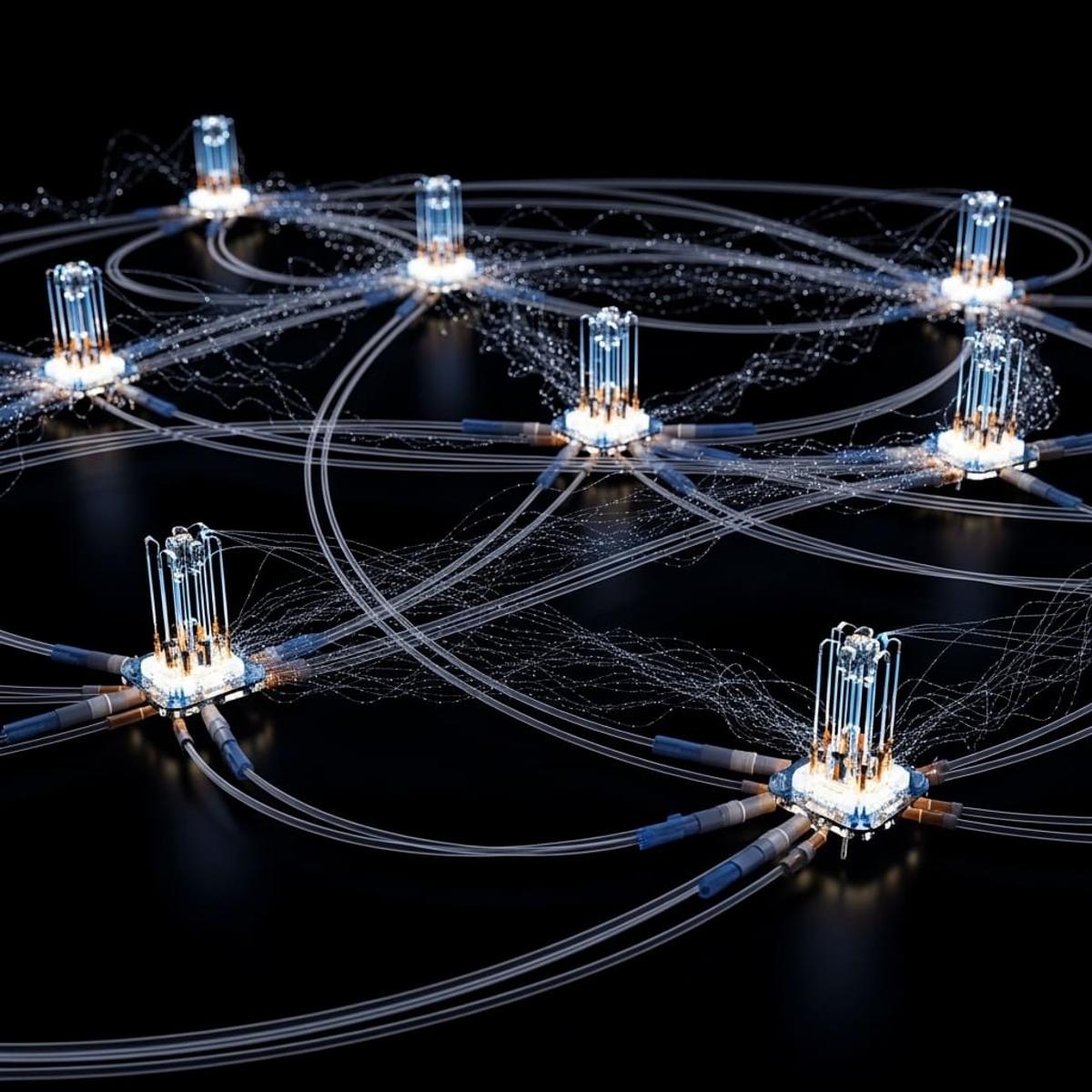
Quantum Networks Share ‘Spooky Action’ Across Multiple Connections Simultaneously
•February 5, 2026
0
Why It Matters
The ability to share and preserve quantum nonlocality across multiple branches paves the way for scalable, secure quantum communication and distributed quantum computing architectures.
Key Takeaways
- •Analytical bipartite correlator works for any measurement settings
- •Enables simultaneous Bell violations in multi‑branch star networks
- •(2,2,465) configuration shows higher robustness than smaller settings
- •Framework extends beyond CHSH to Vértesi and other inequalities
- •Supports scalable quantum communication and distributed computation
Pulse Analysis
Quantum nonlocality, once confined to simple bipartite experiments, is rapidly emerging as a resource for complex networked systems. By formulating a closed‑form bipartite correlator that tolerates any number of measurement settings and weak‑measurement strengths, the authors eliminate a major computational bottleneck that has limited prior analyses. This analytical breakthrough allows researchers to map Bell‑type violations onto star‑network architectures with multiple independent branches, opening a systematic path to explore how entanglement can be distributed and reused across many nodes.
In the experimental realization, a 72‑qubit superconducting processor was programmed to emulate a generalized star network with two branches, each containing sequential weak measurements followed by sharp projective reads. The team tuned optimal weak‑measurement parameters to maximize quantum correlations, achieving simultaneous Bell violations for configurations (2, 2, 6) and the far more demanding (2, 2, 465). The latter displayed a broader tolerance to noise and measurement imperfections, confirming that increasing the number of settings does not necessarily degrade nonlocality when the appropriate inequality—here, Vértesi’s—is employed. These results demonstrate that large‑scale, multi‑branch quantum networks can retain quantum advantages without prohibitive resource overhead.
The implications extend beyond academic curiosity. Robust network‑nonlocality is a cornerstone for device‑independent quantum key distribution, fault‑tolerant distributed quantum computation, and quantum internet protocols that require entanglement sharing among many parties. By providing a versatile analytical toolkit compatible with diverse Bell families, the study equips engineers to design networks that balance measurement complexity against resilience. Future work will likely address noisy entangled sources, heterogeneous weak‑measurement schemes, and integration with error‑corrected quantum processors, accelerating the transition from laboratory demonstrations to real‑world quantum infrastructure.
Quantum Networks Share ‘spooky Action’ across Multiple Connections Simultaneously
0
Comments
Want to join the conversation?
Loading comments...