Quantum Random Number Generator Achieves 10σ Contextuality Violation On-Chip

Key Takeaways
- •10σ KCBS violation confirms genuine quantum randomness
- •21.7 bits s⁻¹ generation rate exceeds many DI QRNGs
- •Semi‑device‑independent design reduces trust assumptions
- •Integrated silicon photonics shrinks QRNG hardware size
- •Enables on‑chip randomness for quantum communication
Pulse Analysis
The rise of quantum‑ready cryptography has intensified demand for provably random numbers, yet most device‑independent generators require bulky entangled sources and strict spacelike separation. By exploiting quantum contextuality—a non‑classical correlation that does not rely on entanglement—the new QRNG sidesteps these constraints. The researchers implemented the KCBS inequality on a reconfigurable silicon photonic mesh, achieving a statistical violation beyond ten standard deviations. This level of confidence permits a rigorous, semi‑device‑independent certification of each bit’s entropy, bridging the gap between theoretical security and engineering practicality.
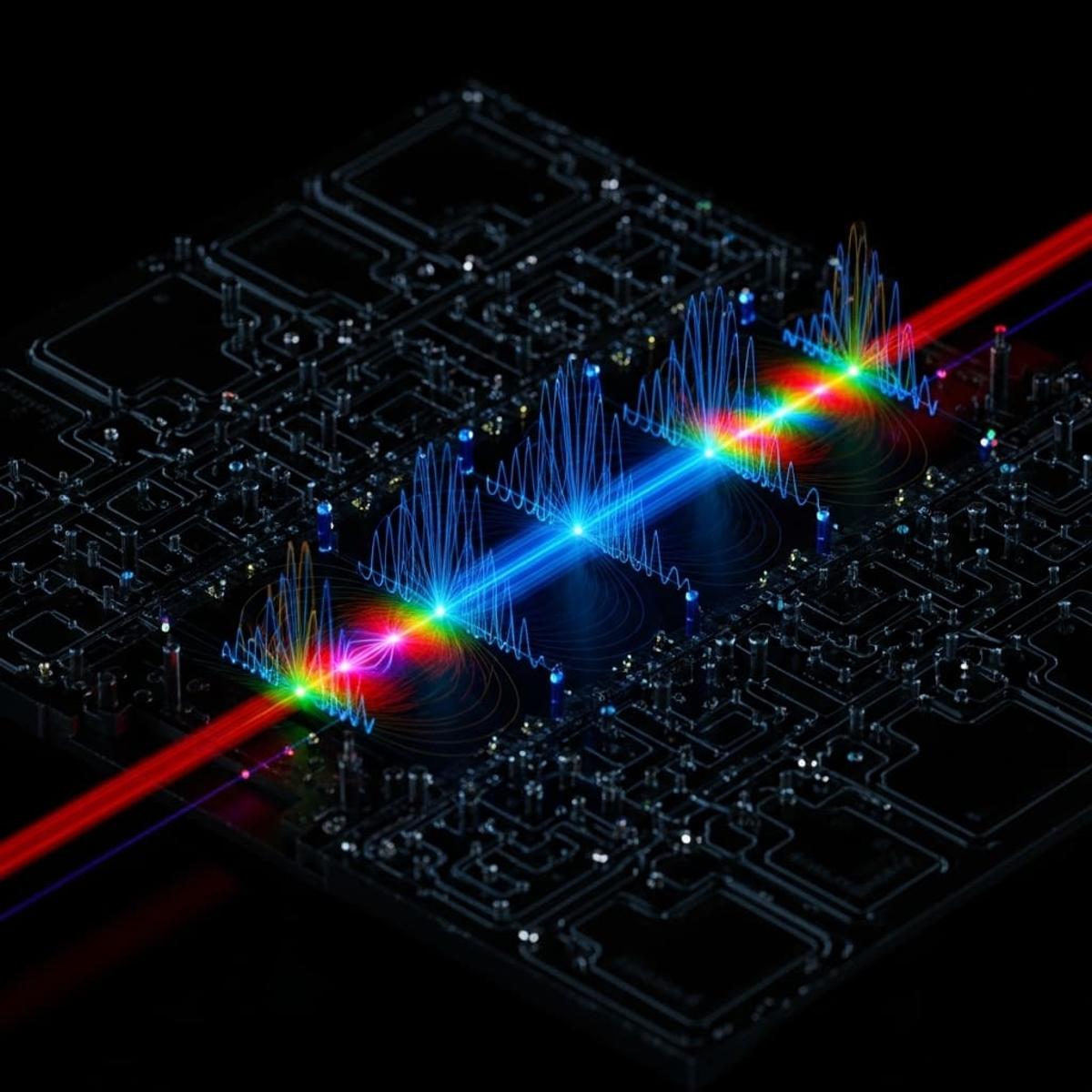
Integrated photonics is the linchpin of the system’s scalability. Two silicon chips host a heralded single‑photon source and a 72‑cell interferometric processor, each cell offering precise Mach‑Zehnder control. Losses are managed through careful coupling, and the platform supports arbitrary SU(2) transformations, enabling reliable qutrit state preparation and measurement. The resulting conditional min‑entropy of 0.077 bits per round yields a steady 21.7 bits per second, a rate that rivals many fully device‑independent prototypes while occupying a fraction of the physical space.
The commercial implications are immediate. A compact, certified QRNG can be embedded directly into quantum key distribution modules, secure cloud hardware, and high‑performance Monte Carlo simulators without exposing the system to entanglement‑related vulnerabilities. As silicon photonic foundries mature, throughput can be boosted by brighter photon sources and optimized mesh designs, potentially reaching hundreds of kilobits per second. This work therefore marks a pivotal step toward mass‑deployable quantum randomness, reinforcing the security backbone of next‑generation digital infrastructure.
Quantum Random Number Generator Achieves 10σ Contextuality Violation On-Chip
Comments
Want to join the conversation?