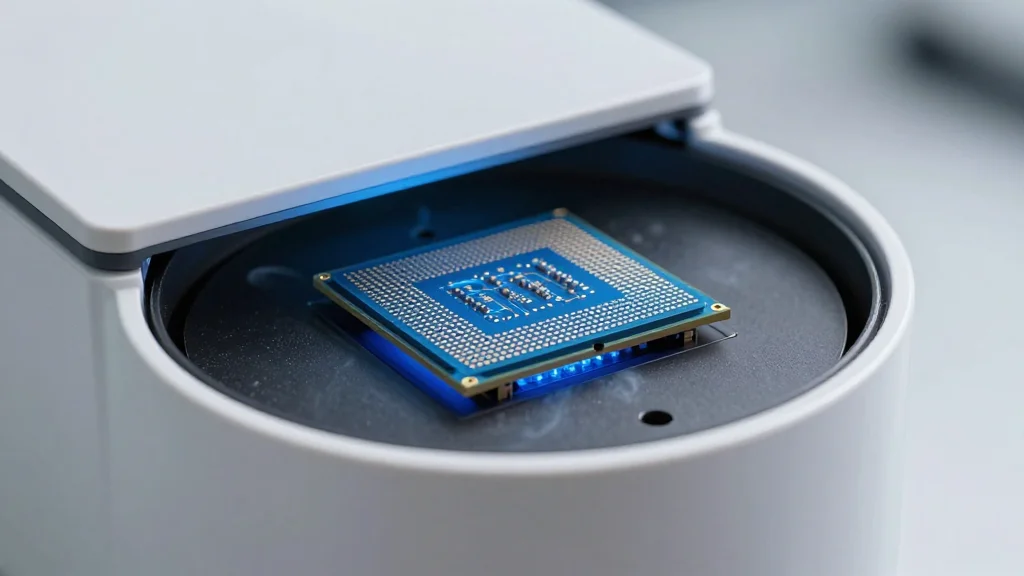
Quantum Science Center Researchers Demonstrate First Digital Quantum Simulation of Spin Transport
Why It Matters
The breakthrough demonstrates that noisy intermediate‑scale quantum (NISQ) devices can now tackle realistic many‑body physics, opening pathways for quantum‑driven materials design and next‑generation spintronic technologies.
Key Takeaways
- •40‑qubit IBM Heron run achieved O(N) measurement algorithm.
- •Simulated ballistic, diffusive, superdiffusive regimes in 1D Heisenberg chain.
- •Direct‑measurement method reduced gate count to ~1,900 two‑qubit gates.
- •Enables quantum‑enabled design of spintronic materials beyond classical limits.
Pulse Analysis
The ability to simulate spin transport on a quantum processor marks a pivotal moment for quantum computing and condensed‑matter physics. Traditional classical methods struggle with the exponential growth of Hilbert space in many‑body systems, limiting accurate predictions for low‑dimensional quantum materials. By leveraging a 40‑qubit architecture and a mid‑circuit measurement (MCM) algorithm, the Quantum Science Center team sidestepped the costly Hadamard test, achieving linear scaling in gate complexity. This technical leap not only showcases the maturity of NISQ hardware but also validates quantum simulation as a credible complement to high‑performance computing.
At the heart of the experiment lies a direct‑measurement protocol that inserts real‑time measurements within the circuit, collapsing ancillary qubits and re‑using them for subsequent operations. This approach trimmed the circuit depth to roughly 100 layers and kept two‑qubit gate counts under 2,000, a threshold that current error‑mitigation techniques can handle. The researchers mapped the Heisenberg Hamiltonian across varying anisotropy parameters, reproducing three transport regimes—ballistic, diffusive, and superdiffusive—each aligning with theoretical predictions and experimental benchmarks from materials like potassium copper fluoride (KCuF₃). The fidelity of Drude weight and diffusion‑coefficient scaling underscores the method’s quantitative accuracy.
For industry, the implications are profound. Spintronic devices rely on precise control of electron spin currents, yet designing materials with optimal transport properties has been hampered by computational bottlenecks. Quantum simulations that can predict spin‑current autocorrelation functions in real time offer a new design toolkit, potentially accelerating the development of low‑power, high‑speed electronics. The QSC team’s roadmap includes extending the methodology to two‑dimensional lattices and thermal‑transport problems, challenges that outstrip classical supercomputers. As quantum hardware scales and error rates decline, enterprises that integrate quantum‑enabled materials modeling could secure a competitive edge in next‑generation semiconductor and sensor markets.
Quantum Science Center Researchers Demonstrate First Digital Quantum Simulation of Spin Transport
Comments
Want to join the conversation?
Loading comments...