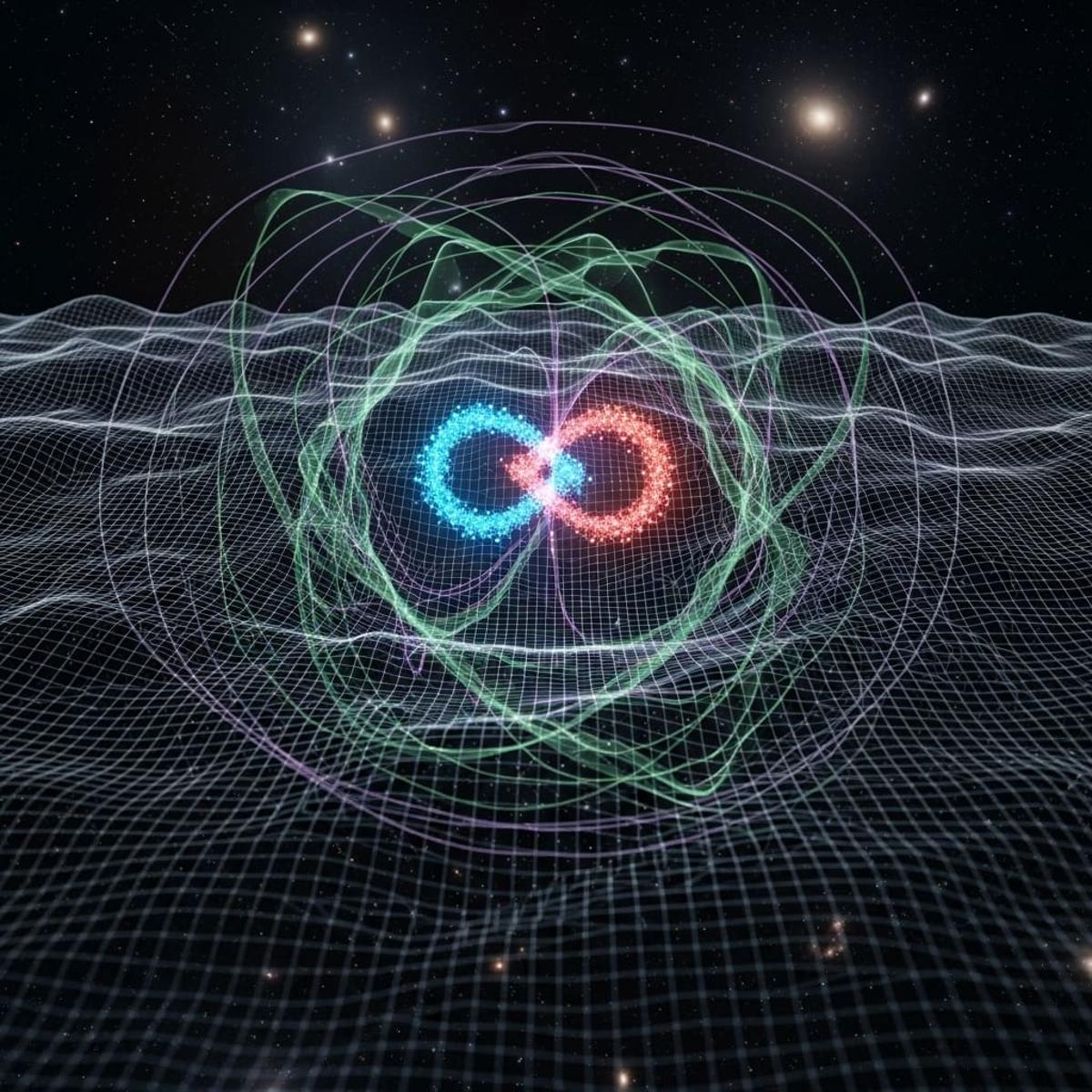
Quantum Teleportation Fidelity Assessed in Expanding Friedmann-Robertson-Walker Universes with Scalar Fields

Key Takeaways
- •Expansion degrades teleportation fidelity for super‑horizon modes
- •Higher initial entanglement mitigates cosmological decoherence
- •Power‑law and de Sitter expansions show distinct fidelity trends
- •Low‑frequency modes are most vulnerable to curvature effects
- •Results inform space‑based quantum communication design
Pulse Analysis
The prospect of a global quantum internet now extends beyond terrestrial fiber to orbiting platforms and deep‑space missions. As quantum key distribution and teleportation move into low‑Earth orbit and eventually interplanetary links, the underlying spacetime is no longer perfectly flat. Researchers therefore must quantify how relativistic phenomena—such as time‑dependent expansion, gravitational redshift, and horizon effects—alter the fidelity of entanglement‑based protocols. Recent studies of Friedmann‑Robertson‑Walker universes provide a realistic testbed, showing that even modest cosmological curvature can introduce measurable noise into quantum channels.
From a theoretical standpoint, linking quantum information to cosmology opens a two‑way diagnostic channel. The Bogoliubov transformations that describe particle creation in expanding backgrounds also dictate how mode entanglement evolves, turning the universe itself into a noisy quantum channel. By mapping the degradation of teleportation fidelity onto an effective thermal‑like squeezing operation, physicists can extract cosmological parameters—such as the Hubble rate or power‑law exponent—from purely informational measurements. This synergy suggests that future quantum‑enabled telescopes might probe the early universe’s expansion history without relying on traditional electromagnetic observations.
Practically, the findings guide the engineering of resilient space‑based quantum links. Selecting higher‑frequency photonic modes, which remain sub‑horizon throughout the mission, preserves fidelity, while boosting the initial entanglement strength counteracts expansion‑induced decoherence. Adaptive error‑correction codes that model the cosmological noise as a Gaussian thermal channel can further safeguard transmitted qubits. As satellite constellations mature and quantum payloads become standardized, incorporating curvature‑aware protocol designs will be essential for achieving reliable teleportation across planetary distances and, eventually, for interstellar quantum networking.
Quantum Teleportation Fidelity Assessed in Expanding Friedmann-Robertson-Walker Universes with Scalar Fields
Comments
Want to join the conversation?