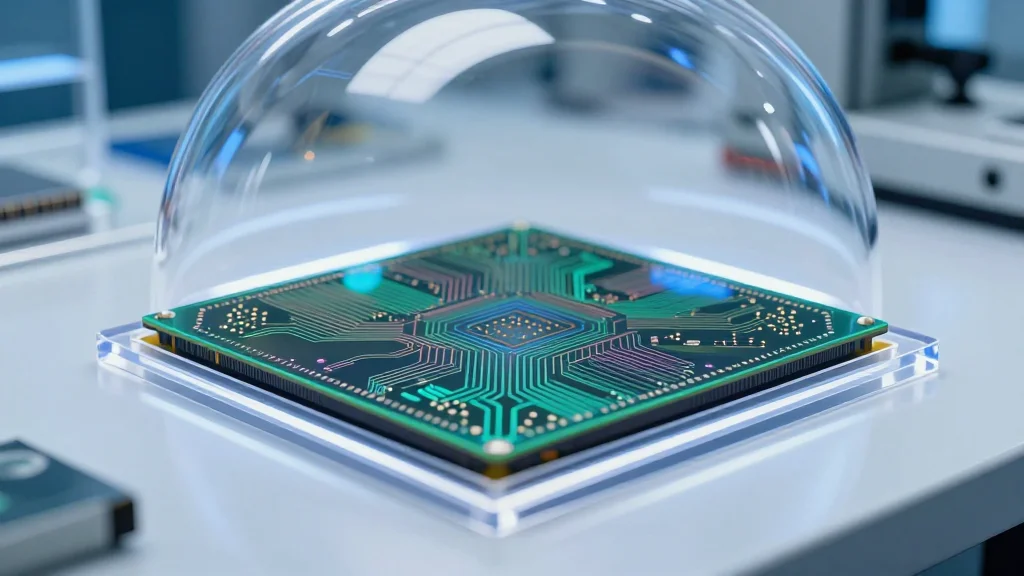
QuantWare Secures $178 Million Series B to Build Industrial‑Scale Quantum Processors

Companies Mentioned
Why It Matters
QuantWare’s funding round signals the first time a pure‑play quantum‑processor company has attracted capital on the scale of a major semiconductor fab. By decoupling chip design from manufacturing, the firm could democratize access to high‑qubit processors, accelerating research, drug discovery, and materials simulation that depend on quantum advantage. Moreover, the involvement of Intel Capital and the CIA‑backed IQT underscores growing strategic interest from both commercial and national‑security stakeholders, suggesting that industrial‑scale quantum hardware is becoming a critical infrastructure asset. If QuantWare can deliver on its 10,000‑qubit roadmap, it will redefine the performance ceiling for superconducting systems and force larger players to reconsider their vertically integrated strategies. The KiloFab model may also inspire similar dedicated fabs in Europe and Asia, fostering a more diversified global supply chain and reducing reliance on a handful of technology giants.
Key Takeaways
- •QuantWare raised €152 million ($178 million) in a Series B round led by Intel Capital.
- •New investors include In‑Q‑Tel (IQT), ETF Partners and existing backers Forward.one and Invest‑NL.
- •Funding will finance KiloFab, a dedicated quantum open‑architecture fab in Delft, boosting capacity ~20×.
- •VIO‑40K architecture targets 10,000‑qubit processors, 100 × larger than current commercial designs.
- •QuantWare now claims the title of world’s largest commercial QPU supplier by volume, serving 50+ customers in 20 countries.
Pulse Analysis
QuantWare’s $178 million raise is more than a financing event; it is a strategic inflection point for the quantum hardware ecosystem. Historically, quantum computing has been dominated by vertically integrated giants—IBM, Google, and Microsoft—who control both chip design and cloud delivery. QuantWare’s fab‑first approach mirrors the semiconductor revolution of the 1980s, where foundries like TSMC unlocked economies of scale and spurred a wave of fabless innovators. By offering an open‑architecture foundry service, QuantWare could catalyze a similar wave in quantum, enabling niche players to focus on algorithms and applications while outsourcing the most capital‑intensive step.
The involvement of Intel Capital and IQT adds a layer of credibility and strategic depth. Intel’s experience in scaling silicon manufacturing and IQT’s national‑security mandate suggest that QuantWare’s roadmap aligns with both commercial profitability and geopolitical imperatives. The 10,000‑qubit VIO‑40K target is ambitious, but if achieved, it would close the gap between experimental quantum advantage and practical, utility‑scale workloads. Competitors will now have to decide whether to double‑down on in‑house fabs or partner with a dedicated quantum foundry, potentially reshaping R&D budgets across the sector.
Looking ahead, the success of KiloFab will hinge on three factors: yield improvement at scale, ecosystem adoption of the VIO modular standard, and the ability to secure long‑term contracts from cloud providers and national labs. If QuantWare can demonstrate reliable, high‑fidelity production, it will not only validate the fab model but also accelerate the timeline for quantum‑enabled breakthroughs in chemistry, logistics and cryptography. The next funding round, likely in 2028 when VIO‑40K shipments commence, will be a litmus test for whether the market has truly embraced a dedicated quantum foundry as the backbone of the emerging quantum economy.
QuantWare Secures $178 Million Series B to Build Industrial‑Scale Quantum Processors
Comments
Want to join the conversation?
Loading comments...