QuEra 2026 Survey: 62% of Organizations Face Classical Limits as Production Deployment Stalls
•February 10, 2026
0
Companies Mentioned

Why It Matters
The findings highlight a bottleneck that could slow enterprise quantum adoption and reshape investment priorities toward talent development and realistic benchmarking.
Key Takeaways
- •62% hit classical computing limits
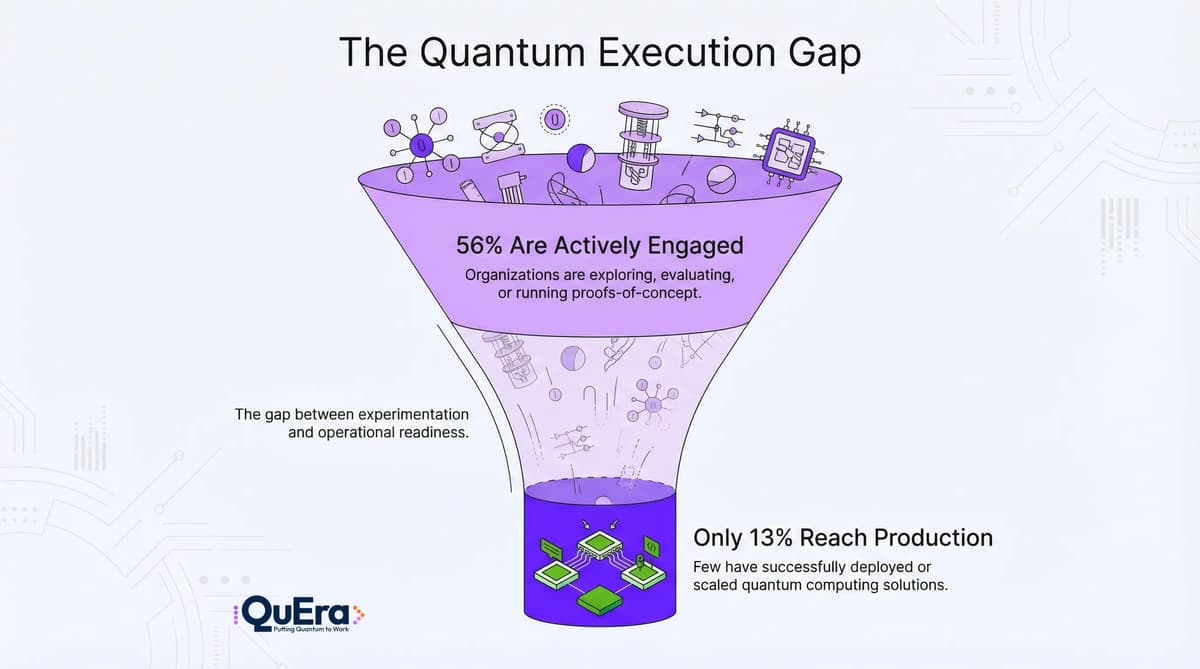
- •Only 13% deployed quantum solutions to production
- •Talent shortage cited by 37% as main barrier
- •UK confidence 88%, US 82%, EU 51%
- •42% of applications target simulation workloads
Pulse Analysis
The QuEra 2026 Quantum Readiness Survey underscores a widening execution gap that is reshaping how enterprises view quantum computing. Rather than chasing speculative breakthroughs, firms are now benchmarking quantum performance against concrete classical limits. The data shows that a majority of organizations are already feeling the pressure of classical bottlenecks, prompting a shift from exploratory pilots to results‑driven projects. This transition forces vendors to deliver verifiable speed‑ups and reliability, accelerating the maturation of quantum hardware and software ecosystems.
Talent scarcity is the survey's most striking barrier, with over a third of respondents naming workforce constraints as the primary hurdle. The "preparedness paradox"—where confidence in quantum readiness falls despite growing awareness—reflects a market that recognizes the complexity of integrating quantum processors into legacy IT stacks. Regional disparities further complicate the landscape: the United Kingdom and United States exhibit strong optimism, while the European Union's more cautious stance is tied to industrial sovereignty and stringent procurement rules. Companies that invest early in specialized quantum talent are likely to capture a competitive edge as the talent pool expands.
Despite deployment challenges, the survey reveals a clear strategic focus on simulation applications such as molecular modeling, protein folding, and battery chemistry—areas where classical approximations near physical limits. Nearly half of respondents anticipate achieving quantum superiority within five years, suggesting that long‑term value perception remains robust. For investors and technology providers, this signals a market ripe for targeted solutions that bridge the gap between experimental validation and production‑grade performance, reinforcing the importance of scalable talent pipelines and region‑specific go‑to‑market strategies.
QuEra 2026 Survey: 62% of Organizations Face Classical Limits as Production Deployment Stalls
0
Comments
Want to join the conversation?
Loading comments...