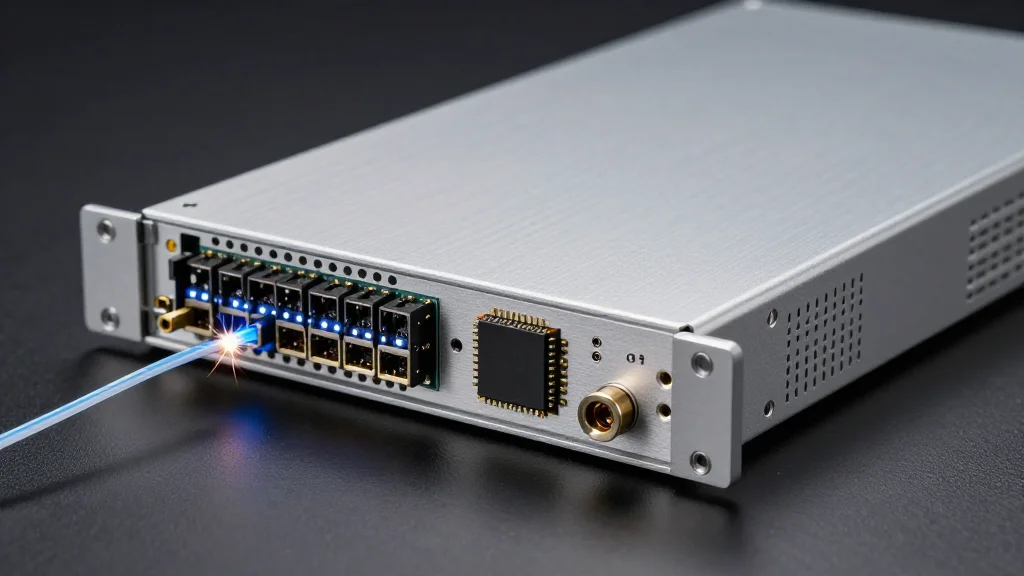
QuiX Quantum Installs Real-Time Feed-Forward Control Unit for Photonic Computing Architecture
Why It Matters
The sub‑nanosecond feed‑forward capability removes a key bottleneck in photonic quantum processors, enabling deterministic operations and scaling toward practical applications. This advancement brings photonic quantum hardware closer to seamless coupling with classical high‑performance and AI systems.
Key Takeaways
- •FFCU achieves 150 ns latency for photon‑based feed‑forward control.
- •Dual‑FPGA bus processes 32 inputs and 32 outputs simultaneously.
- •Real‑time reconfiguration stabilizes Mach‑Zehnder interferometers on chip.
- •Module completes QuiX Quantum’s universal photonic computing stack.
- •Enables integration of photonic quantum processors with classical HPC and AI.
Pulse Analysis
Photonic quantum computing has long been touted for its room‑temperature operation and low error rates, yet measurement‑based schemes have struggled with the need for ultra‑fast adaptive control. In such architectures, single‑photon detections must instantly dictate the configuration of downstream optical elements, a requirement that traditionally demanded manual calibration or slower electronic loops. The introduction of a dedicated feed‑forward control unit addresses this gap by translating detector signals into hardware‑level adjustments within a few hundred nanoseconds, effectively closing the timing loop before the next photon traverses the circuit.
The FFCU’s architecture leverages two tightly coupled FPGAs and a custom analog front‑end, providing 32 simultaneous input channels and 32 voltage outputs that can re‑phase Mach‑Zehnder interferometers on the fly. Its 150‑ns deterministic execution window corresponds to roughly 30 meters of fiber‑optic travel, ensuring that routing decisions are applied well ahead of the target photon’s arrival. Compared with competing approaches that rely on software‑driven feedback or slower ASICs, this hardware‑centric solution offers lower latency, higher determinism, and easier programmability, all of which are critical for scaling photonic qubit counts.
From a commercial perspective, the FFCU completes QuiX Quantum’s full‑stack offering, allowing customers to deploy a single, programmable platform that spans photon generation to quantum‑classical interfacing. This integration opens pathways for co‑location with existing high‑performance computing clusters and AI accelerators, where quantum‑enhanced subroutines could accelerate optimization or sampling tasks. As venture capital and government programs pour funding into quantum photonics, the ability to deliver real‑time control at nanosecond scales positions QuiX as a potential supplier for research labs, cloud quantum services, and future enterprise‑grade quantum data centers.
QuiX Quantum Installs Real-Time Feed-Forward Control Unit for Photonic Computing Architecture
Comments
Want to join the conversation?
Loading comments...