Quobly Toolbox Explores Quantum Phase Estimation Pipeline With Tensor Networks

Key Takeaways
- •Open‑source QPE toolbox simulates up to 20 qubits on laptops
- •Supports circuits of 1,000–100,000 gates using tensor‑network techniques
- •Enables direct comparison of standard QPE and Robust Phase Estimation
- •Integrates DMRG ground‑state preparation via the quimb library
- •Aims to inform fault‑tolerant algorithm development for chemistry
Pulse Analysis
Quantum Phase Estimation is a cornerstone algorithm for fault‑tolerant quantum computing, promising exponential speed‑ups in chemistry and materials science. Yet, the practical resource demands—circuit depth, gate count, and error tolerance—remain opaque, limiting experimental validation and roadmap planning. Researchers have traditionally relied on abstract cost models that ignore hardware constraints, creating a disconnect between theoretical promise and engineering reality. A simulation environment that faithfully reproduces these demands on modest hardware is therefore essential for the field’s maturation.
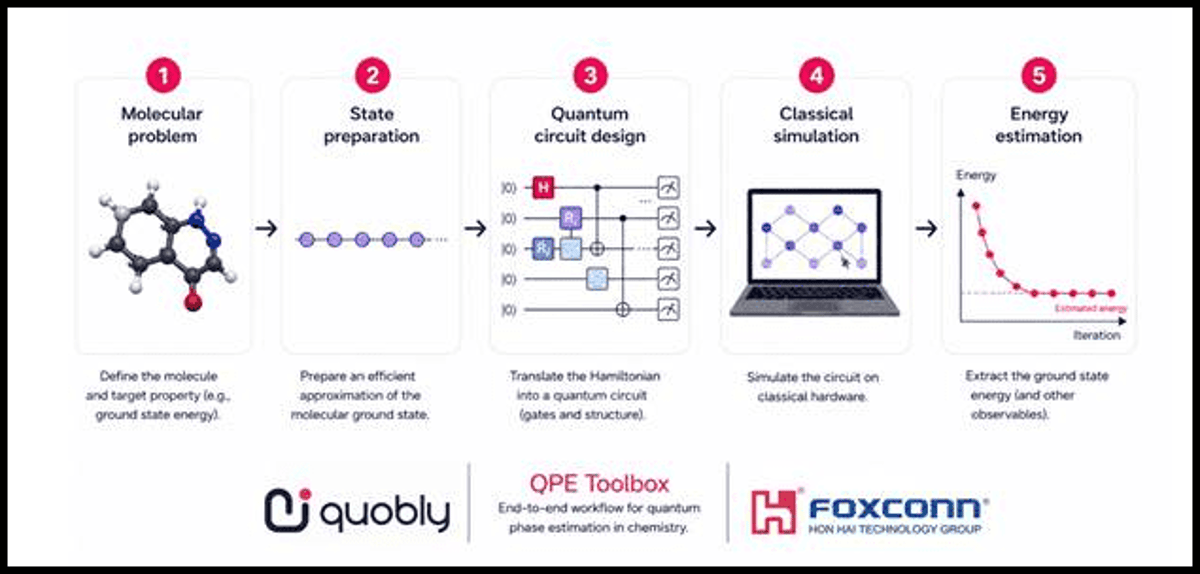
The newly released toolbox from Quobly and Hon Hai Research Institute fills that void by marrying advanced tensor‑network techniques with the open‑source quimb library. Users can prepare molecular ground states using Density Matrix Renormalization Group (DMRG) and encode Hamiltonians through trotterization or qubitization, then run full QPE circuits of up to 20 qubits and 100,000 gates on a laptop. The platform also includes the single‑ancilla Robust Phase Estimation variant, allowing side‑by‑side performance and error analysis. By delivering interpretable numerical experiments without requiring access to scarce quantum hardware, the toolbox democratizes exploration of fault‑tolerant algorithms.
For industry and academia, the impact is twofold. First, it accelerates algorithm‑hardware co‑design by providing realistic benchmarks that inform qubit architecture, error‑correction thresholds, and gate‑set optimization. Second, it lowers the entry barrier for quantum chemistry groups to test and refine QPE‑based workflows, potentially shortening the timeline for practical quantum advantage. As quantum processors scale, tools like this will become indispensable for translating theoretical breakthroughs into deployable applications, reinforcing the strategic partnership between startups and established manufacturers in the emerging quantum ecosystem.
Quobly Toolbox Explores Quantum Phase Estimation Pipeline With Tensor Networks
Comments
Want to join the conversation?