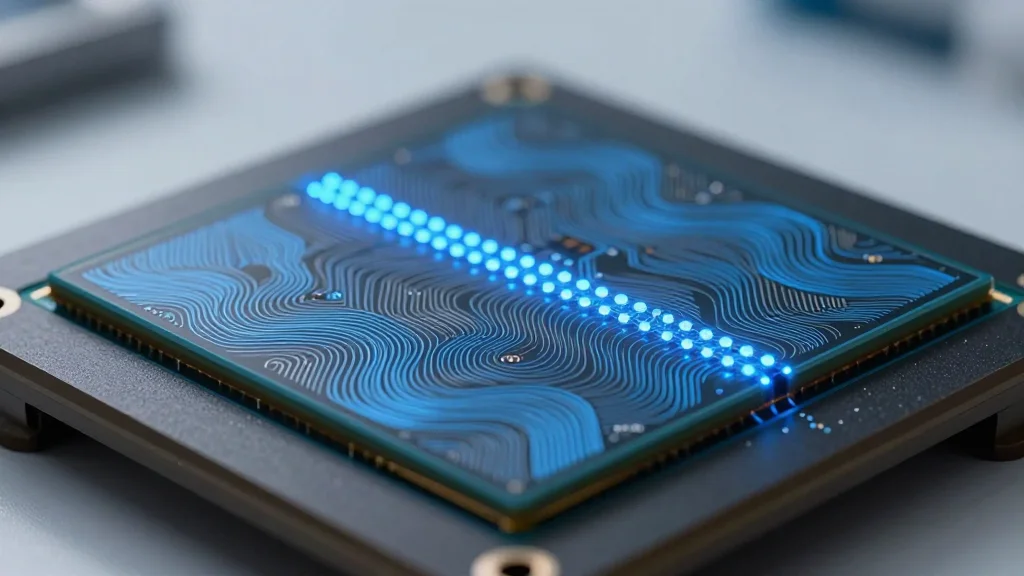
QuTech Demonstrates 99% Fidelity Logic and Qubit Teleportation on Silicon Conveyor‑Belt Chip

Why It Matters
The experiment directly addresses a long‑standing scalability hurdle: static qubits force quantum processors into rigid, lattice‑like architectures that inflate the overhead for error correction. By proving that high‑fidelity gates and teleportation are possible with mobile qubits, QuTech opens a pathway to more flexible chip layouts, potentially reducing the number of physical qubits needed for fault‑tolerant computation. Moreover, silicon’s compatibility with mature semiconductor fabs could translate laboratory breakthroughs into manufacturable devices faster than competing platforms. For the broader quantum ecosystem, the result signals that silicon‑based quantum computing is no longer a niche research area but a viable contender for large‑scale deployment. Venture capital and corporate R&D budgets, which have heavily favored superconducting and trapped‑ion approaches, may now allocate more resources toward silicon spin‑qubit technologies, spurring a diversification of the quantum hardware market.
Key Takeaways
- •QuTech achieved 98.86% average fidelity for two‑qubit CZ gates on moving electron‑spin qubits.
- •Quantum state teleportation was demonstrated over 320 nm (five quantum dots) on a silicon chip.
- •Gate operation time was 58 ns, despite an initial qubit separation of 270 nm.
- •The “conveyor‑belt” shuttling uses phase‑shifted sinusoidal voltages to create a travelling wave potential.
- •Mobile qubits could reduce the overhead of quantum error‑correction codes and leverage CMOS manufacturing.
Pulse Analysis
QuTech’s conveyor‑belt architecture redefines how quantum processors might be built in silicon. Historically, the field has been split between static‑qubit platforms—superconducting circuits with fixed couplers and trapped ions linked by laser beams—and emerging spin‑qubit approaches that promise integration with existing chip‑making processes. The key advantage of mobility is architectural freedom: qubits can be repositioned on demand, allowing logical operations that would otherwise require long chains of swap gates. This reduces circuit depth and error accumulation, two critical factors for near‑term quantum advantage.
From a market perspective, the demonstration could catalyze a shift in investment patterns. Silicon spin qubits have attracted modest funding compared with the billions poured into superconducting giants like IBM and Google. A clear, reproducible pathway to high‑fidelity, fast gates on a platform that can be fabricated in high‑volume fabs may entice both venture capital and large semiconductor players seeking a foothold in quantum computing. The ability to perform teleportation on‑chip also hints at future modular architectures where quantum information can be routed dynamically, akin to data packets in classical processors.
Looking ahead, the real test will be scaling the conveyor‑belt length and integrating many parallel lanes without sacrificing coherence. If QuTech can demonstrate multi‑gate algorithms and error‑corrected logical qubits within the same moving‑qubit framework, silicon could emerge as the most cost‑effective route to fault‑tolerant quantum computers. Until then, the breakthrough stands as a compelling proof‑of‑concept that challenges the dominance of static‑qubit designs and expands the strategic options for the quantum hardware race.
QuTech Demonstrates 99% Fidelity Logic and Qubit Teleportation on Silicon Conveyor‑Belt Chip
Comments
Want to join the conversation?
Loading comments...