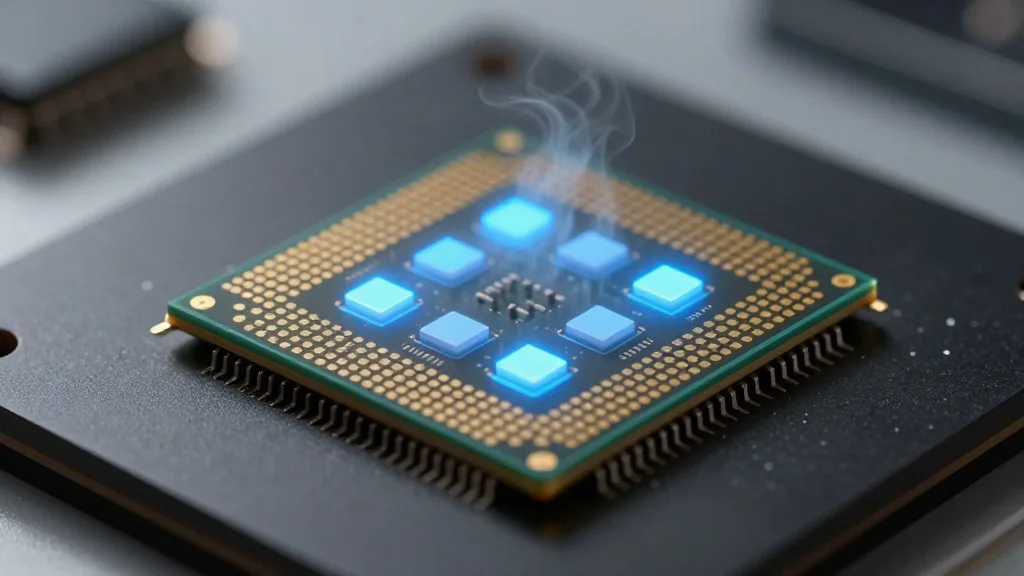
Randomization Can Improve Quantum Computer Performance in Presence of Noise
Why It Matters
Enhanced noise suppression directly extends the usable depth of quantum circuits, accelerating progress toward practical quantum advantage. The simplicity of integration lowers barriers for industry and academic labs to improve device performance.
Key Takeaways
- •Randomized dynamical decoupling outperforms deterministic protocols
- •Technique integrates easily with existing quantum hardware
- •Research published in Physical Review Letters, presented at QSim 2025
- •Improves noise suppression, boosting quantum algorithm reliability
Pulse Analysis
Quantum computers promise exponential speed‑ups for problems ranging from material discovery to cryptographic analysis, yet their fragile qubits are constantly bombarded by environmental noise. Conventional error‑mitigation strategies—such as deterministic dynamical decoupling sequences—have reduced decoherence but often require finely tuned pulse schedules that are difficult to scale across heterogeneous devices. As a result, the depth of quantum circuits that can be executed reliably remains limited, slowing the transition from laboratory prototypes to commercially viable processors. Researchers therefore continue to explore control techniques that can deliver robust noise suppression without imposing heavy engineering overhead.
The University of New Mexico team, led by Ph.D. candidate Leeseok Kim, introduced a “Faster Randomized Dynamical Decoupling” protocol that injects stochastic variations into the pulse sequence. By randomizing the timing and axis of control operations, the method statistically averages out correlated error sources, achieving lower error rates than any known deterministic counterpart. Experimental simulations reported in Physical Review Letters show a measurable improvement in coherence times across several benchmark algorithms. Crucially, the technique can be overlaid onto existing hardware with minimal firmware changes, preserving the architecture of current superconducting and trapped‑ion platforms.
From a business perspective, the ability to boost circuit fidelity without costly redesign accelerates the roadmap toward quantum advantage in sectors such as pharmaceuticals, finance, and logistics. Companies that integrate randomized decoupling can expect longer algorithmic runtimes, reducing the number of physical qubits needed for error‑corrected computation. The research also opens new avenues for hybrid error‑mitigation frameworks that combine stochastic control with machine‑learning‑driven pulse optimization. As the technique gains traction, it is likely to become a standard component of quantum software stacks, shaping the next generation of scalable quantum processors.
Randomization can improve quantum computer performance in presence of noise
Comments
Want to join the conversation?
Loading comments...