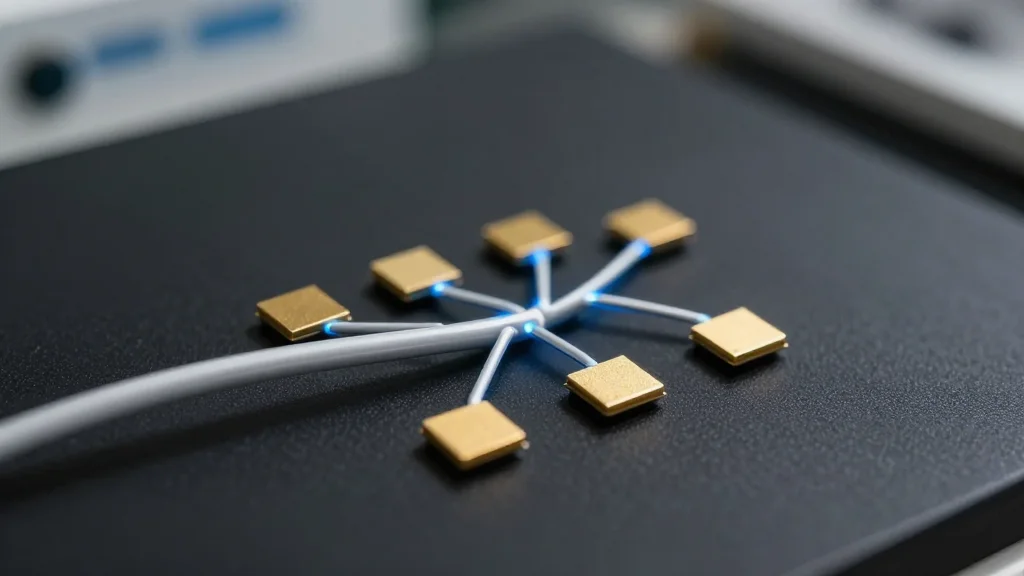
Reducing Wires in Quantum Computers
Why It Matters
Reducing the number of control wires lessens thermal load and physical congestion inside dilution refrigerators, enabling larger, more reliable quantum processors and accelerating the path toward fault‑tolerant quantum computing.
Key Takeaways
- •Time multiplexing shares one wire among multiple qubits with minor slowdown
- •Scheduling hides multiplexing delay behind longer two‑qubit gate operations
- •Wire reduction eases heat load and space in dilution refrigerators
- •Results suggest negligible performance loss for typical superconducting architectures
- •Study motivates building cryogenic electronic switches for scalable quantum control
Pulse Analysis
The rapid expansion of superconducting quantum processors has exposed a practical obstacle: each qubit traditionally requires its own microwave control line, flooding dilution refrigerators with hundreds of wires that introduce heat and occupy valuable space. Engineers have long explored multiplexing as a remedy, but concerns about added latency have stalled adoption. Time multiplexing, which interleaves control pulses on a shared line, promises to shrink the wiring bundle, yet the prevailing assumption was that it would multiply execution time, eroding the fragile quantum advantage.
In the recent PRX Quantum paper, researchers from Chalmers University and collaborators modeled a generic superconducting architecture equipped with cryogenic switches at the wire termini. By aligning fast single‑qubit gates with the idle periods of slower two‑qubit gates, they demonstrated that the effective overhead of time multiplexing can be hidden within the natural gate schedule. Simulations across typical connectivity graphs showed slowdown percentages well below 5% and, in many configurations, virtually zero impact. This counter‑intuitive result stems from the fact that two‑qubit operations dominate the critical path, leaving ample slack for multiplexed single‑qubit commands.
The implications extend beyond academic curiosity. A reduction in wiring directly translates to lower thermal influx, simplifying refrigerator design and reducing cooling power requirements—both costly factors for commercial quantum services. Moreover, the study’s validation of negligible performance loss provides a clear incentive for hardware vendors to invest in cryogenic electronic switches, a component that has so far lagged behind qubit fidelity improvements. As the industry targets processors with thousands of qubits, time multiplexing could become a cornerstone technology, unlocking denser qubit arrays and accelerating the rollout of practical quantum computing solutions.
Reducing Wires in Quantum Computers
Comments
Want to join the conversation?
Loading comments...