Researchers Achieve STVP Angular Momentum Quantification Using a 1-Loop Particle Model

Key Takeaways
- •1-loop particle model quantifies STVP orbital angular momentum.
- •Origin choice determines transverse OAM magnitude.
- •Model matches complex wave‑based calculations.
- •Enables intuitive design of vortex‑based optical devices.
- •Potential extensions to acoustics and quantum systems.
Pulse Analysis
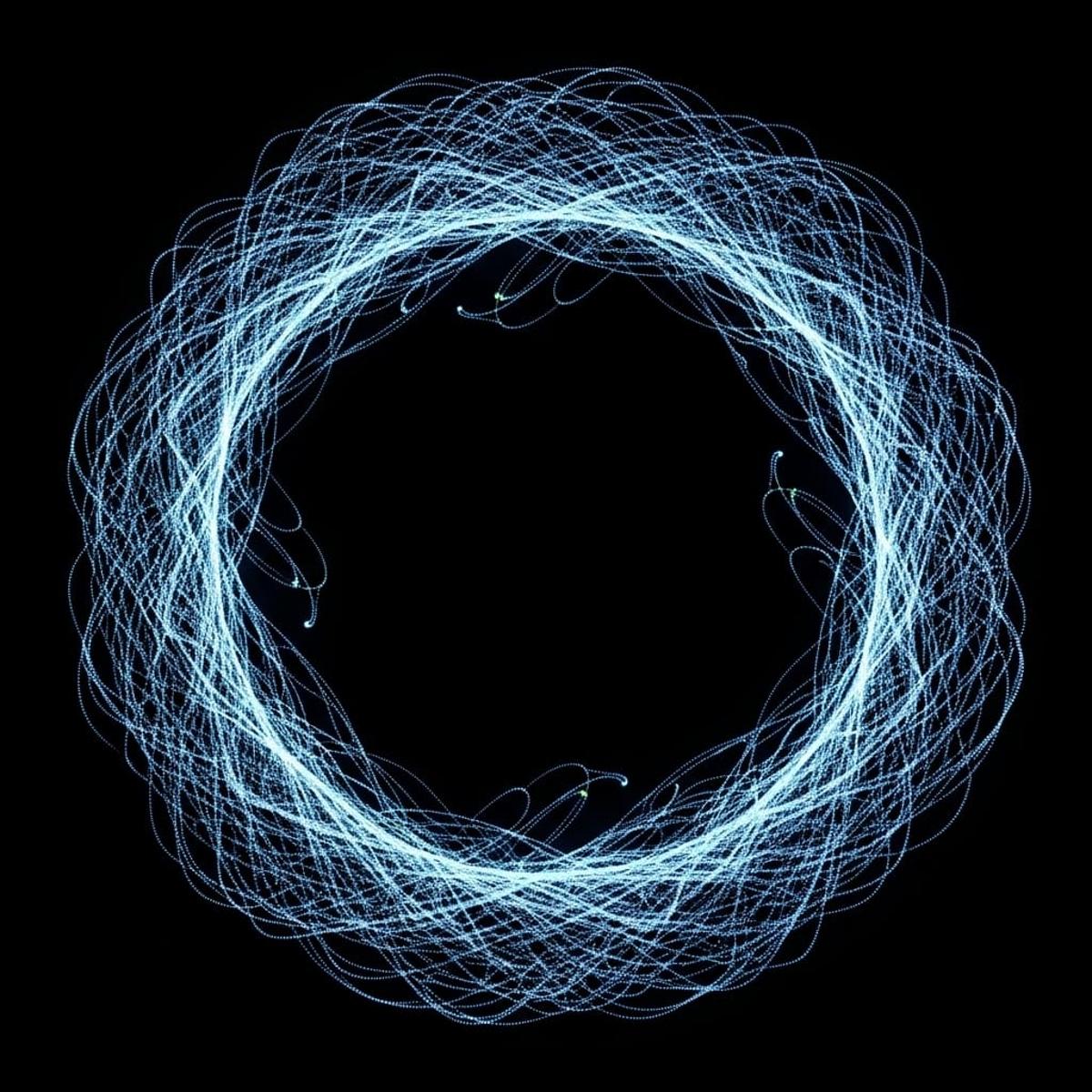
Spatiotemporal vortex pulses have emerged as a versatile carrier of orbital angular momentum, promising breakthroughs in optical tweezers, high‑capacity communications, and ultrafast imaging. Yet, the community has grappled with inconsistent transverse OAM values, largely because traditional wave‑based formalisms are mathematically intensive and sensitive to the chosen reference frame. The new particle‑loop approach reframes STVPs as a simple closed trajectory of massless particles, allowing researchers to apply familiar ray‑optics concepts while preserving the essential physics of angular momentum transfer.
The core insight of the study lies in recognizing that the coordinate origin dictates how transverse OAM is partitioned across the vortex structure. By explicitly incorporating origin dependence into the particle dynamics, the model resolves discrepancies that have plagued earlier theoretical treatments. Validation against both analytical solutions and high‑resolution numerical simulations demonstrates that the loop model reproduces the same OAM spectra as full‑wave calculations, but with dramatically reduced computational overhead. This alignment confirms that a minimalist mechanical analogy can capture the subtleties of spatiotemporal vortex behavior without sacrificing accuracy.
Beyond optics, the methodology offers a template for cross‑disciplinary vortex research. Acoustic vortices, electron beams, and even matter‑wave condensates exhibit analogous swirling phase structures, and a particle‑loop representation could streamline their analysis as well. For industry, the model’s transparency accelerates prototype development for OAM‑multiplexed communication links and optomechanical actuators, lowering barriers to commercialization. Future work that integrates particle interactions or nonlinear media promises to expand the model’s relevance, positioning it as a foundational tool in the broader vortex‑physics toolkit.
Researchers Achieve STVP Angular Momentum Quantification Using a 1-Loop Particle Model
Comments
Want to join the conversation?