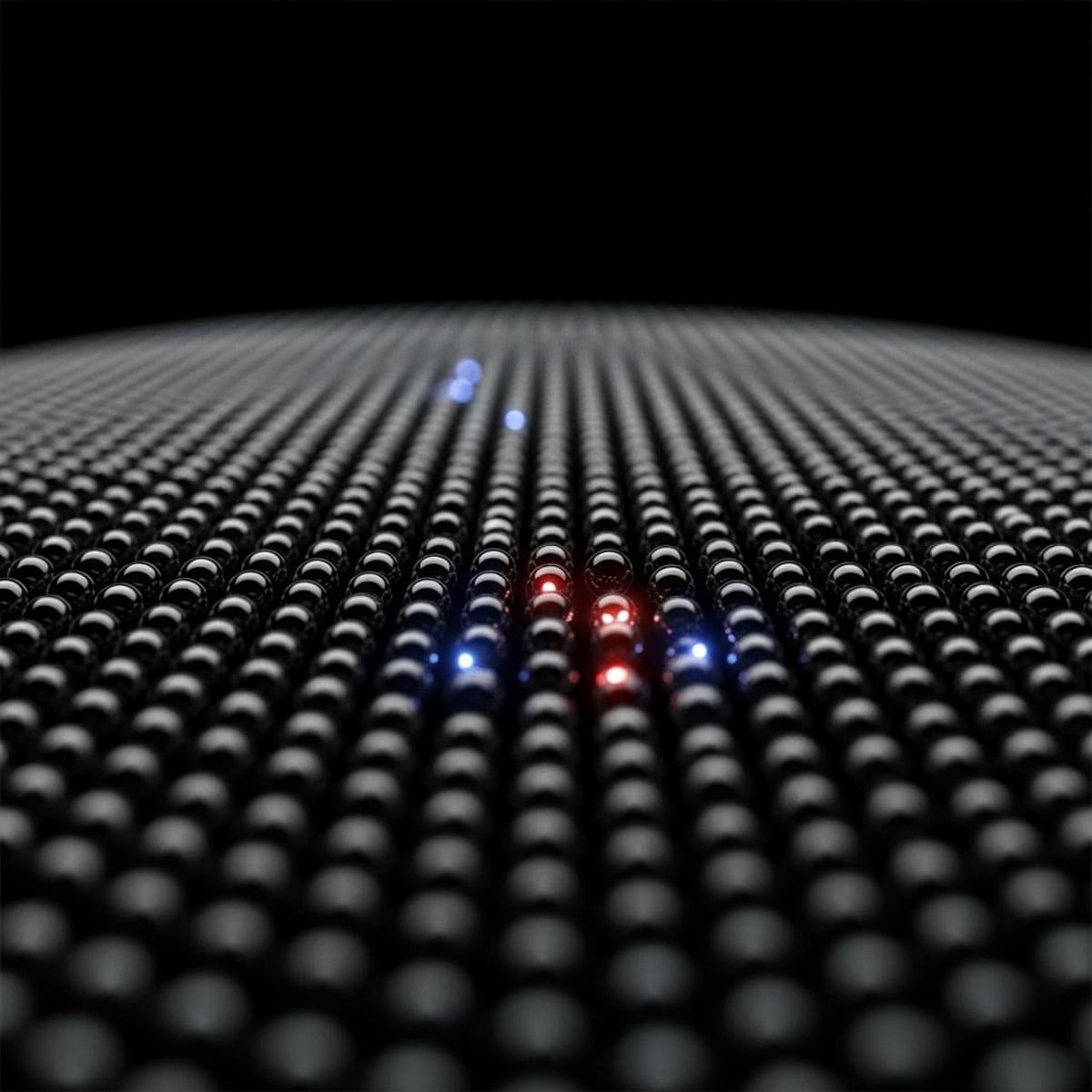
Researchers Identify Sp Dangling Bonds on H-C(100) Surfaces for Diamond Technologies
•February 2, 2026
0
Why It Matters
Accurate detection of sp³ dangling bonds directly improves NV‑centre coherence and enables scalable fabrication of high‑performance diamond quantum sensors and computers.
Key Takeaways
- •STS distinguishes sp3 dangling bonds from benign surface features
- •Band bending from boron doping skews STS energy calibration
- •+3 V tunnelling onset marks unoccupied mid‑gap orbital
- •Negative‑bias peak reflects occupied orbital near valence band
- •Enables atomically precise diamond device fabrication and NV‑center optimization
Pulse Analysis
Diamond’s unrivaled thermal conductivity and wide band gap have made it a premier platform for quantum sensors and computers, yet surface imperfections remain a bottleneck. Among these, sp³ dangling bonds—created when hydrogen atoms are removed—introduce paramagnetic noise and charge traps that degrade the coherence of near‑surface nitrogen‑vacancy (NV) centres. Traditional microscopy can image surface topography but lacks the energy resolution needed to differentiate these electrically active defects, leaving manufacturers without a reliable tool to assess and mitigate their impact.
The breakthrough reported by Oberg, Sung, Weber and colleagues leverages scanning tunnelling spectroscopy (STS) to probe the electronic fingerprint of individual dangling bonds. By conducting STS under ultra‑high vacuum on boron‑doped, hydrogen‑terminated diamond and aligning the spectra with first‑principles density‑functional theory, the team isolated two hallmark features: a +3 V tunnelling onset corresponding to a mid‑gap unoccupied state, and a bias‑sensitive negative‑peak tied to an occupied valence‑band orbital. Crucially, they modeled the pronounced band‑bending induced by boron doping, allowing precise energy calibration that previous STM studies lacked. This methodological rigor transforms STS from a qualitative imaging tool into a quantitative defect‑characterisation technique.
For the quantum‑technology industry, the ability to map sp³ dangling bonds with nanometre precision unlocks several strategic advantages. Fabrication processes such as hydrogen desorption lithography can now target defect‑free regions, enhancing NV‑centre spin lifetimes and sensor sensitivity. Moreover, the approach offers a feedback loop for optimizing doping levels and surface treatments, accelerating the transition from laboratory prototypes to scalable diamond‑based quantum hardware. Future work will likely extend the technique to other wide‑band‑gap materials, cementing STS as a cornerstone analytical method for next‑generation quantum devices.
Researchers Identify Sp Dangling Bonds on H-C(100) Surfaces for Diamond Technologies
0
Comments
Want to join the conversation?
Loading comments...