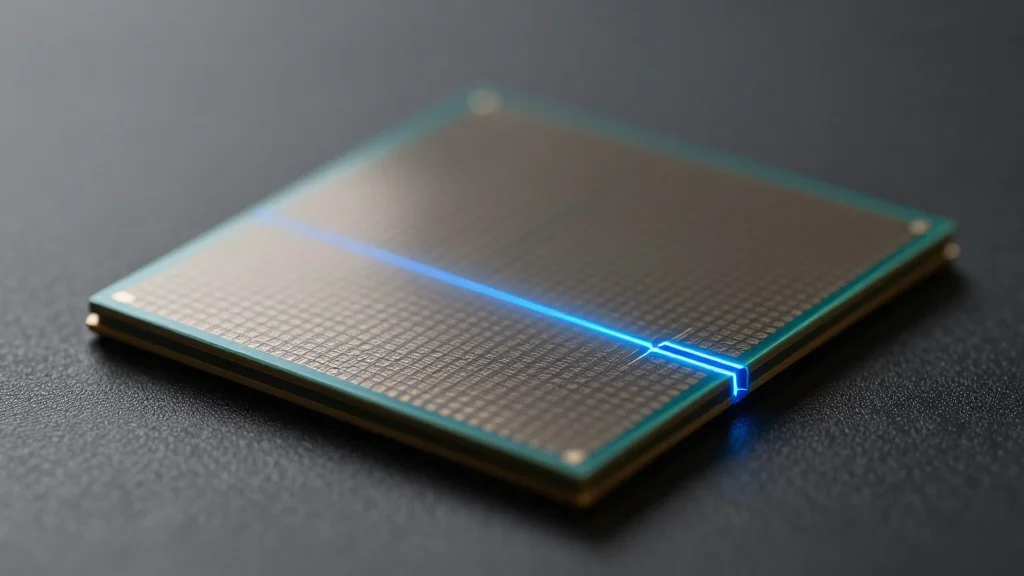
Single Quantum Electron Event Linked to Microchip Bond Failure, Upending Reliability Models

Why It Matters
The discovery that a single quantum event can trigger microchip failure reshapes how the semiconductor sector approaches reliability engineering. By pinpointing a specific electron energy that can break silicon‑hydrogen bonds, manufacturers gain a concrete target for material and process improvements, potentially extending device lifetimes and reducing costly warranty claims. The work also bridges a gap between quantum physics and practical engineering, showing that quantum‑scale phenomena are not confined to research labs but have direct, measurable impacts on billions of dollars of chip production. Beyond immediate manufacturing concerns, the study could influence the development of next‑generation technologies such as quantum‑computing hardware and ultra‑low‑power IoT devices, where energy budgets are tight and quantum effects are amplified. Understanding and mitigating these quantum‑induced failure modes will be essential for achieving the reliability required for critical applications ranging from autonomous vehicles to medical implants.
Key Takeaways
- •A single electron at ~7 eV can break a silicon‑hydrogen bond at the silicon‑oxide interface, initiating sudden chip failure.
- •Deuterium processing improves transistor lifetimes by 10‑50×, explained by the heavier isotope’s impact on quantum bond dynamics.
- •Traditional hot‑carrier degradation models, which focus on gradual thermal damage, miss this quantum‑scale failure mechanism.
- •Manufacturers may need to redesign voltage swings and passivation layers to keep carrier energies outside the dangerous 7 eV window.
- •The research calls for quantum‑aware reliability testing, potentially adding new simulation and measurement steps to standard chip qualification.
Pulse Analysis
Lee’s breakthrough arrives at a moment when the semiconductor industry is grappling with the physical limits of Moore’s Law. As feature sizes shrink below 5 nm, the proportion of atoms at interfaces grows, magnifying the influence of surface chemistry and quantum effects. Historically, reliability engineers have relied on macroscopic models—thermal cycling, electromigration, and hot‑carrier injection—to predict failure rates. The new quantum‑state model injects a microscopic, probabilistic element that could explain the long‑standing “infant mortality” spikes observed in early silicon‑on‑insulator (SOI) devices.
From a competitive standpoint, firms that can integrate quantum‑level reliability checks into their design‑for‑manufacturability (DFM) flow will gain a distinct advantage. Companies like Intel and TSMC have already invested heavily in advanced simulation tools, but those tools largely treat carrier transport classically. Incorporating quantum occupation probabilities may require partnerships with academic groups or the development of new software stacks, creating a barrier to entry for smaller players. Conversely, foundries that offer quantum‑aware reliability as a service could command premium pricing, reshaping the value chain.
Looking ahead, the implications stretch beyond classical silicon. Emerging technologies—such as silicon‑photonic interconnects, neuromorphic chips, and even solid‑state quantum processors—operate in regimes where single‑electron events are the norm rather than the exception. If the same bond‑breaking mechanism applies to these platforms, the industry may need to rethink material choices, perhaps moving toward carbon‑based dielectrics or novel 2‑D materials that lack vulnerable hydrogen bonds. In any case, Lee’s work forces a paradigm shift: reliability is no longer a purely statistical, bulk‑property issue but a quantum‑mechanical problem that must be engineered out at the atomic level.
Single Quantum Electron Event Linked to Microchip Bond Failure, Upending Reliability Models
Comments
Want to join the conversation?
Loading comments...