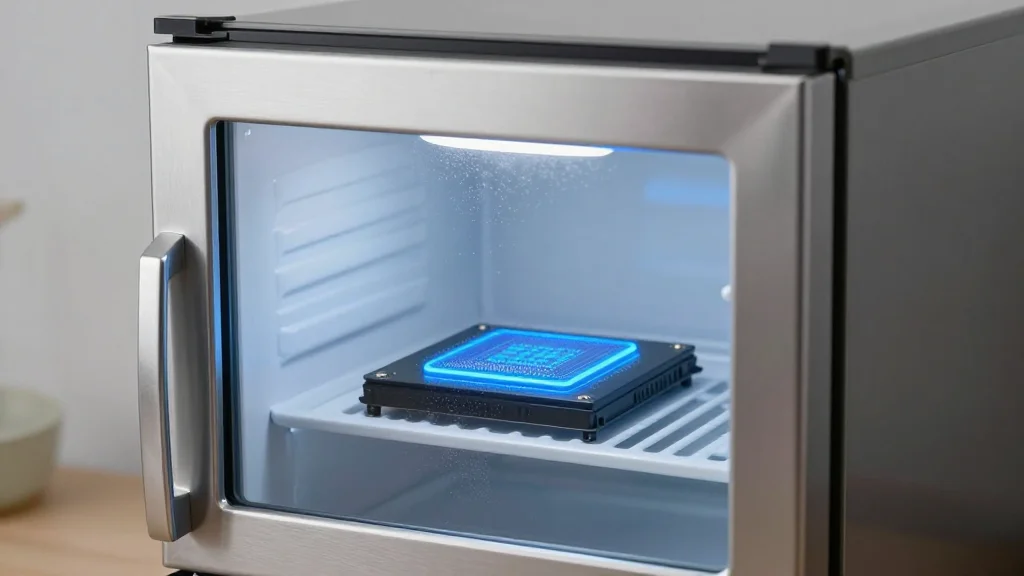
South Korea's ETRI Boosts Quantum Processor Temps, Slashing Cooling Costs

Why It Matters
Lowering the temperature requirement for superconducting qubits directly attacks one of the most prohibitive barriers to commercial quantum computing—expensive, bulky cryogenic infrastructure. By enabling the use of standard refrigeration units, ETRI’s material could accelerate the deployment of quantum processors in data centers, research labs, and potentially even edge environments. The cost savings also make it easier for startups and smaller enterprises to enter the quantum market, diversifying the ecosystem and fostering competition. Beyond economics, the ability to grow topological‑insulator films on 10‑cm wafers aligns the quantum hardware supply chain with existing semiconductor manufacturing processes. This convergence could streamline production, improve yield, and reduce time‑to‑market for quantum chips, positioning South Korea as a key player in the emerging quantum supply chain.
Key Takeaways
- •ETRI developed a topological‑insulator material that raises superconducting qubit operating temperature to -272 °C to -269 °C.
- •Cooling equipment cost could drop to one‑tenth of current levels, roughly $200,000 versus $2 million for existing cryostats.
- •The material is grown on 10‑cm wafers, enabling factory‑scale production.
- •A thin selenium interlayer prevents copper diffusion, preserving superconducting performance.
- •ETRI aims to build a functional qubit prototype by late 2026, targeting commercial‑grade quantum processors.
Pulse Analysis
The ETRI breakthrough highlights a strategic pivot in quantum hardware: moving from exotic, ultra‑cold environments toward more conventional, industrial cooling solutions. Historically, the cost and complexity of dilution refrigerators have confined superconducting qubits to well‑funded national labs and a handful of cloud providers. By slashing cooling expenses and shrinking hardware footprints, ETRI not only lowers the entry barrier but also reshapes the value chain, potentially shifting procurement power toward material suppliers and wafer fabs.
From a competitive standpoint, this development could force other quantum vendors to accelerate their own materials research or explore hybrid architectures that blend superconducting qubits with higher‑temperature platforms. Companies that have invested heavily in cryogenic infrastructure may need to reassess capital allocations, while Korean semiconductor giants could leverage existing lithography lines to become early manufacturers of topological‑insulator wafers. The ripple effect may also influence government funding priorities, with agencies likely to favor projects that demonstrate clear pathways to cost‑effective scaling.
Looking ahead, the true test will be whether the higher‑temperature qubits can maintain coherence times comparable to those achieved at millikelvin temperatures. If ETRI succeeds, the quantum industry could see a wave of modular, data‑center‑compatible processors that accelerate the transition from experimental prototypes to production‑grade machines, unlocking new applications in cryptography, materials science, and optimization.
South Korea's ETRI Boosts Quantum Processor Temps, Slashing Cooling Costs
Comments
Want to join the conversation?
Loading comments...