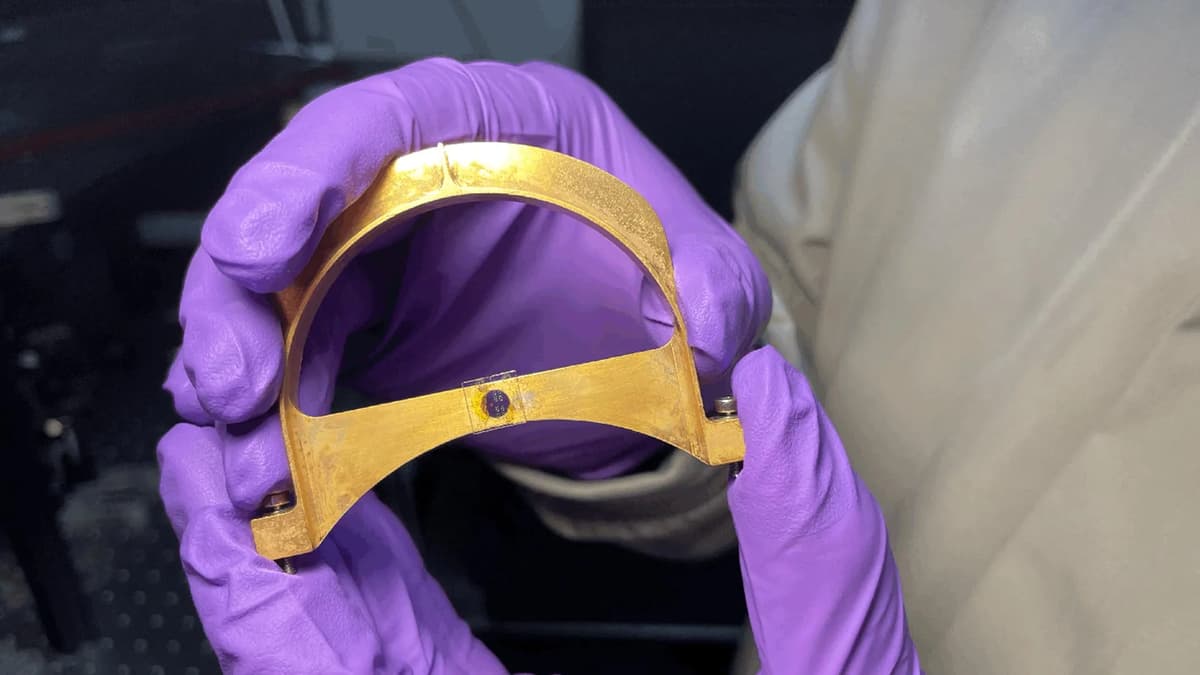
Stanford Quantum Computing Breakthrough Uses Twisted Light to Work without Extreme Cooling
Why It Matters
By operating without extreme cooling, the device dramatically reduces hardware complexity and cost, accelerating the commercialization of quantum communication and computing technologies.
Key Takeaways
- •Room‑temperature device links photon spin to electron spin.
- •Uses MoSe₂ layer on nanopatterned silicon to generate twisted light.
- •Enables entanglement without cryogenic cooling, lowering quantum hardware costs.
- •Could accelerate secure communication and on‑chip quantum processors.
- •Team aims to embed devices into larger quantum networks.
Pulse Analysis
Quantum computing has long been hampered by the need for dilution refrigerators that keep qubits near absolute zero, inflating both capital expense and operational complexity. The Stanford breakthrough sidesteps this bottleneck by demonstrating a nanoscale optical platform that operates at ambient conditions. By coupling the spin of photons—light particles—to the spin of electrons within a transition‑metal dichalcogenide, the researchers create a stable qubit interface without the cryogenic overhead that dominates today’s superconducting and trapped‑ion systems. Consequently, research labs can run experiments on standard optical tables, speeding up iteration cycles.
The device relies on a monolayer of molybdenum diselenide (MoSe₂) deposited on a silicon substrate patterned with sub‑wavelength nanostructures. These silicon features sculpt the electromagnetic field into a ‘twisted’ or cork‑screw wavefront, imparting orbital angular momentum to the photons. When the twisted photons interact with the MoSe₂ layer, they transfer their spin to the material’s electron states, producing entangled photon‑electron pairs. This strong spin‑photon coupling not only stabilizes the quantum state at room temperature but also offers a scalable fabrication route compatible with existing semiconductor foundries. The approach also sidesteps material degradation that plagues low‑temperature superconductors.
From a market perspective, a room‑temperature quantum interface could dramatically lower the entry barrier for quantum‑enhanced services such as encrypted communications, high‑precision sensing, and AI‑accelerated modeling. By eliminating the refrigeration stack, system designers can envision modular chips that plug into conventional data‑center architectures, accelerating the transition from laboratory prototypes to commercial products. Stanford’s roadmap includes testing alternative TMDC compounds and integrating on‑chip light sources, a step that would bring fully photonic quantum networks closer to reality within the next decade. Early prototypes could already demonstrate quantum key distribution over metropolitan fiber links.
Stanford quantum computing breakthrough uses twisted light to work without extreme cooling
Comments
Want to join the conversation?
Loading comments...